
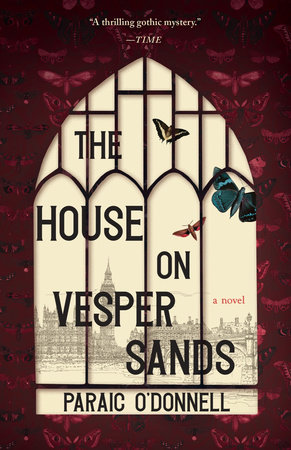
The House on Vesper Sands
London, 1893: after a seamstress dies at a house on a snowy night with a cryptic message stitched into her skin, Inspector Cutter investigates links between her death and the disappearance of several girls.
About
Spoiler notice: Spoilers for the premise and opening setup, including the seamstress’s death, the missing girls, and the investigators’ connection to the case. Later revelations and the ending are not summarized.
The story opens in London in the winter of 1893, with a seamstress standing at a window in a house on a dark, snowy night. Her death raises questions that quickly connect with a wider pattern: girls have been disappearing under circumstances that appear similar, and a cryptic message has been stitched into the seamstress’s skin. Paraic O’Donnell sets the mystery among the city’s sharply divided worlds, where a woman’s work and safety can depend on people with far more money and influence than she has. The opening links one disturbing death to a city already full of unanswered reports, then asks who benefits from the fear surrounding them.
Inspector Cutter of Scotland Yard takes up the case. He is assigned to unusual matters and approaches them with professional commitment and a dry, abrasive manner. His investigation gives the novel a police thread, but the case soon extends beyond the ordinary work of identifying a suspect. Rumours point toward a group called the Spiriters, and stories about missing young women suggest that the danger may involve more than criminal violence. The book holds both possibilities in view: the evidence belongs to an investigation, while the atmosphere draws on Victorian interest in séances, ghosts and other occult claims. Cutter has to decide what can be established as the inquiries move between official institutions and less predictable corners of London.
Gideon Bliss enters the case from a very different position. A Cambridge dropout and divinity student, he is in love with one of the missing girls and has personal reasons to seek her. He becomes an unlikely companion to Cutter, whose bluntness sits uneasily beside Gideon’s more careful, bookish manner. Their association gives the mystery a second point of view: Cutter is accustomed to special investigations, while Gideon is drawn forward by affection and concern. The contrast shapes their exchanges and the way they read events. Neither can solve the disappearance by treating it as an abstract puzzle, because the people involved matter to them in different ways.
Octavia Hillingdon is pursuing the story through journalism. Her employer would rather keep her writing a women’s society column, but she wants to report something with wider consequence. That restriction places her in a familiar late-Victorian conflict over who is allowed to gather information and decide which events deserve public attention. Octavia’s position gives her access to social circles that Cutter and Gideon do not share, while her work also makes her dependent on an institution that limits her ambitions. The three investigators therefore approach the same mystery from different directions: police procedure, personal attachment and reporting. Their paths intersect as they look for connections among the missing girls, the seamstress, and the people who may know more than they admit.
London itself is part of the case. The novel moves among respectable households and poorer neighbourhoods, and its supernatural rumours travel through a city where wealth determines whose disappearance is noticed and whose testimony carries weight. The period setting supplies more than clothes and street names. It frames the work available to women, the social expectations placed on Octavia, and the vulnerability of girls whose lives attract little protection. At the same time, the story’s Gothic elements give ordinary explanations an uneasy edge. A death, a disappearance or a cryptic message can be examined as evidence, yet rumours about stolen souls make the investigators question what kind of evidence they need.
The title points toward a place that gathers the separate threads. As Cutter follows the case, the inquiry leads him and Gideon toward the house on Vesper Sands, associated with the mystery and the secrets concealed around it. The house becomes a destination for their investigation rather than a simple backdrop. Its connection to the case gives the title an ominous pull from early on, but the central question remains what links it to the seamstress and the missing girls. Octavia’s reporting follows related leads from another direction, widening the story beyond the inspector’s formal casework. The plot keeps its attention on how these individual searches begin to overlap, without revealing what the house ultimately contains.
The book combines a historical mystery with police investigation, journalism and supernatural unease. Its central group is unusual: Cutter brings the authority of Scotland Yard, Gideon arrives as an emotionally involved outsider, and Octavia is a working journalist pushing against the limits placed on her assignment. Their differences create friction as well as useful perspectives, while the case connects private grief and missing persons with public rumours about occult activity. The opening setup is built around a seamstress’s death and a rash of disappearances; the broader investigation carries those questions into the hidden world suggested by Vesper Sands. The opening juxtaposes public rumours with three different searches for answers, creating an investigation shaped by social position, institutional limits and personal stakes.
Book details
- Author
- Paraic O'Donnell
- First published
- 2018
- Series
- Inspector Cutter Mystery, book 1
- Subgenre
- Historical mystery, Victorian fiction, Gothic horror
- Primary genre
- Mystery & Thriller, Historical Fiction
- Tags
- No tags for this book.
- Reading order
- This is the only Inspector Cutter Mystery title on the shelf right now.
Review
Editor profile
Baby Bat
Goodreads and social links will be added soon.
- Goodreads — link coming soon
- Social media — link coming soon