
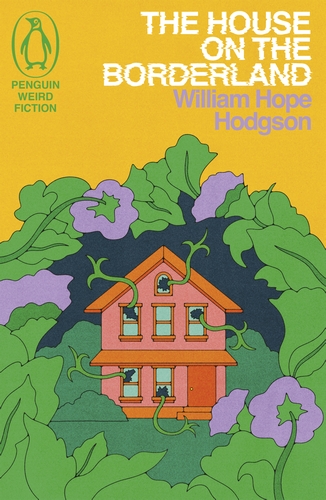
The House on the Borderland
In 1877, two visitors fishing in the west of Ireland find a ruined house beside a deep pit and recover a damaged manuscript.
About
Spoiler notice: Spoilers for the manuscript frame, the Recluse’s visions, the siege by the Swine-things, the fate of Pepper, the ending of the manuscript, and the frame narrator’s final report.
The House on the Borderland begins at a remove from its central story. In 1877, two English visitors, Tonnison and Berreggnog, are fishing in the west of Ireland when they find a deep pit and the ruins of an old house. A damaged manuscript lies among the rubble. One of the men reads it aloud at their tent, and its pages become the account that occupies most of Hodgson’s novel. The opening frame makes the tale feel like a document recovered from a place where something has gone badly wrong. The manuscript is not a neutral report: its writer is alone, trying to set down experiences that he expects other people will dismiss as madness.
The unnamed writer is identified as the Recluse. He lives in an ancient, circular house with his elderly sister Mary and his dog Pepper, cut off from the people in the surrounding countryside. Its curved towers and neglected gardens distinguish it from an ordinary rural home, while the local story that the Devil built it gives the building a history the Recluse initially treats as hearsay. He has kept a diary because the house has unsettled him over many years and because he has no one with whom to discuss what he sees. That private form shapes the narrative: the reader encounters events through the Recluse’s recollections, pauses, doubts and attempts to explain the inexplicable to himself.
One night, while reading in his study, the Recluse is drawn into a vision that carries him away from the familiar room. He finds himself on a vast, silent plain beneath a red ring of fire, then approaches a mountainous barrier and an immense arena. At its centre stands a green, strange double of his own house; around it are colossal figures with animal forms. A huge swine-headed being moves toward the house, and the vision ends with the Recluse being swept back through space to his body. The episode changes the scale of the book. The isolated house is now connected to a landscape beyond the earth, but the Recluse still tries to record the experience in the careful, practical language of someone describing a room he knows.
The threat soon returns in a form that can enter the garden. The Recluse sees a pig-like creature and later discovers a pit near the house; his accounts of these early sightings are coloured by the limits of what he can see and by the fact that Mary does not share his certainty. When pale, strong Swine-things emerge in numbers, they surround and attack the house. The Recluse secures doors and windows, arms himself, and watches from the upper part of the building as the creatures test its defenses. Pepper’s presence gives him a companion and a means of judging danger, but neither the dog nor the house can make the outside world understandable. The attack also gives the diary a more immediate rhythm, built from sounds, watchfulness and movement through the rooms.
After the siege, the Recluse searches the gardens and returns to the pit, trying to connect the attacks with the land around his home. A trap beneath the great cellar provides a further link: water roars below it, and a lowered lantern reveals foam far down in the darkness. The house and the pit are not simply adjacent settings; the roaring water beneath the cellar suggests a connection with the abyss outside. The Recluse’s practical investigations do not settle what the Swine-things are or where they come from. Instead, each discovery leaves another question behind, and the physical route from study to cellar to pit gives the uncanny events a firm geography.
The narrative then opens into episodes that are less like an attack story than a sequence of visions. In the Sea of Sleep, the Recluse meets a woman he loved and lost, and their brief reunion carries a tenderness missing from his daily solitude. Later, while he remains in his study, time races forward: days and seasons blur, the sun becomes a fleeting light, and the world grows dark and ruined around him. Pepper ages and dies during this immense passage, while the Recluse watches the transformation of the earth and the solar system. These scenes make his room a fixed point from which cosmic change is observed. The diary’s matter-of-fact entries hold together intimate grief and events on a scale that overwhelms ordinary human time.
The final chapters return the Recluse to the house and the danger of the Swine-things. A creature from the arena leaves a luminous mark on a dog, and the Recluse fears that the same influence has reached him. The manuscript ends abruptly while he is still in the house, as he hears the cellar trap open and footsteps approach. Its unfinished state leaves the immediate outcome inside the diary unresolved. The outer frame supplies a separate closing account: before leaving the village, the two visitors learn through their driver that the house vanished and a chasm took its place. This return to hearsay does not explain every vision or settle the Recluse’s fate in plain terms. It closes the book by bringing its extraordinary manuscript back to the ordinary landscape where it was found.
Book details
- Author
- William Hope Hodgson
- First published
- 1908
- Series
- No series listed
- Subgenre
- Weird fiction, Cosmic horror, Gothic horror
- Tags
- No tags for this book.
Review
Editor profile
Baby Bat
Goodreads and social links will be added soon.
- Goodreads — link coming soon
- Social media — link coming soon