
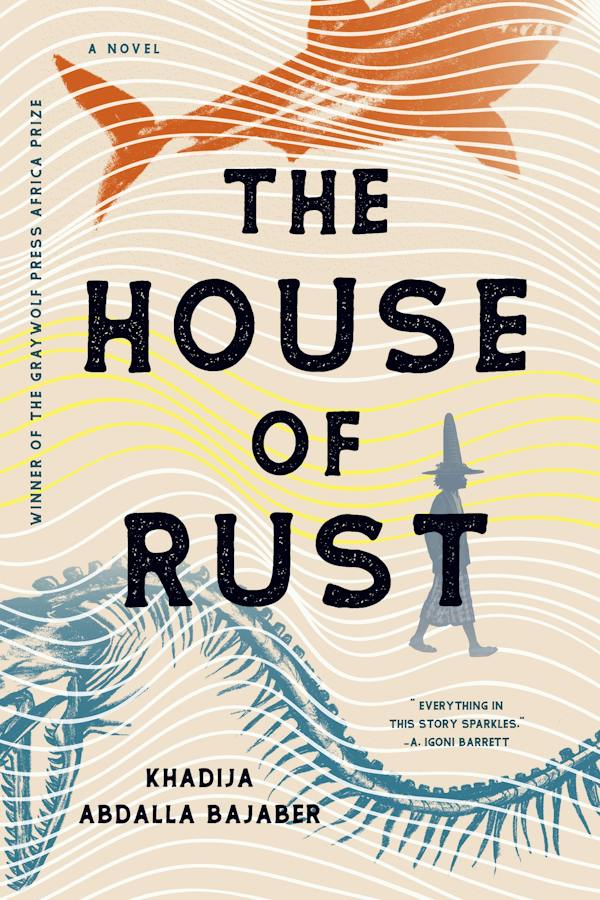
The House of Rust
When fisherman Ali disappears off the coast of Mombasa, his daughter Aisha refuses to accept that he is lost.
About
Spoiler notice: Full-story spoilers below, including Aisha's recovery of Ali, the later danger in Mombasa, and the novel's closing movement toward the House of Rust.
Aisha lives in Mombasa with her grandmother, Hababa Swafiya, and waits for her fisherman father, Ali, to return from the sea. He has been missing long enough for the family to begin considering him dead. Swafiya sets a period of five days before she will accept that conclusion and hold the funeral rites. Aisha refuses to treat the wait as an answer. The ordinary duties of home and neighborhood continue around her: she helps her grandmother, keeps up her prayers, and is expected to behave in ways that will protect her prospects. The novel makes these domestic expectations part of the same world as its supernatural dangers. Aisha's search begins not because she has no ties to home, but because her love for her father and her sense of what she owes him cannot be separated from the life being planned for her.
A talking cat named Hamza offers the means to reach Ali. He is a scholar's cat with his own ideas about how much help to give, and his summons brings forth a boat built from the bones of a great fish. Aisha leaves shore in this strange vessel and enters a sea where animals speak, bargains matter, and stories can be as dangerous as teeth. Her progress depends on encounters with formidable beings rather than a single straightforward chase. The creatures have their own histories, manners, vanities and claims. The sea is neither a blank space between destinations nor a backdrop for a conventional rescue; it behaves like a populated country, with rules Aisha must learn while she is already in peril.
The first part of the voyage is shaped by the costs attached to asking for help. Aisha must offer something dear when she calls creatures from the depths, and each meeting tests whether she can understand what the other party wants before agreeing. Among her opponents are a serpent associated with Mombasa's hidden rule, a keeper of sunken ships whose power reaches into voices, and Baba wa Papa, the immense father of sharks. Hamza's knowledge and cleverness are useful, but do not make Aisha a passenger. She has to listen closely, read a situation, and choose a response under pressure. A threat may announce itself through a long account, a boast, or a demand for proper courtesy as readily as through physical force.
The book gives this fantastic sea a distinctly coastal life. Mombasa and its surrounding waters are crowded with human and animal presences, with local routines and cultural references carried into the novel's invented encounters. Aisha's Hadrami family and the Swahili setting are not ornamental details added to a generic fairy tale: they shape what characters regard as respectful, shameful, generous or owed. Two crows, Whitebreast and Gololi, watch and comment on events from their own social vantage. Goats, cats, fishermen and neighbors belong to a shared environment in which creatures may have loyalties and grievances of their own. The shift between recognizable household life and the marvelous is steady enough that neither realm cancels the other.
Aisha's family story also reaches back to her mother, Shida, whose death and circumstances of birth affect how adults judge Aisha's future. Swafiya wants to keep her safe and hopes she will make a good marriage; those hopes are bound up with love, social standing and a wish to prevent Aisha from inheriting old hurts. A proposed match with Hassan, an egg seller's son, represents a path toward a settled life, but Aisha senses the expectations inside its kindness. The novel treats her grandmother as more than an obstacle: Swafiya has her own burdens and makes plans because she cares for the child in her home. Ali, too, is not simply the missing person at the center of a quest. His attachment to the sea has consequences for the people who depend on him.
When Aisha finally brings Ali back, rescue does not restore the household to its earlier shape. He is unresponsive, and a healer named Zubeir cuts open his heart and removes his longing for the sea. Ali can now live on land, but the change solves one danger by altering the person Aisha set out to save. Swafiya's plans for Aisha move forward, while Aisha's experience has made her want more than a return to routine. Hamza is gone, and the first journey has left questions that cannot be answered by simply staying where she is. Aisha sets out again, this time seeking the House of Rust and the possibility of a life whose limits she can choose for herself.
The later search brings her into a new contest with Almassi, the imprisoned snake-demon ruler associated with Mombasa, and with the dangers that gather around the House of Rust. Aisha is no longer the same girl who first left shore, though the book does not turn growth into effortless mastery. Her earlier encounters return with altered stakes, making the choices she now faces a measure of what she has learned and what still frightens her. The House itself remains difficult to pin down as a simple destination: it can be approached as a place in the novel's uncanny geography, while also carrying the weight of escape, desire and a future not arranged by other people. The story closes its movement through rescue and return by keeping that uncertainty alive, leaving Aisha's independence connected to the risks and relationships she has crossed rather than to a neat escape from them.
Book details
- Author
- Khadija Abdalla Bajaber
- First published
- 2021
- Series
- No series listed
- Subgenre
- Magical realism, Coming-of-age
- Primary genre
- Fantasy, Literary Fiction, Adventure
- Tags
- No tags for this book.
Review
Editor profile
Baby Bat
Goodreads and social links will be added soon.
- Goodreads — link coming soon
- Social media — link coming soon