
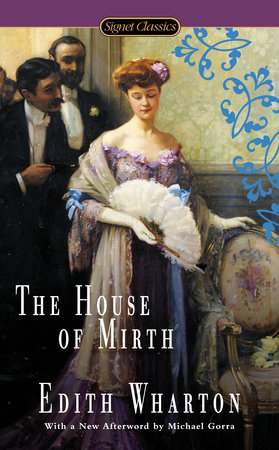
The House of Mirth
In turn-of-the-century New York, Lily Bart is admired for her beauty and manner but lacks the money to remain secure in the society she inhabits.
About
Spoiler notice: Spoilers cover Lily’s changing social position and the consequences of financial and personal choices; the novel’s final events are withheld.
The House of Mirth opens with Lily Bart encountering Lawrence Selden at Grand Central Station, a chance meeting that places her between two worlds. She is moving through fashionable New York with the ease of someone born to its manners, yet she has no independent fortune to support the life she is expected to maintain. Selden, a lawyer with access to the same circles but a less dependent relationship to them, can look at their customs with detachment. Lily cannot afford that distance. Wharton makes the difference visible in the ordinary details of clothing, invitations, travel and household spending: the setting is luxurious, but Lily’s place in it rests on unstable ground.
Lily is twenty-nine, beautiful and socially skilled, and she has been taught to treat marriage as the surest answer to insecurity. Her childhood gives that lesson a history. Her family’s money ran short while her mother continued to defend expensive habits and appearances; Lily grew up learning that beauty might restore the position that money had lost. Now her aunt, Mrs. Peniston, provides a home, while friends such as Judy Trenor offer access to country-house visits and a busy social calendar. None of these arrangements gives Lily full control over her future. She can be welcomed as a companion and admired as an ornament while still understanding that affection, money and shelter may be withdrawn.
The contrast between Lily and Selden is not a simple choice between romance and calculation. Their conversations allow Lily to imagine a life less governed by display, and Selden recognizes a thoughtful person beneath the role society assigns her. Yet he remains a man whose earnings and independence let him move through the same world with fewer risks. Lily’s attraction to him has to contend with the practical question of what a marriage can provide. Wharton keeps both responses in view: Lily’s longing for freedom is real, and so is her fear of losing the comforts that have defined her. Their relationship becomes a measure of the gap between an ideal of personal choice and the conditions under which Lily must choose.
That pressure follows Lily into the Trenors’ circle. Gus Trenor offers to make money for her through investments, and the money helps her meet expenses. The arrangement appears at first to be a solution she can accept without surrendering her independence. But it carries obligations and assumptions that Lily has not fully faced. Wharton uses the episode to show how financial dependence can alter the meaning of a social gesture: help can be described as generosity while also creating a claim on the recipient. Lily’s concern with appearances makes it harder for her to ask plainly what she owes, what she has agreed to, and what others may believe about the transaction.
Reputation is another form of currency, and Lily’s is shaped by people who can afford to set the terms of a story. Bertha Dorset’s influence and the gossip of their acquaintances narrow Lily’s access to the very gatherings that once sustained her. Her relationships with wealthy friends, potential husbands and the women who might offer more modest support all shift as rumors circulate. Wharton’s society does not need a formal verdict to discipline someone: invitations fall away, relatives interpret hearsay, and a woman already short of money has fewer ways to answer a public suspicion. Lily’s social decline is therefore neither a single accident nor solely a private failing; it unfolds through connected decisions and unequal power.
As her position changes, the novel turns its attention to kinds of work and care that Lily’s former world rarely notices. Gerty Farish, Selden’s cousin, has built a modest life around practical service, including charitable work among women with few resources. Lily once helped Nettie Crane reach a sanatorium; later, Nettie, now married and known as Nettie Struther, has a household of her own that offers a perspective on endurance far from the country houses. These encounters place lives side by side without pretending that their circumstances are equal. Lily has been trained to see security through wealth and social approval, while the women she meets make daily arrangements with less protection. Their presence gives the novel’s critique a human scale.
First published in 1905, The House of Mirth is a novel of manners that treats money as more than a background detail. It shapes where Lily can live, how she is read, which relationships look respectable and how quickly a rumor can become material damage. Wharton’s attention to conversation and social ritual shows a world that rarely states its rules outright, even as it rewards conformity and punishes missteps. The shifting boundary between welcome and exclusion gives ordinary visits, favors and conversations real force: each can preserve Lily’s place or make it more precarious. This Signet mass market paperback edition, published in 2015, includes an introduction by Anna Quindlen and an afterword by Michael Gorra. The book’s enduring tension lies in Lily’s simultaneous knowledge of society’s limits and her difficulty imagining a secure life beyond them.
Book details
- Author
- Edith Wharton
- First published
- 1905
- Series
- No series listed
- Subgenre
- Literary historical fiction, Modern classics, Literary fiction
- Primary genre
- Historical Fiction, Literary Fiction
- Tags
- No tags for this book.
Review
Editor profile
Baby Bat
Goodreads and social links will be added soon.
- Goodreads — link coming soon
- Social media — link coming soon