
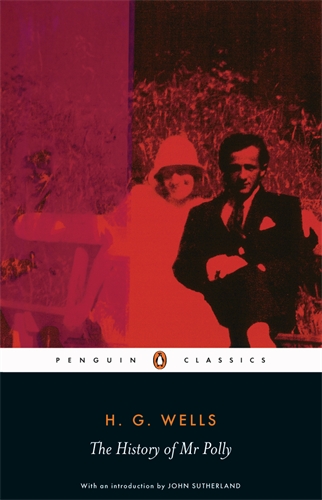
The History of Mr Polly
At thirty-five, Alfred Polly is a shopkeeper who feels trapped by his work and marriage.
About
Spoiler notice: This overview includes the shop fire, the confrontation with Uncle Jim and the novel's ending.
Alfred Polly begins in a state of furious dissatisfaction. His shop, marriage and surroundings seem to have joined forces against him, while his digestion supplies a bodily accompaniment to his complaints. H. G. Wells's 1910 novel then turns back to show how he arrived at this apparently settled, thoroughly uncomfortable life. Polly's private language is an early clue to the difference between what he does and what engages him. He invents elaborate expressions and comic names, enjoying the sound of words even when their conventional meanings escape him. Other people may find him inadequate to their expectations, but the account gives room to the lively imagination those expectations overlook. The question is how such a man has ended up with so little pleasure in the world around him.
His working life begins with a six-year apprenticeship at the Port Burdock Drapery Bazaar. Business interests him intermittently; companionship interests him much more. The shared rooms and friendships offer a social education that his childhood lacked, and even this demanding establishment feels freer than school. Yet his talent for amusing himself can work against the convincing display of enthusiasm employers require. When he later waits for an interview, he watches other applicants anxiously and knows how slight his own chances may be. A prospective employer explains the need for a willing, industrious young man while Polly's mind supplies an absurd nickname for him. He gives the appropriate assurances aloud. The division between his obedient responses and his wandering thoughts makes the comedy inseparable from the insecurity of needing somebody else to hire him.
The death of his father unexpectedly offers another possibility. Polly inherits three hundred and ninety-five pounds, a sum that suggests independence without supplying any clear understanding of how to achieve it. Bereavement is complicated too: his father had seemed a permanent presence, often distant and disappointed, until memories of ordinary shared moments make the loss more personal. At the funeral gathering, Polly meets the Larkins cousins, including Miriam. Eventually he commits himself to marriage with her and a shop at Fishbourne, announcing both decisions to relatives who believe they have been arranging his affairs for his benefit. He tries to present the choice as an assertion of initiative. Once the marriage preparations gather force, however, he feels carried along by expectations he has helped set in motion and cannot easily stop.
Owning a shop does not produce the freedom he imagined. The business deteriorates, money becomes a source of anxiety and life with Miriam turns increasingly hostile. Wells places these failures beside a wider account of small retailers consuming their savings while mistaking precarious self-employment for security. Polly cannot readily translate that general explanation into a workable answer to his own predicament. In desperation, he deliberately starts a fire as part of a plan that includes his death. The actual blaze changes everything. He wants to live, raises the alarm and remembers a woman trapped nearby. Rescuing Mrs. Rumbold gives him an urgent purpose entirely different from the one with which he began. The crowd sees a brave rescuer emerging from the danger; it does not know that he created it.
Survival breaks the sense that his existing life is the only possible one. After the insurance settlement, Polly leaves most of the money for Miriam and departs with twenty-one pounds. Walking through the countryside, he discovers pleasures that are small, immediate and unrelated to maintaining the appearance of a successful shopkeeper. The Potwell Inn eventually offers a practical setting for that change. Its landlady needs help, and the work involves boats, a ferry, painting and gardening rather than the narrow routine he has come to hate. His usefulness develops through particular jobs and relationships. The inn is also a household, with the landlady's young granddaughter sharing its daily life. Polly finds somewhere his presence matters, although neither the employment nor the welcome can guarantee protection from everything outside it.
The danger comes from Uncle Jim, the landlady's nephew, who intimidates the household, takes money and drives other men away. Polly has found a place worth staying in just as he learns how difficult staying may become. His encounters with Jim bring physical fear into the apparent refuge, and Jim's eventual return leads to a disturbing night whose full sequence the narrator deliberately withholds. Polly is found outside, Jim has taken his clothes, and a gun has been fired, but the account does not establish an explicit killing by Polly. The uncertainty matters because the inn's later peace rests partly on a disappearance the reader cannot reconstruct with complete confidence. Wells allows a change in circumstances without giving every frightening event a tidy explanation or making Polly suddenly capable of mastering them all.
Five years later, concern about Miriam sends Polly back to Fishbourne. He imagines that the wife he deserted must be struggling, then discovers a thriving tea shop run by Miriam and her sister Annie. She has received life-insurance money after a drowned body wearing Polly's clothes was mistaken for his. Miriam recognizes her husband, and their meeting exposes how much each has assumed about the other's life. Polly tells her that he is not returning. Back at Potwell, he explains that the drowned man was Uncle Jim; the earlier confrontation still receives no complete account. The final conversation leaves questions about judgment and responsibility alongside Polly's enjoyment of the evening. His happiness is tangible, but it does not cancel the fire or desertion. The novel ends with the ordinary prospect of supper after a life has become unexpectedly worth inhabiting.
Book details
- Author
- H. G. Wells
- First published
- 1910
- Series
- No series listed
- Subgenre
- Literary fiction, Modern classics
- Primary genre
- Literary Fiction
- Tags
- No tags for this book.
Review
Editor profile
Baby Bat
Goodreads and social links will be added soon.
- Goodreads — link coming soon
- Social media — link coming soon