
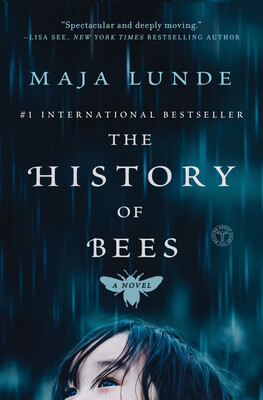
The History of Bees
Across three timelines, biologist and seed merchant William seeks a better hive in nineteenth-century England, Ohio beekeeper George struggles to pass his family business to his son, and Tao hand-pollinates fruit trees in a future China without bees.
About
Spoiler notice: This overview describes the three timelines, the family tensions, the disappearance of bees and the event that sets Tao searching for her son. It does not disclose what she discovers, how the three stories connect, or the novel’s ending.
Maja Lunde builds The History of Bees from three lives set far apart in time but connected by the work people ask bees to do and the care they owe their children. In England in 1852, William is a biologist and seed merchant who wants to design a better hive. In Ohio in 2007, beekeeper George is trying to keep a family business alive while his son Tom imagines a different future. In China in 2098, Tao earns her living hand-pollinating fruit trees in a world where bees have disappeared. Each strand begins with practical concerns: a hive that might work, a farm that must survive, a day’s labour done high among blossoms. Together they turn those concerns into a long view of dependence, inheritance and the cost of treating nature as if it will always repair what people damage.
William’s story starts with a personal and professional setback. He has withdrawn into depression after his work receives little recognition, and the prospect of a new hive gives him a reason to return to his scientific ambitions. He hopes the design will improve beekeeping and restore his standing, but his family is part of the project’s meaning too. His children, especially his son Edmund, are not simply an audience for his achievement; William wants the work to secure their future and bring them closer to him. That desire gives the historical strand its tension. A clever design can be judged by whether it houses bees, yet William also measures it by what it might prove about his value as a father and provider. His plan therefore carries both curiosity and the pressure of wanting to leave a legacy.
George’s 2007 strand shifts the focus from invention to continuity. He has inherited a working knowledge of beekeeping and wants Tom to take over, while Tom is drawn toward academic study and a life outside the family operation. Their disagreement is not just about which job is sensible. George understands the apiary through years of physical practice and sees the business as a bond between generations; Tom’s education gives him other ways to interpret the world and his obligations. At the same time, the bees themselves become less predictable. Reports of colonies disappearing and trouble spreading through apiaries make the future of the farm uncertain. The conflict between father and son unfolds inside that environmental pressure, so neither can treat the argument as a private matter alone. Their choices are tied to a livelihood that depends on living systems beyond either man’s control.
Tao’s future is the most starkly changed of the three settings. Because natural pollination has failed, she climbs fruit trees and uses a small brush to move pollen from flower to flower. The work is repetitive and exhausting, and it shapes the time she can spend with her young son, Wei-Wen. Tao and her husband want him to have opportunities beyond the labour assigned to their generation, making education a measure of hope as well as a family ambition. When a tragic accident leads the authorities to take Wei-Wen away, Tao sets out to understand what has happened. The plot becomes a search through a society organised around scarcity and official control, but her immediate purpose stays close to home: she wants to reach her child. The future strand makes ecological collapse visible in the routines of ordinary survival rather than in a distant scientific report.
The book’s structure lets readers compare these families without pretending their circumstances are identical. William’s work belongs to a period of natural history and invention; George faces agricultural and familial change in a recognisable present; Tao lives with consequences that the earlier characters cannot see. Alternating among them creates questions about what counts as progress and who gets to define a successful future. A hive can be designed, a business can be passed down, and a child can be prepared for a better life, yet each plan depends on relationships that resist simple control. The recurring parent-child tensions give emotional shape to the environmental premise. William wants recognition and closeness, George wants continuity, and Tao wants her son to have choices. Their hopes are personal, but they also reveal how people imagine the next generation inheriting the world they leave behind.
Bees function here as more than a symbol placed beside the human stories. Their absence or presence alters food production, work and the possibilities available to families. By moving between a nineteenth-century attempt to improve the hive, a modern beekeeper facing a struggling business and a future worker replacing pollinators by hand, Lunde traces how one species can sit at the centre of systems people often take for granted. The novel also leaves room for differences between intention and consequence: William’s ambition, George’s attachment to his trade and Tao’s daily labour are not versions of the same choice, even as each story touches the relationship between humans and nature. The result is a multigenerational novel about family expectation and environmental dependence, using three distinct settings to ask what people owe one another when the conditions of ordinary life begin to change.
Book details
- Author
- Maja Lunde
- First published
- 2015
- Series
- Climate Quartet, book 1
- Subgenre
- Climate fiction, Family saga, Literary fiction
- Primary genre
- Literary Fiction, Historical Fiction
- Tags
- No tags for this book.
- Reading order
- This is the only Climate Quartet title on the shelf right now.
Review
Editor profile
Baby Bat
Goodreads and social links will be added soon.
- Goodreads — link coming soon
- Social media — link coming soon