
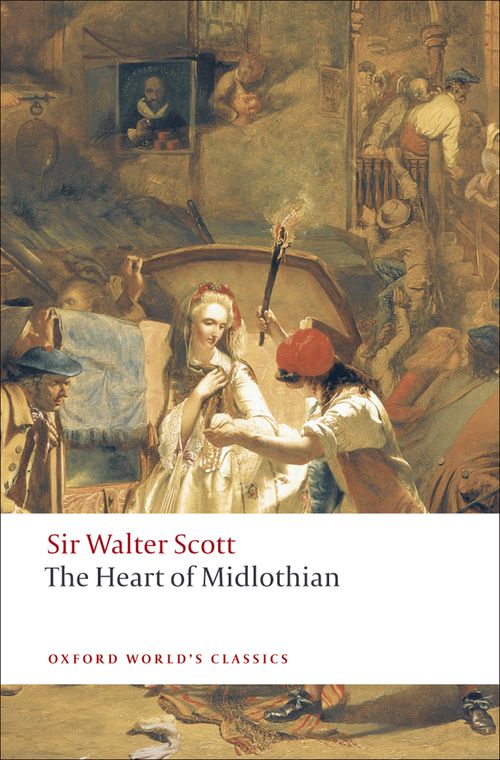
The Heart of Midlothian
With her sister Effie facing execution after the disappearance of a newborn child, Jeanie Deans refuses to offer testimony she knows would be untrue.
About
Spoiler notice: Full-plot spoilers, including Effie’s pardon, her missing child’s fate and the sisters’ later lives.
The Heart of Midlothian takes its name from Edinburgh’s Tolbooth prison, placing confinement and punishment at the centre of a story that eventually travels far beyond the city. Published in 1818, Walter Scott’s novel unfolds against the Porteous disturbances of 1736, when anger over a reprieve becomes an attack upon the authority meant to administer justice. That public struggle gives the private crisis of the Deans family a dangerous setting. Effie Deans faces a capital accusation following the disappearance of her newborn child, and her sister Jeanie must find a way to help her. Scott connects the prison, the family home and the royal court through the decisions of a woman whose resources are limited but whose determination is not easily exhausted.
The sisters come from a household governed by David Deans’s strong religious convictions. His concern for his children exists alongside exacting ideas about conduct, repentance and duty, and the difference between Jeanie and Effie becomes particularly important under that pressure. Jeanie’s steadiness does not mean that she feels less deeply. Effie’s greater restlessness does not make her suffering less real. Once the younger sister is imprisoned, the family’s moral vocabulary becomes inseparable from fear for her life. The accusation depends upon circumstances surrounding the birth and the missing infant, with the novel describing a historical statute that treats concealment as evidence carrying terrible consequences. The reader is asked to consider the distance between those circumstances, a legal conclusion and the full history of what has actually happened.
Jeanie is pressed to supply the statement that might remove the charge’s essential condition: she could say that Effie had told her about the pregnancy. The proposal is made to sound like a small adjustment in the service of an overwhelming good. Yet Effie did not make that disclosure to her, and Jeanie cannot turn a desired account into a remembered conversation. Her refusal is agonising because she understands what is at stake. The novel does not present truthfulness as a comfortable position from which to judge someone else. Jeanie has to bear the possibility that adherence to conscience will be understood as a failure of sisterly love. Her response is to seek another means of saving Effie, undertaking an effort that will demand far more than a few words under oath.
The journey to London takes Jeanie from familiar surroundings towards people whose position might open a route to royal mercy. Much of the distance is covered on foot, though the narrative also allows her assistance and transport along the way. Her purpose remains intensely particular: she wants her sister’s life spared, rather than a reputation for courage or an opportunity to rise in the world. The contrast between that purpose and the social procedures around powerful people gives the journey much of its force. Reaching London does not itself mean reaching the person who can help. Through the Duke of Argyle, Jeanie gains access to Queen Caroline, and her plain account must now survive an interview whose political sensitivities she cannot always recognise.
The audience with the Queen is neither effortless nor simply ceremonial. The memory of the Porteous affair makes another request for mercy from Scotland unwelcome, and Jeanie’s answers sometimes touch upon matters more awkward than she intends. Argyle understands those hazards and tries to guide the conversation. Jeanie eventually makes her appeal through the suffering of a living sister and a grieving father, bringing the discussion back from national resentment to a person who can still be saved. What the Queen offers is intercession, rather than a pardon issued by her own authority. Effie is subsequently spared, but rescue does not restore the family to its earlier condition. She leaves home, and the later course of her life becomes bound to George Staunton, the man Jeanie knows under another identity as Robertson.
The final part of the novel follows the consequences long after the immediate danger of execution has passed. Jeanie marries Reuben Butler and establishes a family life, while Effie becomes Lady Staunton. The missing child’s history eventually leads back into the sisters’ world through a young member of Donacha Dhu’s band, known as the Whistler. Sir George dies in an attack involving that band, and the evidence gives terrible reason to believe his own son may have fired the fatal shot. Jeanie intervenes when the boy is threatened with summary execution, but loosening his bonds does not produce the reformation she hopes for. He escapes after setting fire to flax. Later efforts to redeem him from captivity in America arrive too late, and the narrative loses sight of him after further violence and flight.
Jeanie and Butler keep that history from Effie, seeing no useful purpose in adding its horror to her grief. Effie stays with them for a time, then returns to fashionable society, where outward brilliance does not remove her unhappiness. Eventually she retires to a convent abroad without taking the veil and spends the remainder of her life in seclusion. Jeanie and Butler’s ending is quieter, following the prosperity of their children and the esteem of their neighbours. The closing moral explicitly contrasts worldly splendour with peace of conscience. Scott has reached that conclusion through a story in which mercy must repeatedly be attempted under imperfect conditions, and in which saving a life cannot guarantee how it will be lived. The sisters’ affection endures, but neither affection nor a royal pardon can undo every consequence of the past.
Book details
- Author
- Walter Scott
- First published
- 1818
- Series
- No series listed
- Subgenre
- Literary fiction, Modern classics
- Primary genre
- Literary Fiction
- Tags
- No tags for this book.
Review
Editor profile
Baby Bat
Goodreads and social links will be added soon.
- Goodreads — link coming soon
- Social media — link coming soon