
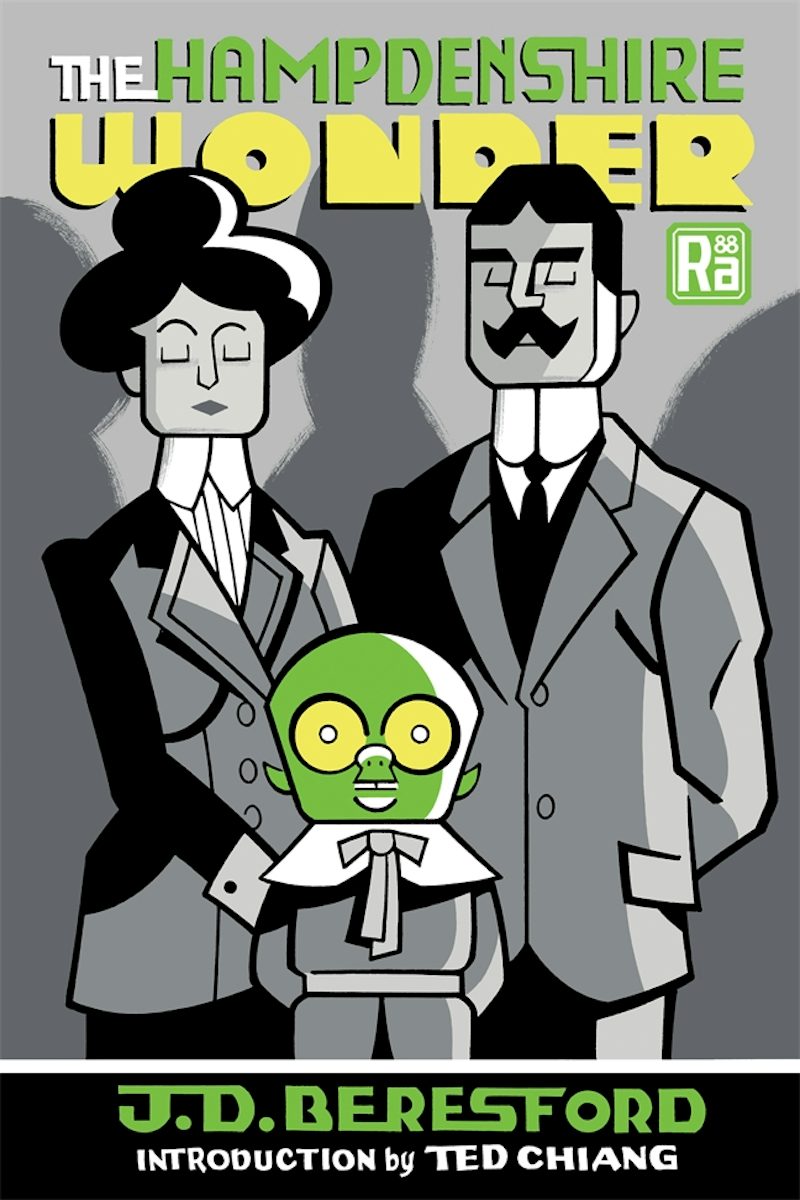
The Hampdenshire Wonder
An infant’s steady gaze unsettles the passengers in a railway carriage, drawing a curious narrator into the history of Victor Stott.
About
Spoiler notice: This overview discusses Victor’s death, the inquest, his mother’s fate and the epilogue.
The first unsettling thing about Victor Stott is that he looks back. On a train, a narrator absorbed in Henri Bergson’s philosophy notices a woman carrying an infant with an unusually large head. His first response is disgust, but the child’s steady attention soon disturbs the adults around him. People who expect to examine a baby find themselves feeling examined. That reversal introduces The Hampdenshire Wonder, J. D. Beresford’s 1911 novel, also published as The Wonder. Victor’s exceptional intelligence will become the subject of investigation, admiration and fear, but the account comes through people whose own limitations remain visible. The narrator’s fascination does not erase his vanity or prejudice. The book begins by making the observing adult uncomfortable, before it tries to explain the child who has caused that discomfort.
The story then turns back to Victor’s father, Ginger Stott, whose reputation as a cricketer offers a familiar form of exceptional ability. Sporting fame can be measured, reported and discussed in ways that his son’s mind cannot. Ginger approaches parenthood with ambitions for another cricketer, while Ellen Mary enters the marriage with a deliberate purpose of her own. The narrator’s account of her courtship credits her with an independence of judgment that the surrounding conventions might otherwise hide. Their child defeats the expectations brought to his birth. His appearance and behaviour provoke alarm in his father and a reverence in his mother that grows increasingly absolute. The household becomes a place where people confronted by the same child assign profoundly different meanings to his existence, without finding a reliable way to reach him.
Henry Challis offers another response: intellectual curiosity combined with the resources to indulge it. His interest brings Victor into a house where a substantial library promises access to accumulated knowledge. Even before the visit, Challis feels an unease that sits awkwardly beside his eagerness to understand. His secretary considers measurements and psychological observation; the household servants have their own apprehensive explanations. Victor disregards the expected courtesies and asks for books. The encounter puts a child’s demand beside the elaborate social machinery of a comfortable adult home. Reading then changes the conditions of his development, giving him access to theories and records beyond what he could observe for himself. It also gives the people watching him more evidence of his abilities without necessarily giving them greater understanding of his thought.
Beresford interrupts that progression to question the account being written. The narrator once imagined that solitude and reflection had equipped him to compose a true intellectual history of Victor. Challis persuades him that he cannot possess the necessary understanding and should instead write the story as it touched his own life. The admission matters because readers have already encountered scenes assembled from reports and other people’s observations. Notes can supply material, but arranging them requires choices and imagined connections. The narrator recognises those additions without discovering a way to dispense with them. His difficulty mirrors the difficulty faced by the adults around Victor: they can name intelligence, gather evidence and offer explanations, yet the mind they want to describe may remain outside the capacities of their language.
Later conversations make that distance personal. Returning to the district with writing of his own to do, the narrator becomes involved in Victor’s walks and daily routine. He resents the possibility of becoming an attendant to a child he still partly considers insufferable. Gradually he wonders whether what sounds like arrogance is an unsuccessful attempt to communicate at the listener’s level. When he asks Victor to explain his own life, the boy says there are no data and refuses to proceed through trial and error. This is not a convenient lecture in which an extraordinary intelligence translates the universe for everyone else. The narrator comes away frustrated, preoccupied and increasingly conscious that his questions may be inadequate. Intellectual superiority, as the story imagines it, can deepen isolation instead of overcoming it.
That isolation acquires a devastating finality when Ellen Mary reports that Victor has not returned for his meal. His punctuality makes an explanation the narrator initially offers seem implausible to her. A search spreads through the neighbourhood, and the boy’s body is recovered from a pond. The inquest returns a verdict of accidental death. The narrator, however, believes Victor was pushed in and held beneath the water, interpreting the position of the body in the mud as evidence against an ordinary fall. He keeps his suspicions out of the proceedings and cannot establish a culprit. His thoughts move between a local man and the possibility of religious fanaticism, but neither possibility becomes a solved crime. The distinction between the verdict, his conviction and what can actually be proved remains essential to the ending.
The aftermath brings no public recognition equal to the narrator’s sense of what has been lost. Victor’s grave carries only initials and a date, while the power he exerted over people seems to disappear with his death. Ellen Mary’s collapse adds a family tragedy to the intellectual one. In the epilogue Challis turns towards a disturbing question of his own: whether perfect knowledge would destroy the curiosity that makes thinking and acting pleasurable. To solve everything might leave nothing to seek. His argument does not explain Victor away or repair the loss; it gives another shape to the uncertainty surrounding him. The closing appeal to mysteries beyond the hills leaves ordinary human beings with limits, speculation and hope. The extraordinary child remains beyond the complete account the narrator once believed he could write.
Book details
- Author
- J. D. Beresford
- First published
- 1911
- Series
- No series listed
- Subgenre
- Classic science fiction
- Primary genre
- Sci-Fi
- Tags
- No tags for this book.
Review
Editor profile
Baby Bat
Goodreads and social links will be added soon.
- Goodreads — link coming soon
- Social media — link coming soon