
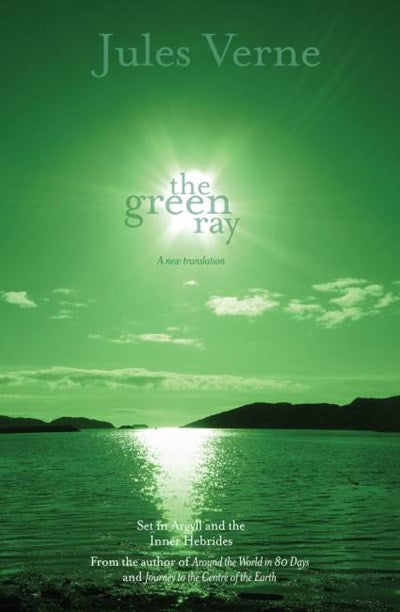
The Green Ray
Helena Campbell refuses to discuss marriage until she has seen a mysterious green ray at sunset.
About
Spoiler notice: This overview reveals the sea-cave rescue, the result of the sunset search and Helena’s marriage.
Helena Campbell has a condition to set before anyone arranges her marriage: she must first see the Green Ray. Her uncles have found what they consider an excellent husband, a wealthy and extraordinarily learned young man named Aristobulus Ursiclos. They have already imagined the wedding when their niece arrives carrying a newspaper and redirects the conversation towards a glimpse of colour at sunset. Jules Verne’s The Green Ray turns that demand into a journey along the Scottish coast, where weather, islands and passing boats keep interrupting the search. The excursion also gives Helena time to discover whether the future her affectionate guardians have planned bears any resemblance to the life she wants.
Sam and Sib Melville have devoted themselves to Helena since her parents died. The brothers are so closely matched that one can finish the other’s sentences, and they pass a single enormous snuffbox between them. Their certainty about her marriage comes from loving inexperience: two lifelong bachelors believe a suitable young man must necessarily make their niece happy. The household divides its year between Glasgow and a country home near Helensburgh, with Helena’s wishes governing holidays and excursions. Dame Bess manages domestic life, while Partridge remains devoted to the family’s Highland customs. Helena has comfortable rooms, a tower retreat and considerable freedom. Her uncles’ affection leaves room for her own wishes, even while they believe they know what is best for her.
The newspaper describes a green flash at the last instant of a sunset over the sea. Helena connects that account with a legend promising that anyone who sees the ray will understand the heart and avoid deception in matters of feeling. That belief explains why a seemingly slight curiosity matters so much when marriage is being discussed. The novel makes the practical search awkward. A westward view is insufficient if islands and headlands interrupt the line between sea and sky. Helena insists on a clear sea-horizon, and the approaching end of summer adds urgency. Her uncles agree to Oban, only to find that the surrounding islands obstruct precisely the view they have promised her.
Aristobulus is waiting at Oban, where the brothers hope acquaintance will ripen into affection. His education and fortune look admirable in a list of qualifications, but conversation with him is another matter. He analyses the air, examines stones and explains whatever comes within reach, often without noticing what the people beside him actually want. He initially dismisses the ray as a minor scientific curiosity, then agrees that Helena should be shown it. His confidence also extends to patronising pronouncements about women’s intelligence. Verne establishes the mismatch through conduct: a man able to discuss an extraordinary range of subjects has little inclination to listen to the particular young woman he expects to marry.
Oliver Sinclair offers another kind of companionship. A traveller and artist from Edinburgh, he has already been involved in a dangerous incident in the Gulf of Coryvrechan, where Helena helped bring about his rescue. When they meet again, a croquet ball she strikes damages his painting equipment. Oliver accepts the accident with good humour and makes light of his ruined canvas, allowing the awkward introduction to become a friendly exchange. He does not yet know how much he owes Helena, who forbids the others to explain her part in the rescue. When he describes pursuing colours on turbulent water, she recognises something of her own pursuit of a colour in the sky.
The repeated failures make the journey a sequence of expectations and interruptions. Oliver joins the sunset watches, sharing Helena’s excitement instead of simply tolerating it. One evening on the island of Seil seems to offer everything they need: clear weather, calm water and an unobstructed horizon. A sailing boat then moves into the exact line of sight, its sail screening the sun during the decisive moment. There is no useful angle from which the disappointed watchers can escape the obstruction. The passenger who lands afterwards is Aristobulus, returning from a geological excursion. His arrival turns a navigational coincidence into another exasperating encounter with the man the brothers have chosen.
On Staffa, the attraction of a dramatic landscape becomes genuinely dangerous. Helena is trapped in Fingal’s Cave as the tide rises and a storm drives water through its entrance. Oliver cannot reach her by the submerged footpath, so he takes a small boat into the cavern. The boat breaks against the rocks, leaving those outside to fear that he has died as well. Inside, he finds Helena sheltering in a recess called Fingal’s Armchair. He stays with her through the rising water, protecting her as her strength fails. Only after the tide recedes can he carry her out along the damaged ledge. Their growing affection has passed through a situation in which both depend on more than amusing conversation or agreeable manners.
The next sunset finally rewards the search, although its two central seekers miss the reward. Sam, Sib, Dame Bess and Partridge see the green ray; Oliver and Helena are looking into each other’s eyes. Three weeks later they marry in Glasgow, with the uncles as pleased as their niece. Oliver subsequently paints the green ray he did not actually observe, and the brothers defend his green light against viewers who think it imaginary. Aristobulus remains untroubled by the marriage, still capable of reducing tears to their chemical composition while missing what makes the family weep or smile. Helena and Oliver end by accepting that they have found the happiness promised by the legend without needing to witness its phenomenon themselves.
Book details
- Author
- Jules Verne
- First published
- 1882
- Series
- No series listed
- Subgenre
- Classic adventure, Literary fiction
- Primary genre
- Adventure, Literary Fiction
- Tags
- No tags for this book.
Review
Editor profile
Baby Bat
Goodreads and social links will be added soon.
- Goodreads — link coming soon
- Social media — link coming soon