
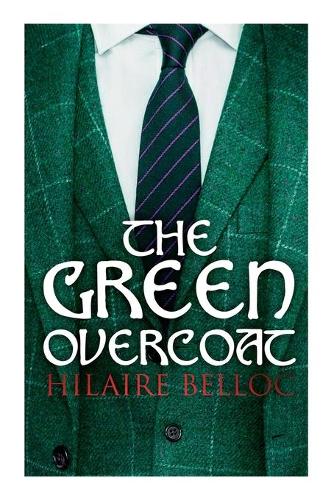
The Green Overcoat
A shy university psychologist borrows a luxurious green overcoat to escape a rainstorm and is abducted by young men who mistake him for its wealthy owner.
About
Spoiler notice: This overview reveals the kidnapping, forged-cheque dispute, Professor Higginson’s invented experiences and the final settlement.
Professor Higginson wants to leave a party without being noticed. He is a shy psychologist attached to the Guelph University in Ormeston, much happier with his subject than with the discomforts of social life. When he cannot find his familiar Inverness cape and discovers a storm outside, a magnificent green overcoat seems to offer a temporary solution. He puts it on without permission, reassuring himself that it can be returned before its owner needs it. Hilaire Belloc’s The Green Overcoat, first published in 1912, follows the consequences of that small surrender. Its luxurious cloth and fur lining promise shelter, but wearing another man’s property soon makes Higginson answerable for another man’s identity.
The trouble begins almost immediately, in a taxi that takes him away from his intended destination. Two young men seize, gag and bind him, then carry him to an empty house. Jimmy and Melba have the manner and education of gentlemen, which offers their prisoner very little protection from their readiness to use force. They call him Brassington and demand payment. Higginson initially imagines that surrendering the modest cash in his pockets might buy his freedom. His relief collapses when the amount turns out to be two thousand pounds. The kidnappers are dealing with what they consider an overdue obligation, while the professor is trying to understand a dispute in which he has never taken part.
The coat itself seems to prove that his denial is a lie. Its pocket contains John Brassington’s cheque book, complete with the owner’s name and address. Jimmy reads its counterfoils as evidence of a wealthy man’s careful business habits, then orders Higginson to sign. Faced with threats and confinement, the professor begins constructing excuses for doing what he knows he should refuse. He imagines stopping the cheque before it clears and using the paper trail to expose his tormentors. Even that attempted surrender fails at first: his first signature looks wrong, and Jimmy tears up the form. The learned specialist has entered a world of money, pressure and practical consequences for which his professional confidence provides no useful preparation.
The garment later acquires a separate route through the story. Higginson entrusts it to a man with a broken nose, paying him to return it to its owner. The errand becomes an opportunity to sell it instead. The man checks the pockets but does not understand what use he could make of the cheque book, so he leaves it inside. After injuring his leg on broken glass, he takes the coat to Mr. Montague and receives a sovereign for a garment worth far more. Montague sees both a resale value and the possibility of obtaining more from its rightful owner. The discovery of the cheque book introduces another possible source of profit, carrying the financial complications onward with the cloth.
Higginson’s own return home creates a different emergency. His disordered evening clothes attract comments in the street; his landlady, Mrs. Randle, is overwhelmed to see him, and the police arrive to ask about his disappearance. Telling them everything would also mean explaining the cheque. When Mrs. Randle reacts to his uncertainty about the day, he sees a way out: the missing period can become a gap in his memory. A defensive invention begins to grow into a public account of unusual mental experiences. The novel moves between the humiliation of the private man and the authority attached to his position. Respectful listeners make it easier for him to speak, but every additional explanation gives him something else to maintain.
His colleague George Babcock challenges the story and presses him for something more convincing than general claims about visions or voices. Higginson supplies an invented figure in wet blue clothes, smelling of seaweed and without arms. A newspaper report then appears to describe a drowned man with those characteristics, and the apparent connection makes the professor deeply uneasy. Publicity turns the tale into evidence of a future life. Students know about it, a clergyman approaches him with intense admiration, and a reporter wants an interview. The professor who wanted only to get home unnoticed has become a public figure whose supposed experiences can be interpreted, enlarged and circulated by people he cannot easily dismiss.
Charles Kirby, a solicitor and Brassington’s friend, eventually brings the disputed identities and money together. At the final meeting he confronts Higginson about the forged cheque, explains how the borrowed coat caused the abduction and sets out what public exposure would cost everyone present. Brassington’s son has been involved in gambling losses with Jimmy, and Kirby argues that pursuing revenge would damage the son as well as the professor. Brassington has lost two thousand pounds, but recovering respectability may matter more than recovering the money. Kirby’s method is to make the consequences unmistakable, guiding a collection of frightened or angry men towards an agreement they each have reasons to accept.
The settlement depends on another fiction: Brassington is publicly credited with giving Higginson ten thousand pounds for research and is rewarded with a baronetcy. The professor will receive no such money. The coat returns to its owner, while the people around it acquire reputations that conceal what happened. Higginson’s supposed fortune brings begging letters, and Babcock suggests saying that the money is committed to the university after his death. His psychic reputation also leaves him reviewing books about spirits and giving lectures, often without payment. Belloc’s narrator refuses a grand final accounting, reminding the reader that these are people in a story. The overcoat is home; the explanations needed to preserve everyone’s standing are still doing their work.
Book details
- Author
- Hilaire Belloc
- First published
- 1912
- Series
- No series listed
- Subgenre
- Literary fiction
- Primary genre
- Literary Fiction
- Tags
- No tags for this book.
Review
Editor profile
Baby Bat
Goodreads and social links will be added soon.
- Goodreads — link coming soon
- Social media — link coming soon