
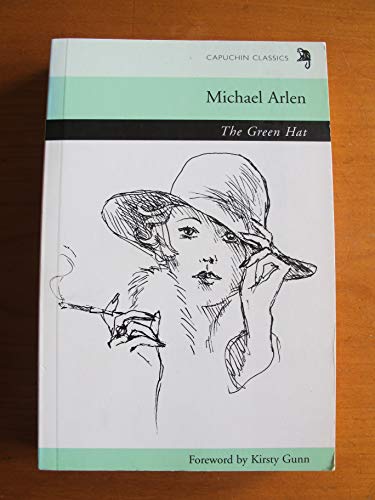
The Green Hat
An unnamed narrator meets Iris Storm at his London flat, drawn first by her green hat and conspicuous car.
About
Spoiler notice: This overview reveals the explanation of Boy Fenwick’s death, Iris’s final deception and the closing crash.
Iris Storm first appears as a striking visitor to a London flat, with a green felt hat, a leather jacket and a yellow Hispano-Suiza waiting outside. The man who will tell her story is preparing to leave his rooms in Shepherd’s Market. His books are packed, and a chapter of his own life seems to be ending when hers enters it. Michael Arlen’s The Green Hat, first published in 1924, follows the disturbance behind that glamorous arrival. Its world has expensive cars, fashionable acquaintances and polished conversation, but reputation can turn a roomful of cultivated people into a tribunal. Iris moves through that world carrying a history other people believe they already understand.
The narrator’s address places him between two versions of Mayfair. Shepherd’s Market can sound respectable on writing paper while the lane itself is narrow, noisy and shabby. That gap between a presentable surface and a less comfortable reality runs through his account. He notices Iris’s clothes and car before he knows her circumstances, imagining a personality from what he can see. She has come to visit Gerald March, who lives upstairs and is the narrator’s friend. Gerald is her twin brother, although she says they have not seen each other for nearly ten years. Their reunion introduces a family estrangement that an impressive entrance cannot explain away.
Iris’s conversation keeps defeating easy classifications. She can speak with wit about the elderly gentlemen who claim the privileges of good manners while taking liberties with women. She can also describe herself with a bitterness that startles her listener. When he tries to understand her through familiar ideas about adventurous women, she insists that he has mistaken shame and compulsion for carefree pleasure. Even the narrator’s efforts to reconstruct her marriages begin as guesses: two rings prompt speculation, then a remembered newspaper headline supplies a possible connection to Captain Storm. The account makes the process of forming an opinion visible, including how readily an observer can supply a story before hearing one.
Behind Iris’s present life is her attachment to Napier Harpenden. They loved each other when young, but his father, Sir Maurice, opposed their relationship. In Iris’s later recollection, Napier’s future and the family’s ambitions outweighed what the two wanted. The childhood landscape survives in a great ash tree they called Harrod’s, a name taken from happy visits to the London shop. Their memories give that tree an intimacy no fashionable room possesses. Napier has meanwhile become engaged to, and then married, Venice. Iris’s return therefore concerns another woman’s hopes as well as a love interrupted years before. The novel allows Venice a presence that complicates any straightforward wish to see the old lovers reunited.
The earlier marriages carry a further burden of explanation. Hilary Townshend identifies Boy Fenwick as Iris’s first husband; Hector Storm belongs to the later part of her history. Boy’s death has acquired a story about purity that others use against her. Iris, meanwhile, tells the narrator that Hector went to Ireland and died after hearing her whisper Napier’s name in her sleep. That is her anguished account of responsibility, rather than an independently established explanation of his death. Desire, guilt and loyalty have become entangled in the way she remembers both men. People discussing her can sound entirely certain while relying on phrases whose meaning they have never properly examined.
The final chapter brings those habits of judgment into a country-house library at Sutton Marle. Iris asks the narrator to accompany her as she faces Sir Maurice, with Hilary and Guy de Travest also present. The reception begins with courtesy and becomes a struggle over Napier’s marriage, career and obligations. Sir Maurice presents himself as defending a whole inherited way of life; Iris answers with the damage that his earlier interference has done. Hilary challenges the assumption that children must live by their parents’ ideas. Guy’s sympathy briefly weakens Sir Maurice’s authority, but an accusation involving Boy Fenwick turns the encounter back towards the old scandal. Affection and hostility share the same room, spoken in the language of intimate acquaintance.
Napier arrives with Venice and insists on revealing what Iris has wanted kept private. According to his disclosure, Boy had syphilis when he married her and killed himself after realising what he had done. Iris had let an ambiguous explanation of his death damage her own name, protecting his reputation and Gerald’s admiration for him. Napier believes that telling the truth will restore the respect she deserves. Her response exposes the cost of his intervention: he has taken away an act of generosity she wanted to keep. Venice, too, refuses the role of a merely possessive wife. She openly defends Iris and Napier’s love, even while her own distress becomes painfully apparent.
The apparent release from misunderstanding does not produce a happy departure. Napier returns to Venice because Iris has told him that his wife is pregnant, a claim Venice denies. The lie sends him back to the woman Iris has just seen suffering. Iris drives away alone, and the men follow until her car crashes into the old ash tree. Sir Maurice understands her choice as a way of making the event appear accidental to Napier and Venice. The narrative ends with the wreck and the green hat, without a final account of Iris’s condition. That return to the object that first caught the narrator’s eye closes a story in which seeing a woman clearly comes much later than looking at her.
Book details
- Author
- Michael Arlen
- First published
- 1924
- Series
- No series listed
- Subgenre
- Literary fiction
- Primary genre
- Literary Fiction
- Tags
- No tags for this book.
Review
Editor profile
Baby Bat
Goodreads and social links will be added soon.
- Goodreads — link coming soon
- Social media — link coming soon