
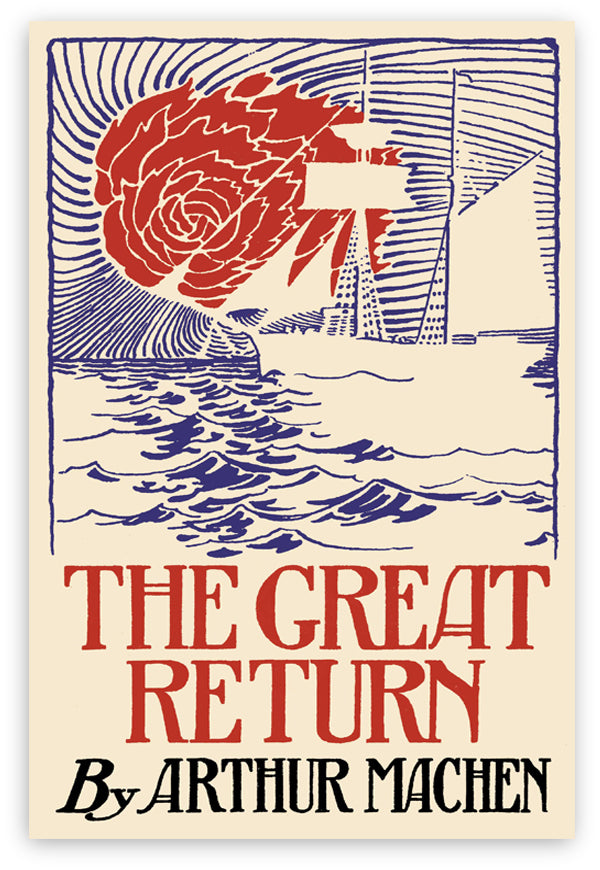
The Great Return
An unnamed narrator notices a brief newspaper report of strange events during a revival in the Welsh town of Llantrisant.
About
Spoiler notice: This overview discusses the reconciliations, Olwen Phillips’s reported recovery, the Grail imagery and the concluding church service.
A small newspaper notice draws the narrator of The Great Return towards Llantrisant, a Welsh town where an apparent religious revival has been accompanied by unexplained occurrences. The paragraph barely gives him anything to investigate. Its references to lights and remarkable events sit among ordinary local information, as though something extraordinary has been compressed until it almost disappears. Machen begins by considering how easily reports of marvels pass through newspapers without receiving serious attention. His narrator has an appetite for such things, but also insists on evidence. The story follows his effort to assemble scattered impressions into an account, while leaving open whether the pattern he finds can ever settle the questions that first attracted him.
The setting changes with his departure from London. War hangs over the city in oppressive weather, anxiety and the expectation that unfamiliar lights might be signals to an enemy. Against that atmosphere, the summer coast of Arfon appears extraordinarily peaceful. Sea colours, flowers and the sound of water offer relief before the investigation properly begins. The contrast prepares for a story in which altered feeling is as important as a spectacular sight. When the narrator visits Llantrisant's church, its lingering fragrance is difficult to reconcile with what he knows of the rector's religious habits. Details that might seem minor elsewhere become clues because they do not fit the familiar character of the place and its people.
The account gradually turns from the investigator's puzzlement to a reconstruction of events earlier that summer. One of its first witnesses is Mrs Parry, an older woman whose deafness has long been accepted by her neighbours. She arrives at the market saying she has heard a great bell coming across the sea, and responds indignantly to remarks the other women assume she cannot hear. Her experience includes birdsong and everyday sounds restored alongside the mysterious bell. The episode makes the reported wonder intimate and bodily rather than merely distant spectacle. Even here, the story's form matters: the narrator brings together what people say happened, and the meaning of their experiences remains part of what he is trying to understand.
Other reports enlarge the field of inquiry. Sailors describe a red light first mistaken for a signal or the lamp of an unusually fast craft, then expanding into an immense fiery rose before disappearing. Some connect its final appearance with the old chapel of St Teilo on the headland. Their accounts supply comparisons drawn from their own work before exceeding anything those comparisons can comfortably explain. The strange event also seems to alter the witnesses themselves, who struggle to communicate what they felt as well as what they saw. Figures called the Fishermen appear in local testimony. Their presence draws the narrator towards older sacred associations without giving him a simple way to prove how much the townspeople already knew.
Changes in conduct provide another kind of evidence. Solicitor Lewis Prothero and farmer Philip James have been locked in a bitter dispute that has cost the farmer his home. Their meeting in the market is expected to end in violence, but instead Prothero begs forgiveness, returns the property and provides compensation. The two swear friendship before the churchyard cross. The reversal matters because it changes material circumstances as well as emotions: reconciliation is accompanied by restitution. During the visitation, generosity also gathers around a grocer anxious about his daughter's wedding. Gifts and unexpected money make the celebration possible, though the narrator acknowledges that this good fortune could have an ordinary explanation. Wonder is being sought among human relationships as much as among lights and apparitions.
Olwen Phillips's experience joins these strands. Described as gravely ill and close to death, she tells her mother of three red-robed men bearing a bell, an altar-like object and a cup. The doctor returns expecting to find that she has died, but the narrative instead reports her restored health. Her vision helps the narrator connect the story's imagery with the Holy Grail. In the concluding church gathering, distinctions between local religious communities give way as townspeople crowd together and hear what seems to be worship beyond the sanctuary's veil. The bell, altar and cup become the central images of a sacred return. The account conveys the intensity of that collective experience without placing the reader outside it as an unquestioning witness.
After the service, the strangers and objects are no longer seen openly, although their impressions persist in dreams and memory. The nine days leave reports of renewed strength, gentleness and forgiveness, with old enemies meeting as friends. These effects are not treated as less significant than the more obviously marvellous appearances. Yet the closing pages return to uncertainty about inherited tradition, expectation, vision and shared hallucination. The narrator asks whether people might have perceived what they were already prepared to perceive, and whether one person's impression could spread to others. The Great Return leaves that argument alive beside its account of transformation. Its conclusion offers no final test that would allow the reader to separate every miracle from every possible explanation.
Book details
- Author
- Arthur Machen
- First published
- 1915
- Series
- No series listed
- Subgenre
- Classic fantasy, Weird fiction
- Primary genre
- Fantasy, Literary Fiction
- Tags
- No tags for this book.
Review
Editor profile
Baby Bat
Goodreads and social links will be added soon.
- Goodreads — link coming soon
- Social media — link coming soon