
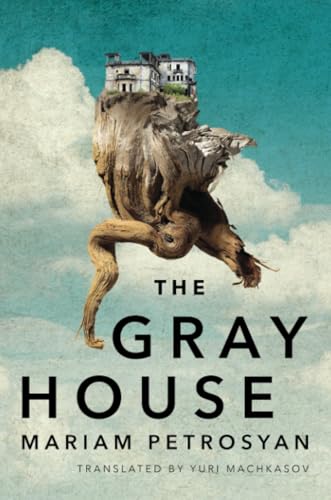
The Gray House
In an old boarding school for physically disabled children, students build tribes, customs and stories around a building they call the House.
About
Spoiler notice: Contains broad plot details from the publisher description and the novel’s opening material, but does not summarize the complete book or its ending.
The Gray House is a boarding school on the edge of an unnamed town, set apart from the newer apartment blocks around it. Its students have physical disabilities and are routinely overlooked by the people they call the Outsides. Inside, however, the school is not a neutral institution that happens to contain their lives. The students call it the House, and the building seems to press its own character on everyone who lives there. The opening presents its worn exterior, enclosed courtyard, old rooms and improvised spaces as part of a place whose identity comes from accumulated use. It is at once a school, a home and a world whose boundaries the young residents learn to navigate for themselves.
That world has its own arrangements of power. Students are known by nicknames, grouped into dormitory tribes and governed by habits and rules that are meaningful to the people who made them. The names can sound comic, but they also compress a complicated social map: who belongs where, who has influence, and how a newcomer may be treated. The students build identities in relation to these groups, while the adults who oversee the school cannot fully control the culture taking shape inside it. Everyday routines therefore carry more weight than a simple timetable suggests. A room, a corridor, a meal or a gathering can signal welcome, exclusion or a shift in standing.
Petrosyan tells the story through a changing set of teenage perspectives rather than a single guide who can explain the House from above. The effect is cumulative. Each narrator knows particular corners, loyalties and rumors, and each has a partial account of how the place works. Their stories do not always fit neatly together; the House grows through their competing versions of it. Students tell tales about the building’s past and about the Outsides, making shared folklore from limited knowledge. These accounts give them language for things they cannot settle, while also showing how memory and invention help a group make a world feel coherent.
The novel’s fantastic quality emerges inside these concrete arrangements. The House is treated by its residents as alive, and its spaces seem to resist ordinary expectations about distance and time. Days and nights do not always feel measurable by clocks, and familiar routes can take on a different character depending on who is moving through them. The narrative lets uncertainty remain active: readers encounter the building through people who already accept its oddities as part of daily life. This approach keeps the strange close to the ordinary. Classes, meals, friendships and arguments continue, even as the House suggests that the physical setting may be more than a backdrop.
The students’ bodies shape how they move through this setting, but the novel does not reduce them to a single shared experience. Their impairments, aids and access needs are part of the school’s material life; so are their humor, rivalries, attachments and inventions. The House gives the young people room to form relationships and customs among themselves, while its social divisions can create fresh constraints. Their abilities and reputations are understood locally, in a culture with its own standards. The result is a portrait of community that holds belonging and exclusion together: people may be protected by a group and limited by its rules at the same time.
Beyond the school walls, the Outsides exert pressure even when they are not fully known. The students imagine and recount that external world from a distance, but graduation means that their separation cannot remain permanent. The prospect of leaving complicates the security of the House. The students have built lives around its spaces and customs; returning to a world that has treated them as marginal may require them to negotiate unfamiliar expectations. Meanwhile, deaths among the students and pressure from outside threaten the established order inside the building. The story’s tension gathers around whether the tribes can preserve their place and how much change the House and its residents can bear.
The book is structured as a long encounter with a place rather than a puzzle explained in one authoritative account. Its many voices, embedded tales and shifting descriptions ask the reader to learn the House much as its inhabitants do: by noticing repeated details, hearing different versions and revising an early impression. That design makes the building’s mystery inseparable from social life. Questions about what the House is sit alongside questions about who gets to name a person, define a group or decide what counts as normal. The novel leaves those questions in the hands of characters whose knowledge is intimate but incomplete.
First published in Russian in 2009, The Gray House appeared in English in Yuri Machkasov’s translation in 2017. The translated title emphasizes the building that organizes the novel, while the Russian title, Дом, в котором..., is often rendered literally as “The House, In Which...”. Petrosyan’s story combines a school community, layered narrators and a fantastic setting without separating them into distinct modes. The reader follows young people making meaning from the rules and spaces available to them, even as those rules begin to feel unstable. This account describes the novel’s central setup and narrative approach; it does not attempt to resolve the House’s mysteries or recount the full ending.
Book details
- Author
- Mariam Petrosyan
- First published
- 2009
- Series
- No series listed
- Subgenre
- Magical realism, Coming-of-age, Weird fiction
- Primary genre
- Fantasy, Literary Fiction
- Tags
- No tags for this book.
Review
Editor profile
Baby Bat
Goodreads and social links will be added soon.
- Goodreads — link coming soon
- Social media — link coming soon