
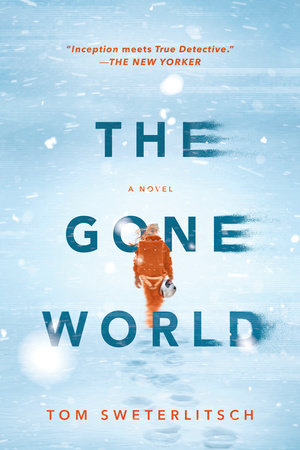
The Gone World
In 1997, NCIS Special Agent Shannon Moss investigates the murder of a Navy SEAL’s family and the disappearance of his teenage daughter.
About
Spoiler notice: Spoiler-light account: this draft stays with the publisher's premise and the author's comments about the novel's design. It does not describe the final resolution.
The Gone World begins in western Pennsylvania in 1997, where NCIS Special Agent Shannon Moss is assigned to investigate the murder of a Navy SEAL's family and the disappearance of his teenage daughter. The missing SEAL served as an astronaut aboard the U.S.S. Libra, a spacecraft believed lost in Deep Time. The case therefore sits at an unusual junction: Moss must work through a violent family crime, the movements of a missing child and a secret military programme whose consequences reach beyond an ordinary investigation. These elements turn a recognisable murder inquiry into one that requires Moss to think about places and times other investigators cannot reach.
Moss is not an outside observer learning about time travel for the first time. The book's publisher identifies her as part of a clandestine NCIS division, and Sweterlitsch has explained that he tells the story closely through her point of view. In an interview about the novel, he said that scientific details and criminal-investigation information enter the narrative when Moss herself would be thinking about them. That choice gives the speculative machinery a specific human channel: the reader encounters it in the same context as the agent who must decide what a clue means and what to do next. It also keeps the investigation at the centre of a story with unusually large questions around it.
The investigation reaches forward in time. Moss travels into possible futures to seek evidence that can help her understand the present case and find the missing girl. A future is not simply a destination where the answer waits intact; what she sees is tied to possibility, uncertainty and the cost of returning with knowledge. The official descriptions leave the mechanics at the level of this premise, while Sweterlitsch's interview discusses how he approached the problem of making time travel feel coherent inside a mystery. He traced the idea to a conversation with a relative who works as a special agent, who wondered how investigators might speak to witnesses after their relationships to a crime had changed.
That starting point links the novel's two kinds of suspense. A murder inquiry asks what happened and who will speak about it. Time travel lets Moss look for answers at a later point, but it does not remove the emotional weight of the original event or guarantee that evidence gathered in another possible future can settle the present. Sweterlitsch has described the book as beginning from a blend of science fiction and mystery, and he has said that his early conception joined NCIS, spaceflight and time travel. The procedural frame gives the larger speculation a concrete task: Moss must follow people, events and testimony rather than merely contemplate an abstract theory of time.
The scale widens as Moss discovers that her assignment may concern more than one family's fate. The publisher names the Terminus as the end of humanity, an approaching catastrophe glimpsed in the future and moving toward the present. That possibility changes the pressure around each trip: the future is both a place to investigate and a warning that may be difficult to interpret. The title itself can be read alongside this structure of futures and losses, though the book's official description does not define it as a single symbol. What it does make clear is that the case and the fate of the human world become connected through Moss's work.
Sweterlitsch's account of his research helps distinguish the novel's scientific texture from a claim that its time travel is established physics. He said that wormhole travel was part of his research and that many of the underlying discussions are speculative. He also described inventing terminology for elements of the fictional mechanism, while consulting a physicist about whether science-heavy passages felt plausible. The result, as the author explains it, is science fiction shaped by selected ideas and extrapolations, with inventions filling the gaps required by the story. Readers do not need to treat the imagined technology as a real method; within the novel, its rules matter because they shape what Moss can learn and what her choices mean.
The book also carries a horror dimension. Sweterlitsch said that the horror grew out of the science-fiction and mystery premise, and that he wanted the source of the threat to feel genuinely alien rather than like a familiar creature with understandable motives. That intention sits behind the publisher's description of the Terminus as a terrifying end approaching across time. The emphasis is on the limits of human understanding as much as on danger: an investigator can gather information and test explanations without becoming certain that the phenomenon will fit familiar categories. This makes the cosmic scale relevant to the case rather than an unrelated backdrop.
The Gone World combines a crime investigation, speculative time travel and horror without losing sight of Moss's immediate task. Each journey into a possible future promises information, but it also makes the investigation harder to contain within one timeline and one family's tragedy. The threat named the Terminus presses against that narrower case, giving Moss a reason to ask whether solving a murder can also change what lies ahead. Sweterlitsch's close focus on her thinking keeps the enormous premise attached to a working investigator who must judge testimony, interpret clues and decide when a possibility is worth acting on. The novel's scale is cosmic; its point of entry is one agent trying to find a missing girl.
Book details
- Author
- Tom Sweterlitsch
- First published
- 2018
- Series
- No series listed
- Subgenre
- Time travel, Crime thriller, Cosmic horror
- Primary genre
- Sci-Fi, Mystery & Thriller, Horror
- Tags
- No tags for this book.
Review
Editor profile
Baby Bat
Goodreads and social links will be added soon.
- Goodreads — link coming soon
- Social media — link coming soon