
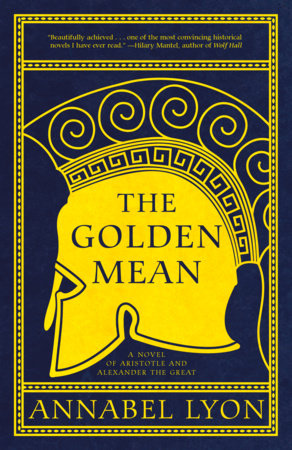
The Golden Mean
In 342 BC, Aristotle is reluctant to tutor Alexander, the rebellious son of his boyhood friend Philip of Macedon.
About
Spoiler notice: Spoilers cover Aristotle’s appointment to teach Alexander, the court setting and the novel’s broad intellectual and personal conflicts. Later turns and the ending are withheld.
Set in 342 BC, The Golden Mean imagines the relationship between Aristotle and the young Alexander, before the pupil becomes the conqueror known to history. Aristotle is asked to tutor Alexander, the rebellious son of Philip of Macedon, a boy whose inheritance places him at the centre of a dangerous court. The philosopher has ambitions and a life of his own, and at first resists taking on the task. Yet the political situation makes his teaching matter beyond the private exchange between teacher and student. The premise gives Lyon a way to place familiar historical figures in an intimate, unsettled present: Alexander is still growing into his power, while Aristotle must decide what obligations come with the knowledge he carries. The result is historical fiction built around a question of influence: how much can a teacher shape a student whose future may alter the world, and what responsibility follows from trying?
Aristotle narrates the novel in the first person, a choice that brings philosophical thought into contact with ordinary physical life. He is not presented only as a name attached to ideas; Lyon’s imagined voice makes room for appetite, fatigue, irritation, desire and humour alongside observation and argument. That closeness matters because the story asks readers to consider the mind as something housed in a body, moving through work, illness, household life and the practical demands of the day. The philosopher’s intelligence does not remove him from uncertainty or make him a neutral guide to events. Instead, his judgments belong to a particular person, with needs, attachments and blind spots. This perspective lets the novel explore ethical questions as lived problems rather than as abstract propositions detached from consequence.
The Macedonian court supplies the pressures around the lessons. Philip’s household is a political environment in which proximity to power can be both an opportunity and a danger. Aristotle arrives with his own purposes, but tutoring Alexander draws him into relationships and intrigues that cannot be kept separate from the work of teaching. The publisher’s description presents the court’s schemes as increasingly sinister and Alexander as charming, surprising and at times horrifying. These qualities make the pupil difficult to reduce to a simple emblem of future greatness. He is a young person whose capacity, temperament and position develop together, and Aristotle must respond to the person before him while knowing what that person could become. The tension between immediate experience and later reputation gives the historical setting much of its force.
Teaching is therefore both a personal relationship and a political act. Aristotle can offer Alexander habits of thought, questions and ways of looking at the world, but he cannot control how those tools will be used. The novel’s central conflict is not merely whether the student will learn; it is whether learning can be separated from power when the student is an heir to the Macedonian throne. Aristotle’s role makes responsibility difficult to measure. Guidance may open possibilities, while the decisions made by a powerful pupil belong to that pupil too. By placing these concerns inside an evolving friendship, Lyon examines the limits of influence without turning the story into a lesson with an easy answer. The teacher’s sense of culpability grows from attachment as well as from principle.
The book’s title points toward a further tension between extremes and balance. In an interview included on the publisher’s page, Lyon discusses Aristotle’s idea of the mean between extremes as relevant to emotional steadiness and behaviour. That idea provides a useful context for the novel, though its characters are not simply examples in a philosophical demonstration. Their circumstances test how ideals hold up against desire, fear, ambition and the instability of court life. Aristotle himself is a figure of thought, but also a man attempting to find steadiness in his own life. The narrative can move between serious reflection and dark humour because physical detail keeps the intellectual world grounded. Ideas matter here partly because people must try to live with them, often without the calm conditions that a tidy argument might require.
Lyon’s historical novel works from the record of ancient figures while making clear that its private conversations and interior lives belong to imaginative reconstruction. Aristotle and Alexander were real people, but the novel’s first-person voice is a contemporary act of fiction, not evidence of what Aristotle literally thought or said. The Golden Mean begins Lyon’s Alexander duology, yet this volume stays close to the years when the future ruler is still a pupil and the philosopher is still trying to understand the demands of his position. Their exchanges matter because teaching can change the way someone thinks without guaranteeing what that person will do. Court politics give that uncertainty a sharper edge: a lesson offered to a boy may eventually have consequences far beyond the schoolroom. The novel keeps that uneasy space between knowledge and action at the centre of their developing friendship.
Book details
- Author
- Annabel Lyon
- First published
- 2009
- Series
- The Alexander duology, book 1
- Subgenre
- Literary historical fiction, Ancient world fiction
- Primary genre
- Historical Fiction, Literary Fiction
- Tags
- No tags for this book.
- Reading order
- This is the only The Alexander duology title on the shelf right now.
Review
Editor profile
Baby Bat
Goodreads and social links will be added soon.
- Goodreads — link coming soon
- Social media — link coming soon