
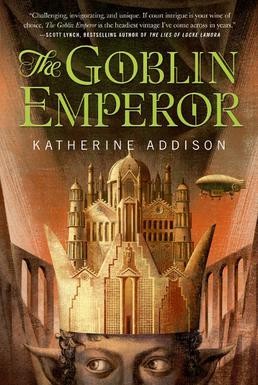
The Goblin Emperor
Maia is the youngest and least favoured son of the emperor of the Elflands, of mixed Elven and Goblin heritage, and has spent his life in exile from a court that considers his mother's marriage an embarrassment.
About
Spoiler notice: Major spoilers follow for the complete novel, including identity revelations and the ending.
Maia receives the throne as news of a disaster, before he has any reason to believe the imperial court will welcome him. The youngest son of Emperor Varenechibel IV has lived at remote Edonomee with Setheris, a resentful cousin whose guardianship is abusive. Maia's goblin mother and elven father have left him with a mixed heritage treated as an embarrassment by his father's household. When an airship crash kills the emperor and his three older sons, Maia becomes the surviving legitimate heir. Setheris recognises that the Lord Chancellor's letter discusses funerals without arranging a coronation, and urges an immediate journey to court. Once there, Maia insists on being crowned and appoints the messenger Csevet as his secretary. His new authority begins with small decisions made under enormous pressure, not with confidence that he knows how to govern.
The Untheileneise Court makes every ordinary encounter formal. Names, titles, household appointments and forms of address tell people who may speak and what kind of power they possess. Maia takes the regnal name Edrehasivar VII, but the ceremony does not erase his unease or the prejudice surrounding him. His guards, the soldier Beshelar and the mage Cala, are constantly present, while Csevet helps translate correspondence and political intentions. The crash investigation soon finds evidence of an incendiary device, changing an inheritance tragedy into a murder case. Maia commissions Thara Celehar, a Witness for the Dead, to investigate independently of Chancellor Chavar's official inquiry. Celehar's ability does not supply an instant answer: the imperial dead convey terror and confusion, sending the investigation beyond the palace. Magic exists here alongside airships, administrative machinery and the slow work of discovering evidence.
Learning to rule also means deciding when a familiar demand should be refused. Maia's sister Vedero is being treated as a potential marriage alliance, although she wants to study astronomy. He delays the negotiations rather than accepting a powerful nobleman's claim to her future. He confronts Setheris by directing him towards a distant administrative position, discovering that he can use office to limit a man whose cruelty has previously governed his life. His choice of an imperial signet incorporating an emblem made for his mother gives his goblin heritage an official place instead of concealing it. Meanwhile, his own marriage is arranged with Csethiro Ceredin, and the treasury official Berenar offers him private instruction. The process is uneven: Maia needs help precisely because titles and good intentions cannot substitute for knowledge of the state's affairs.
The novel gives political consequences to personal conversations. Celehar reveals the grief and vulnerability that have allowed the widowed empress to exert pressure on him, and Maia chooses to keep trusting his investigation. Csethiro's initial reserve also changes as she discovers that the emperor is different from the person she expected. Through the opera singer Min Vechin, Maia meets representatives of the Clocksmiths' Guild of Zhaö, whose proposed bridge could connect parts of the empire separated by the Istandaärtha River. He cannot simply order their scheme into existence; it must survive the scrutiny and factional interests of the Corazhas, his council. A separate land dispute gives him practice in making a workable decision from a map and conflicting demands. These scenes make government a sequence of responsibilities that continues even while the mystery of his family's deaths remains unresolved.
Opposition becomes direct violence when Maia is abducted and confronted by Chavar and Princess Sheveän. They intend to force his abdication in favour of Sheveän's son Idra, Maia's nephew. Maia refuses to proceed without speaking to the boy, and Idra refuses the throne they want him to take. The rescue exposes betrayal within the emperor's own guards: Dazhis has helped the conspirators, and his punishment takes the form of ritual suicide. Maia witnesses its distressing execution rather than receiving a clean report that justice has been done. He protects Idra and the boy's sisters, replaces officials and continues the bridge negotiations. The coup has consequences for his household and his trust in others, but it is a separate conspiracy from the sabotage that originally made him emperor.
The visit of Maia's maternal grandfather, the Great Avar of Barizhan, brings another ruling family and another culture into the court. It also gives Maia opportunities to ask questions about the neglect his mother endured. During the festivities, Celehar's report identifies the airship bombers and implicates House Tethimada. At the Winternight Ball, Eshevis Tethimar attacks Maia with a knife; Beshelar is wounded protecting him, and Cala kills the attacker with a spell. The subsequent investigation connects Tethimar's ambition to the original murders and his plan to govern through a marriage to Vedero and a regency for Idra. Maia insists on interviewing the bombers, confronting their claimed political justification himself. Their insistence that violence was necessary to change the empire leaves him addressing the human decisions behind his accession, rather than viewing it simply as fortunate escape from exile.
The conclusion gives Maia firmer relationships and an achievable public project, without pretending that taking power has abolished cruelty. Trials bring execution for the Tethimadeise conspirators, while exile is used for other participants in the struggle over his throne. He also makes arrangements for innocent relatives affected by the punishments. Celehar is permitted to leave for a vocation serving people without influence, and Maia's connections with Vedero, Idra, Csethiro and his guards become less constrained by fear. At the council's final bridge vote, a tie leaves the decision to him. He approves construction and names it the Wisdom Bridge for everyone who died in the airship, not only his father. Katherine Addison ends with this act of commemoration and connection: an emperor establishing what his reign might accomplish through attention, negotiation and the use of authority he once felt unable to possess.
Book details
- Author
- Katherine Addison
- First published
- 2014
- Series
- No series listed
- Subgenre
- Epic fantasy
- Primary genre
- Fantasy
- Tags
- No tags for this book.
Review
Editor profile
Baby Bat
Goodreads and social links will be added soon.
- Goodreads — link coming soon
- Social media — link coming soon