
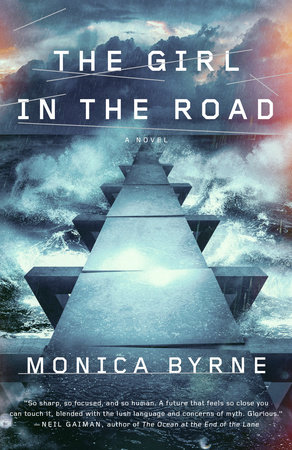
The Girl in the Road
In a future shaped by shifting global power and new energy systems, Meena flees India along the Trail, an energy-harvesting structure across the Arabian Sea, bound for Ethiopia.
About
Spoiler notice: This overview discusses Meena's decision to travel from India along the Trail, Mariama's journey across Africa, and the novel's broad setting, structure, and concerns. It avoids explaining the precise relationship between their stories, later revelations about either character, and the ending.
The Girl in the Road sets two journeys against a future in which political and cultural influence has shifted toward Asia and Africa. Meena leaves India for Ethiopia by way of the Trail, an energy-harvesting structure crossing the Arabian Sea. In a second narrative, Mariama travels across the Sahara with a caravan, under the protection of the enigmatic Yemaya. Both stories move toward Addis Ababa, though their characters begin from different places and circumstances. The novel's central design joins a recognisable journey narrative to a speculative world shaped by new technologies, social change, and older forms of inequality.
Meena's departure is driven by immediate danger and by the unanswered questions surrounding her family. The Trail offers a route across the sea, but it is also an exposed and uncertain environment, inhabited by people seeking passage or refuge. Its engineering premise gives physical form to the book's interest in energy and mobility: infrastructure can connect distant places while also concentrating risk and control. Meena must rely on what she carries and on the people she encounters, and the demands of travel keep the speculative setting close to the body. The crossing is at once geographical and personal, though the novel lets the meaning of that movement develop through her experiences rather than reducing it to a single symbol.
Mariama's chapters trace a different kind of passage. Travelling with a group across the Sahara, she depends on relationships formed in motion, especially her bond with Yemaya. The caravan gives the story a shifting community rather than a stable home base: trust, care, and authority are negotiated among people with their own histories and needs. Mariama's account has its own pace and texture, and its relation to Meena's becomes a question that draws the alternating structure forward. The novel asks readers to hold the narratives side by side without immediately collapsing one into an explanation of the other.
That structure lets Byrne connect intimate choices with large historical and political changes. In this imagined future, India has risen in global influence, while African cities such as Addis Ababa occupy new cultural and political importance. Yet a changed map of power does not mean that power has become fair or harmless. The novel keeps exploitation, violence, displacement, and unequal access in view as its characters move through the world. Its attention to these pressures is linked to questions of gender and queer identity, which appear within everyday social relations as well as in the larger future society. The result is a setting that imagines change without treating the future as a clean break from the present.
Technology and mythic imagery sit together in the book's speculative mode. The Trail, energy systems, and other signs of a transformed society invite practical questions about how people live with invention and infrastructure. At the same time, the journeys are rendered through heightened images and forms of perception that leave room for uncertainty. In an interview, Byrne has described the novel as deliberately drawing on more than one genre, including science fiction, fantasy, mystery, and literary fiction. That openness is apparent in the way the narrative moves between political world-building, suspense, relationships, and symbolic material without settling into only one register.
The novel also makes travel a way of examining memory and identity. Each protagonist carries a past that influences what she fears, trusts, and hopes to find, while the road brings her into contact with people who complicate those expectations. Movement does not guarantee freedom: routes have barriers, communities have hierarchies, and escape can expose a traveller to new dangers. Nor does the book treat its characters as simple representatives of a social issue. Their desires and contradictions remain personal even as the world around them raises questions about race, gender, sexuality, class, and belonging. The broad scope comes from the pressure between a particular life and the systems that shape it.
The Girl in the Road is therefore both a speculative journey and a braided account of two lives approaching the same destination. Its parallel narratives create suspense through difference: one follows Meena across the Arabian Sea, while the other follows Mariama across the African continent. The design encourages attention to echoes, gaps, and shifts in perspective, and to the ways geography and time affect what a character can know. Byrne builds a future with unfamiliar arrangements of power and technology, but keeps its emotional questions legible: what survival demands, how people make connections under pressure, and whether movement can change the stories that have shaped them. The novel's world and its journeys remain intertwined, carrying the reader toward a convergence without disclosing in advance what that convergence means. The alternating form also asks the reader to revise assumptions as one account changes the context for the other. This makes the act of comparison part of the reading experience: not a contest over which character's hardship matters more, but an inquiry into how distance, inherited conditions, and shifting social roles shape what each can imagine as possible.
Book details
- Author
- Monica Byrne
- First published
- 2014
- Series
- No series listed
- Subgenre
- Literary fiction, Climate fiction, Adventure fiction
- Primary genre
- Sci-Fi, Literary Fiction
- Tags
- No tags for this book.
Review
Editor profile
Baby Bat
Goodreads and social links will be added soon.
- Goodreads — link coming soon
- Social media — link coming soon