
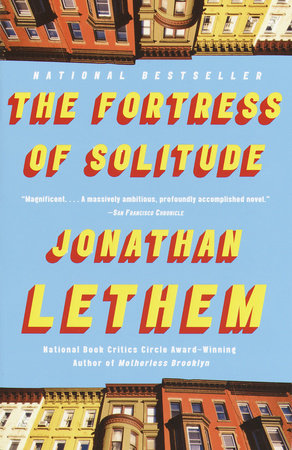
The Fortress of Solitude
Growing up on a changing Brooklyn block, Dylan Ebdus is robbed by older boys before he forms a friendship with Mingus Rude.
About
Spoiler notice: Spoilers below for the opening premise, the ring’s abilities, and Dylan’s adult return to Brooklyn; the final outcome is not disclosed.
The Fortress of Solitude begins with Dylan Ebdus arriving as a child on Dean Street in Brooklyn, where his bohemian Jewish parents, Rachel and Abraham, have made a home in a neighborhood becoming known as Boerum Hill. Gowanus is not a blank backdrop for his growing up: its streets have their own games, language, dangers and pecking order, none of which Dylan understands at first. The only white family on the block, the Ebduses occupy a visible position that shapes how Dylan is seen. He enters public school and neighborhood life exposed to the same daily changes as the streets around him, but without the knowledge that might help him read them.
Older boys regularly rob Dylan, emptying his pockets. The recurring theft makes vulnerability part of daily routine rather than a single exceptional episode. His isolation begins to change when he forms a friendship with Mingus Rude, a Black teenager who is also motherless. As the boys move among stoopball, graffiti and street parties, Dylan enters a social world that was difficult for him to reach alone. Both have lost their mothers, but that shared absence does not make their lives identical: Dylan is white in a neighborhood where his parents are the only white family. Their closeness sits alongside differences of race, family and experience that friendship cannot simply erase. Dylan wants belonging and protection, while the meaning of their shared neighborhood is never the same for each boy.
The novel’s Brooklyn is made from specific forms of popular culture and street life. Graffiti tags mark space and carry identities; stoopball turns public steps and pavement into a field of play; music travels through the neighborhood alongside funk and hip-hop. Comics supply Dylan with a language for danger, secret powers and rescue. Graffiti also carries moral conflict: when a tag is placed on a sleeping homeless man, Abraham sees an act that confuses right and wrong, complicating any simple celebration of the art as pure self-expression. These elements shape how the characters imagine themselves, while remaining part of an ordinary urban setting where violence, drugs and affection sit close together. Lethem brings them into one narrative instead of treating childhood, music, city life and comic-book fantasy as separate subjects.
A mysterious ring adds the novel’s single overtly fantastic element: its wearer can fly and become invisible. Dylan thinks about the ring through the comic-book superheroes he admires and imagines using it to fight crime. The power gives physical form to a child’s wish to escape his exposure and to act when the world around him seems unsafe. Yet the fantasy cannot by itself repair what is broken between people. As Dylan grows older, the idea of rescue remains bound to memories of childhood and to his friendship with Mingus. The ring’s place in the story therefore reaches beyond adventure: it tests what Dylan thinks he can do for someone else, and what he would rather not face about himself.
The story follows Dylan beyond Dean Street, extending from Brooklyn to Vermont and California and from the 1970s into the 1990s. That wider span keeps his adult life in view alongside the neighborhood he continues to remember. He works with music as an author of liner notes and struggles to form lasting romantic connections; neither adult role frees him from the childhood he revisits. Gowanus also changes, becoming Boerum Hill through gentrification. The shift in the neighborhood’s name makes visible how one place can carry different meanings for people who live there at different times. Dylan’s later return brings him into contact with a home that has continued to change without him.
Memory gives the novel its emotional structure. Dylan keeps circling the people and places that shaped him, trying to understand what he experienced as a child and what he failed to see. The novel’s two self-contained chapters, “Liner Note” and “Prisonaires,” stand apart from the surrounding narrative, and its musical references provide a way to think about how separate pieces can belong to a larger arrangement. Popular culture is not decoration around Dylan’s private history; it supplies forms through which he learns to interpret friendship, race, masculinity and heroism. Lethem’s movement between neighborhoods and periods allows the meanings of early events to shift as Dylan acquires more distance but not necessarily more certainty.
The title names both a place of imagined refuge and a condition Dylan struggles to leave. A fortress can protect a child from the world, but it can also keep him enclosed with old fears and partial explanations. The novel examines a boyhood shaped by racial difference, class, family absence and an uneven transition between neighborhoods, while resisting the idea that any one memory can stand for the whole place. Dylan’s perspective matters, but it is not the same as knowing everything about the people beside him. The result is a coming-of-age novel in which superhero fantasy and Brooklyn street life meet the slower work of looking back: friendship survives in memory, but understanding what it meant takes longer.
Book details
- Author
- Jonathan Lethem
- First published
- 2003
- Series
- No series listed
- Subgenre
- Literary fiction, Coming-of-age
- Primary genre
- Literary Fiction
- Tags
- No tags for this book.
Review
Editor profile
Baby Bat
Goodreads and social links will be added soon.
- Goodreads — link coming soon
- Social media — link coming soon