
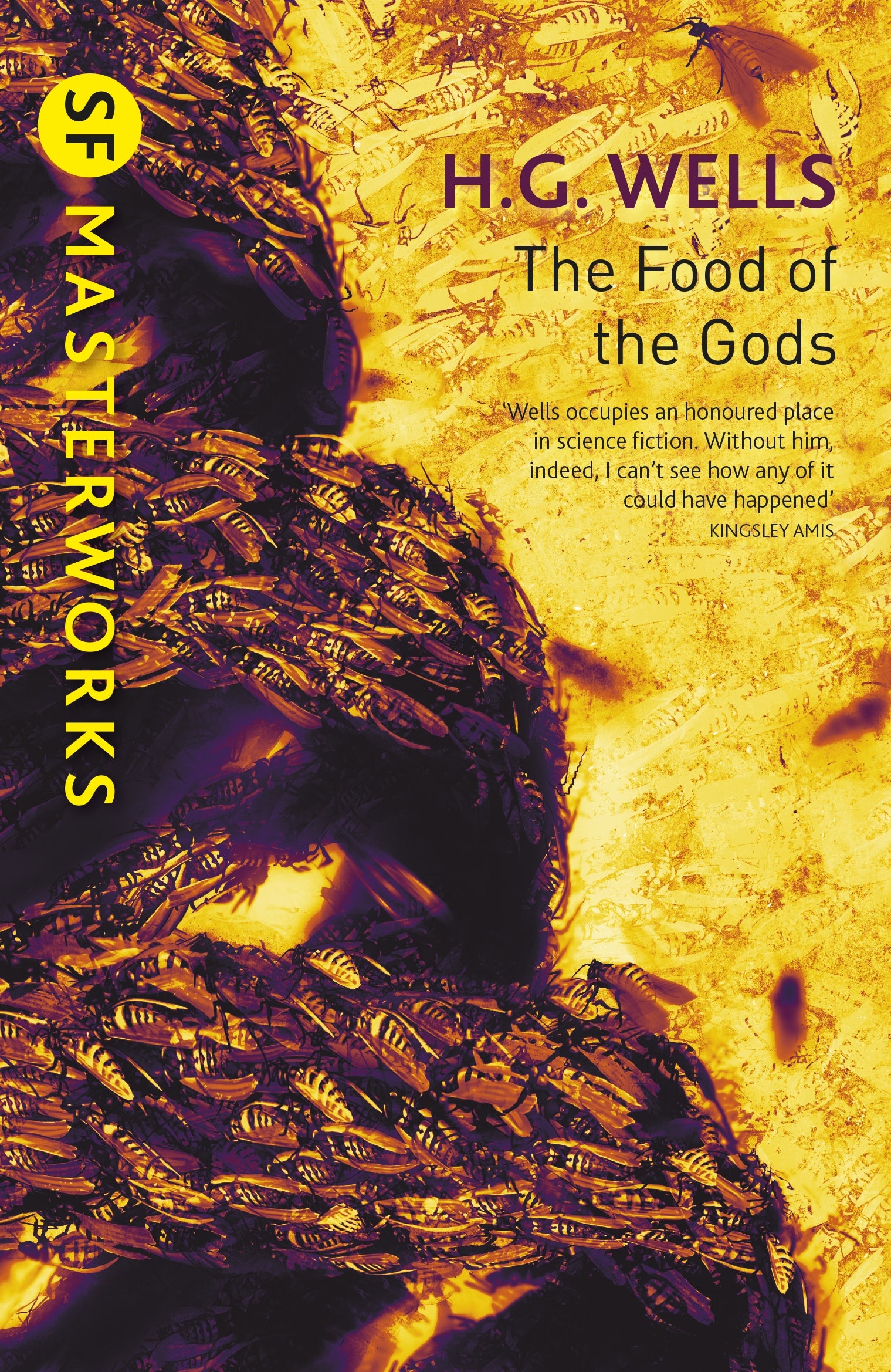
The Food of the Gods
Chemist Bensington and physiologist Redwood develop a fictional substance intended to change the pace of growth, then test it on an experimental farm.
About
Spoiler notice: This overview includes Caddles's death and the giants' decision at the end of the novel.
The discovery begins with two scientists whose ambitions are considerably larger than their arrangements for managing the consequences. Bensington, a chemist, and Redwood, a physiologist, investigate growth and arrive at Herakleophorbia IV, the substance the narrator calls the Food of the Gods. Within H. G. Wells's fictional premise, it allows living things to develop far beyond their usual size. The prospect invites excitement about research, practical applications and commercial possibilities before anyone has understood what such growth will require. Published in 1904, the novel moves from a small experimental project into a struggle over the future of society. Its opening comedy makes the transition possible: the men can think inventively about a particular scientific problem while remaining remarkably unobservant about the people and circumstances through which their discovery must enter everyday life.
An isolated farm at Hickleybrow appears to Bensington an ideal place for controlled experiments. He hires Mr. and Mrs. Skinner to manage it, overlooking signs that their habits hardly match the precision his work requires. The demand to measure the poultry every day becomes a joke between Skinner and a local carpenter. That small failure of seriousness has consequences on a very different scale once the chickens grow enormous and the Food escapes its intended uses. Familiar rural creatures become dangerous because the relationship between their appetites and their surroundings has changed. An oversized pullet carrying off a child turns the village's ordinary objects into inadequate means of rescue. A watering-can and a croquet mallet are pressed into service. The absurdity remains, but the people inside the joke are now exposed to physical danger.
The substance also reaches children, making containment a question about lives rather than simply about experiments. A giant child cannot be accommodated indefinitely by ordinary furniture, ordinary lessons or an ordinary household's expectations. Redwood's preparations for his son show how much thought the problem demands. He plans drawing materials, books, tools and music on a suitable scale, imagining the boy's education as more than keeping a large body fed. Even a piano would need to be brought into the room in pieces. These details give the fantastic premise domestic substance. Growth requires a world capable of supporting curiosity and imagination alongside physical needs. The father's enthusiasm is affectionate, but the scale of his planning also reveals that a discovery cannot be confined to the moment when a scientist announces it.
As the children grow, the difference becomes social and political. The larger generation must find room within institutions established by people who regard their own dimensions as normal and permanent. Young Redwood and the Princess introduce affection and companionship into that difficulty. Their relationship gives the question of the giants' future a personal urgency beyond public arguments over safety. Meanwhile, the vocabulary used to discuss them helps shape how others respond: exceptional young people can be turned into a menace simply by describing their presence as a collective threat. Wells follows a society that has already been altered but still hopes to govern the alteration through familiar prohibitions. The resulting tension concerns authority as much as size, because deciding where a giant may go means deciding what sort of life that person is allowed to imagine.
Caddles exposes the cruelty of that arrangement when he leaves the rural life in which his strength has been put to work cutting chalk. In London he finds crowds, traffic, shops and immense activity without an explanation of what it all means or where he belongs. His questions receive jokes and orders to move along. Hunger eventually leads him to take bread, and the police pursue him rather than answering the wider grievance he cannot clearly express. The confrontation escalates as he arms himself with an electric-light standard and officers threaten to shoot. He brings the weapon down on an officer, and the riflemen kill him. The episode contains violence on both sides, but its course shows how thoroughly his earlier search for understanding has failed. Society can enforce its rules against him without offering him a place within them.
The larger confrontation brings Redwood to the giants as an intermediary carrying Caterham's proposed terms. The offer would remove them to a separate territory, stop production of the Food and forbid them children. Its promise of order consequently requires their eventual disappearance. Inside the encampment, Redwood finds young people who have their own loyalties, plans and willingness to fight. His son has been wounded, and the Princess is beside him. The father discovers that being important to his child does not make him the owner of the child's future. That recognition connects the political debate with the earlier nursery preparations: providing for a new generation does not entitle the old one to dictate the limits of what it may become. Caterham's settlement makes those limits explicit and unacceptable to its intended subjects.
The giants refuse, declaring that the Food must continue to spread. Their confidence is exhilarating, but it also has a coercive edge when they contemplate making the smaller people take it. Growth becomes a principle they believe justifies struggle, rather than a condition everyone has freely chosen. The final speech carries their ambitions beyond the immediate battlefield toward an almost limitless future. Wells ends with that determination, without narrating the next battle or proving that their programme succeeds. The reader is left between the smaller world's demand that change cease and the giants' willingness to force change onward. What began as a manageable experiment has produced people who will not consent to being managed into extinction. The unanswered question is how a transformed world can be shared when both sides define survival through incompatible demands.
Book details
- Author
- H. G. Wells
- First published
- 1904
- Series
- No series listed
- Subgenre
- Classic science fiction
- Primary genre
- Sci-Fi
- Tags
- No tags for this book.
Review
Editor profile
Baby Bat
Goodreads and social links will be added soon.
- Goodreads — link coming soon
- Social media — link coming soon