
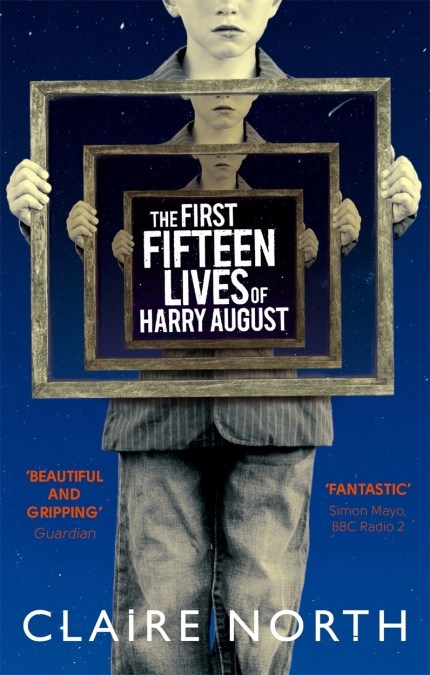
The First Fifteen Lives of Harry August
Harry August is born, lives, dies and begins again at the same point, carrying the memories of every previous life.
About
Spoiler notice: Spoilers cover Harry’s repeated-life premise, the message that begins the central mystery, and the broad shape of his investigation. The cause of the changing future and the novel’s ending are not revealed.
Harry August dies, then returns to the beginning of his life with the memories he has already made. The cycle repeats: the same birth, childhood and world, but not the same experience of living them. The novel opens near the end of Harry’s eleventh life, when a child comes to his bedside with a warning that the world is ending faster than it should. Her message gives a new urgency to a pattern Harry has long understood as personal fate. What can someone do when life starts over, history appears to repeat, and the future is now changing? Claire North builds the book around that question, placing an intimate account of one person’s many lives inside a mystery that grows to planetary scale.
Harry’s early lives are shaped by the work of understanding what is happening to him. He returns to the same starting point but retains the knowledge and memories of previous rounds, so each childhood begins with an adult’s accumulated past inside it. His condition complicates ordinary ideas of age, learning and identity: he can grow up again, but he cannot meet the world as a blank slate. The story follows his attempts to make sense of this experience, including the isolation of carrying knowledge no one around him can share. Gradually, Harry finds evidence that he is not alone. Other people repeat their lives too, and their existence turns his private puzzle into a hidden social world.
The people who share Harry’s condition have developed ways to pass knowledge between lives and to look after those who are newly beginning. Their community gives Harry a context for his own experience, while also introducing obligations and limits. If someone can act with memories of events still to come, then information becomes a form of power. The group has reasons to preserve the broad course of history and rules about how much to change it. Harry has to consider what follows from those rules, how trust works among people with long memories, and whether repeating the same world makes intervention pointless. The book uses these questions to explore progress and responsibility through the concrete choices of its characters.
Its structure moves across Harry’s successive lives rather than following one continuous biography. Events that seem settled in one period can be revisited from another, and the same historical landmarks return as Harry carries new knowledge into a familiar past. That movement allows the novel to connect personal change with the persistence of public history. A life can be different in its details even when the larger events remain recognizable. North uses this back-and-forth chronology to show how repetition affects memory: experience accumulates, but it does not automatically produce certainty. Harry’s understanding changes as he encounters people again under different circumstances and considers what he owes to them.
The warning at Harry’s bedside breaks the pattern he has relied on. The child says the end of the world is arriving sooner, suggesting that something is shifting across the repeated histories. Harry must investigate this change and determine what kind of response it requires. The mystery brings him into conflict with another member of the life-repeating community and turns long spans of time into part of a pursuit. The book’s speculative premise therefore has a thriller’s forward pressure: Harry follows clues, weighs what he can trust, and tries to distinguish deliberate interference from the natural limits of his knowledge. The danger is not simply that he might fail to prevent a catastrophe, but that every attempted correction could carry its own consequences.
Although its scale reaches across decades and world events, the story keeps returning to relationships. Harry’s repeated lives affect how he understands intimacy, loyalty and loss. People around him may be encountering a moment for the first time while he remembers earlier versions of it; that imbalance can make closeness difficult, and it also gives friendship unusual depth. The novel’s concerns include what a person should commit to when time seems abundant, how memory changes attachment, and whether a life can retain meaning when it may be lived again. These questions are not detached puzzles: they shape Harry’s choices and the way he approaches the people whose paths cross his.
The title points to a limited portion of a life that is, for Harry, both singular and repeated. Fifteen lives are not presented as fifteen unrelated opportunities; each carries traces of the ones before and leads into the next beginning. North’s novel combines speculative fiction, mystery and a character-focused meditation on time, memory and consequence. The central hook is clear, but its implications widen as Harry learns how others live with the same condition and confronts evidence that history is no longer holding steady. The result is a narrative about accumulating experience without escaping uncertainty, and about deciding what to do when the past can be revisited but the future remains open to change.
Book details
- Author
- Claire North
- First published
- 2014
- Series
- No series listed
- Subgenre
- Time travel, Literary fiction
- Primary genre
- Sci-Fi, Literary Fiction
- Tags
- No tags for this book.
Review
Editor profile
Baby Bat
Goodreads and social links will be added soon.
- Goodreads — link coming soon
- Social media — link coming soon