
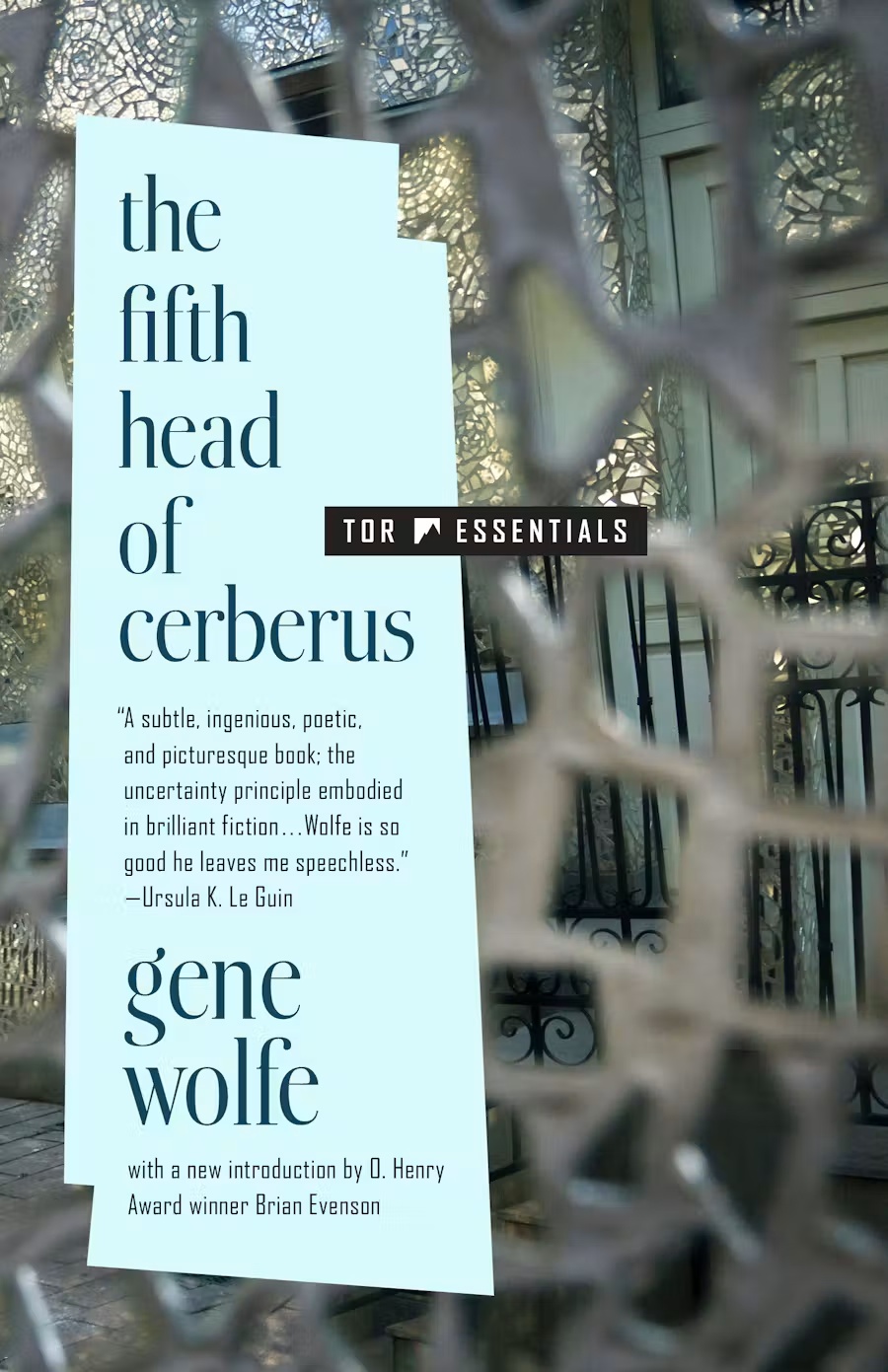
The Fifth Head of Cerberus
On the twin colony worlds of Saint Croix and Saint Anne, stories about a family, an anthropologist, and the planets' vanished shapeshifting people gradually intersect.
About
Spoiler notice: This overview discusses the three novellas' premises, settings and narrative forms, plus their shared questions about identity and colonial history. It avoids explaining the hidden relationships among the narrators, the disputed history of the planets, and the late revelations.
Gene Wolfe's The Fifth Head of Cerberus is a science-fiction book made from three linked novellas set on the colony planets Saint Croix and Saint Anne. The worlds circle one another, and human settlement has overlaid a local history that remains uncertain: people speak of native shapeshifters as an extinct race, while some accounts suggest they may persist. Wolfe builds the book around that uncertainty rather than offering a straightforward expedition or a single authoritative history. Family relationships, stories about the past, and documents produced under pressure become evidence readers must consider. The title names the first novella as well as the complete volume, so the first part establishes a world that the next two will revisit through markedly different forms.
The opening novella follows a young narrator growing up in an unusual household on Saint Croix. His father is a scientist who runs a brothel and pursues experiments involving the boy and his brother. The narrator describes his upbringing in a composed, retrospective voice, giving the account an orderly surface even as its circumstances grow unsettling. Wolfe uses this distance to make the narrator's language part of the story: what he notices, accepts, or leaves unstated shapes the reader's view of the family. The household's private routines sit within the larger colonial society, where inherited status and the official story of the native population are both unsettled. The result is a family narrative that opens onto questions about how a person receives, performs, or inherits an identity.
The second novella changes its frame. It presents a mythic tale associated with John V. Marsch, an anthropologist visiting the planets, and shifts attention toward the remembered culture of Saint Anne. A young man's quest gives the section the shape of legend rather than memoir or case report. Its images and episodes place human observers at a distance from a community they hope to understand, while the tale itself preserves a way of seeing the world that can be lost or misread when recast by outsiders. Wolfe does not use this form simply to supply a historical explanation for the first story. The relation between the two is more oblique: the myth adds another account of the planets, but its placement and framing invite questions about who tells it, what has been translated, and how a story changes when it crosses cultures.
The final novella takes the form of a documentary file assembled around Marsch's imprisonment. Reports, testimony and institutional records replace the earlier sections' continuous first-person narration and embedded tale. The shift makes authority itself part of the subject. A file can appear more objective than a personal recollection, yet its documents are produced by people with limited knowledge and unequal power over the person they describe. The scientist's confinement brings that problem into view: the record of an investigation is also a record of the institution controlling it. The book therefore moves among three kinds of evidence—a remembered life, a transmitted story and an archive—without making any one form an uncomplicated key to the others.
Read together, the novellas circle questions of identity, memory, colonialism and belonging. Saint Croix and Saint Anne are not neutral scenery: one is a settled human society shaped by migration and family power, while the other is associated with the people official accounts call vanished. The competing stories about the planets' past make the boundary between colonizer and colonized less secure than a textbook account would suggest. Wolfe does not resolve that history here as a simple moral allegory. Instead, his characters try to interpret partial evidence, and their attempts carry personal and political consequences. A claim about what a person is can also become a claim about who has the right to speak, classify others, or govern a world.
The book's craft depends on withholding a single stable vantage point. The opening narrator's retrospective account, the second section's tale-within-the-tale, and the final collection of documents each ask the reader to judge how a narrative was made. A detail can change its weight when it reappears under another form, so connections emerge through comparison rather than a guide explaining them. This technique makes uncertainty structural: the reader is not merely missing facts but has to assess the reliability and limits of the forms that carry those facts. The repeated shifts also create a pattern between the parts, with each novella remaining distinct while reframing the others. Brian Evenson's introduction to the 2022 Tor Essentials edition describes them as linked yet structurally distinct, a useful account of the design without settling every ambiguity.
Wolfe's approach makes this a compact but formally ambitious work of literary science fiction. Its speculative premise—human colonies on twin planets, a possibly surviving shapeshifting people, and a disputed history of settlement—supports an inquiry into how identities are made and remembered. Its narrative experiment asks a parallel question about stories: who authored a record, who preserved it, and what remains outside its frame. The form rewards attention to distinctions among voices and documents while leaving room for more than one interpretation. The three novellas do not simply repeat a plot from alternate angles; they create tension among different accounts and kinds of knowledge. That design allows the book to keep its central mysteries active even as its setting and characters become more familiar.
Book details
- Author
- Gene Wolfe
- First published
- 1972
- Series
- No series listed
- Subgenre
- Literary fiction, Classic science fiction
- Primary genre
- Sci-Fi, Literary Fiction
- Tags
- No tags for this book.
Review
Editor profile
Baby Bat
Goodreads and social links will be added soon.
- Goodreads — link coming soon
- Social media — link coming soon