
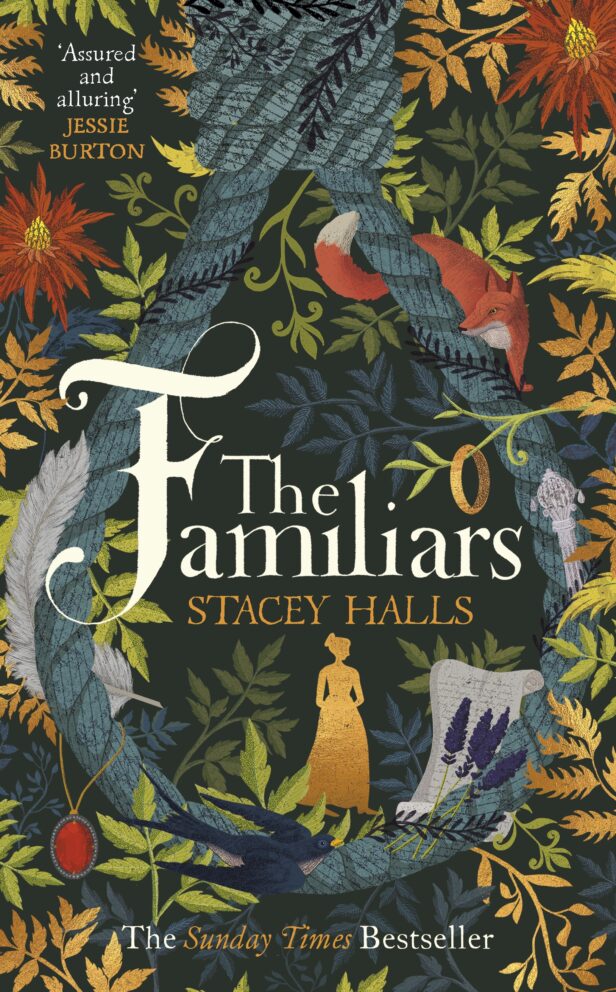
The Familiars
In Lancashire in 1612, seventeen-year-old Fleetwood Shuttleworth is pregnant for the fourth time and fears another childbirth may kill her.
About
Spoiler notice: Spoilers cover Fleetwood’s fourth pregnancy, her discovery of the physician’s warning, her alliance with Alice Gray, and the witchcraft accusation that places Alice in danger. Later revelations and the outcome of the trial and pregnancy are withheld.
In Lancashire in 1612, Fleetwood Shuttleworth is seventeen, mistress of Gawthorpe Hall, and pregnant for the fourth time. Her three earlier pregnancies ended in loss, and she fears that this childbirth may kill her. When she finds a physician’s letter warning her husband Richard that another pregnancy could be fatal, private dread becomes an explicit threat. Fleetwood takes the letter outside and heads for the woods, where she can think away from the household. Her sickness returns as she moves through the grounds, and the contrast between the windows of Gawthorpe and the shelter of the trees introduces a setting that is both her home and a place from which she wants to escape. There, by chance, she encounters Alice Gray, a young woman whose knowledge and confidence draw Fleetwood into a new source of help.
Their first meeting begins with a small confrontation over land and a sack of rabbits. Fleetwood sees Alice in the woods and assumes she has been poaching on the Shuttleworth estate. Alice says she did not know she was on Fleetwood’s land, and when Fleetwood asks how she killed the rabbits, Alice answers that she did not kill them; they were already dead. Fleetwood identifies herself as mistress of Gawthorpe, while Alice gives little away and runs off before Fleetwood can learn her name. This uneasy encounter makes the class boundary concrete: Fleetwood can invoke her husband’s authority and the magistrate, while Alice is on land that belongs to someone else and is questioned as an intruder. Their later meeting changes the meaning of the first, when Fleetwood learns Alice is a midwife.
Alice promises that she can help Fleetwood deliver a healthy child and challenge the physician’s prediction. Fleetwood hires her and begins to depend on her care. They occupy very different positions: Fleetwood is the privileged wife of a landowning gentleman, while Alice is poor and illiterate. The difference does not prevent the women from forming a friendship, but it shapes what each can risk and what authority she can call upon. Fleetwood’s pregnancy is treated as a family concern because her husband wants an heir; Alice’s work as a midwife places her close to other women’s bodies and private needs. When the witchcraft accusations draw Alice into their reach, care itself can be recast as suspicious knowledge, and Fleetwood’s personal trust conflicts with the judgments being made around her.
The novel’s first-person narration keeps the reader close to Fleetwood’s uncertainty. Alice’s thoughts are not separately narrated, so Fleetwood has to interpret silences, incomplete explanations, and the reports she receives about the accused. That form suits the story’s central problem: Fleetwood needs to decide whom she can trust while she is physically vulnerable and dependent on people whose interests may differ from hers. She is often accompanied by Puck, her French mastiff, especially when she moves beyond the Hall. His presence gives her companionship during Richard’s frequent absences, but it cannot answer the questions she faces about Alice, the accusations, or her own future. The reader learns the witch-hunt through the same limited channel Fleetwood has, rather than through an all-knowing account of every accused person’s life.
Richard’s wish for an heir places pressure on his marriage to Fleetwood, while the physician’s letter shows that her safety is also at stake. He is frequently away, and Fleetwood is left to make sense of a warning that was addressed to him. She cannot even be sure whether he read it. The discovery brings distrust into a marriage already strained by the loss of three children: has Richard withheld something terrible, or is she confronting a danger he has yet to understand?
As the accusations spread, Alice is arrested and held, and Fleetwood tries to help her before the proceedings at Lancaster. The threat is connected to a documented event: the 1612 Pendle witch trials, in which local people faced accusation and prosecution. The novel names real figures and places, including Fleetwood Shuttleworth, Alice Gray, and Gawthorpe Hall, but their friendship is imagined rather than established by historical evidence. Within the story, Fleetwood’s effort to help Alice means confronting how quickly suspicion can turn a woman’s healing work, social position, or lack of protection into evidence against her. Alice’s arrest also changes the stakes of Fleetwood’s pregnancy: the person she trusts with her care is now caught in a process that Fleetwood cannot control from the safety of her own household.
The title refers to the animal or spirit companions that people associated with witchcraft and the Devil. A familiar could make an apparently private relationship with an animal part of an accusation carrying a death sentence. The Pendle cases spread through connected households, implicating members of the same families; some accused people acknowledged having such companions despite the danger. In the novel’s world, Fleetwood therefore has to consider more than whether Alice has helped her. That help exists within a community prepared to read hidden meaning into conduct, relationships, and practical knowledge. Her wealth gives her access and authority, but it does not let her decide how the authorities will interpret another woman’s life.
Book details
- Author
- Stacey Halls
- First published
- 2019
- Series
- No series listed
- Subgenre
- Literary historical fiction, Historical fiction
- Primary genre
- Historical Fiction
- Tags
- No tags for this book.
Review
Editor profile
Baby Bat
Goodreads and social links will be added soon.
- Goodreads — link coming soon
- Social media — link coming soon