
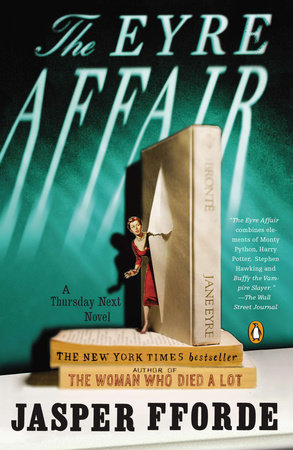
The Eyre Affair
In an alternate Britain in 1985, literary detective Thursday Next works for SpecOps, where forged texts and stolen manuscripts are matters for investigation.
About
Spoiler notice: This overview introduces Thursday Next, the alternate 1985 setting, SpecOps and the literary crime involving Jane Eyre. It avoids the novel's later reversals, character fates and resolution.
The Eyre Affair begins with a detective story and then unsettles the boundaries that usually keep books safely on shelves. Jasper Fforde places Thursday Next in a Britain recognisable as 1985 only at a glance: its history, institutions and everyday technologies have taken different turns, and literature matters to public life with unusual force. Thursday works in the Special Operations Network, or SpecOps, as a specialist in literary detection. Her cases involve forged texts, stolen manuscripts and disputes over authorship. In this world, those are not quaint scholarly matters. They can become police business, political controversy and the starting point for a crime that reaches directly into fiction.
This is an alternate history with a comic, deliberately improbable texture. The Crimean War has continued far beyond its place in our history, time travel is a regulated reality, cloning is established, and resurrected dodos can be kept as pets. Other parts of the setting feel less advanced than the real 1985: airships still provide a familiar way to make long journeys, while literature occupies a place closer to mass entertainment and civic identity. Fforde lets these differences sit beside ordinary work and domestic concerns instead of pausing to build a formal rulebook. The result is a world whose oddities are treated as practical facts by its inhabitants, even as they continually complicate Thursday's cases.
The novel's literary obsession has its own institutions and factions. SpecOps includes divisions that respond to unusual kinds of crime, while Thursday's LiteraTec role focuses on offenses involving texts and authorship. Arguments about who wrote Shakespeare's plays have grown into a public cause, and performances can attract militant hecklers as well as ordinary audiences. This comic exaggeration makes the book's central idea concrete: a culture can treat stories as shared property and still fight fiercely over who controls them. Fforde draws on familiar literary works, especially Charlotte Brontë's Jane Eyre, but the story does not depend on the reader having memorised a canon. Recognition adds another layer; the investigation remains legible as an investigation.
Thursday's professional life changes when a more dangerous operation crosses her path. A criminal begins stealing people from literary works, turning an abstract offense against a manuscript into a threat to characters and the stories that contain them. One of the central tools in this crime is a device that allows movement between a book and the world outside it. That premise gives the novel a literal answer to an old readerly wish: to step inside a story. Fforde immediately gives the idea legal and practical consequences. If a character can be removed, the shape of a narrative can change; if an investigator can enter, familiar police skills must work in an unfamiliar kind of scene.
Jane Eyre becomes the defining case because its title character is taken from the pages of Brontë's novel. Thursday has to pursue the criminal through a landscape that is both made of literature and governed by the internal logic of a published story. This is not simply a new setting for a conventional chase. The boundaries of point of view, narration and plot become part of the investigation, so Thursday must think about what the book permits as well as what the criminal intends. Fforde uses the contrast between the printed work and its altered state to create suspense while making literary form visible. The familiar novel remains recognisable, but its stability can no longer be assumed.
The book also follows Thursday's private history alongside her official work. Her past includes service in the long Crimean conflict and the loss of her brother, experiences that inform her anti-war outlook and her reactions to danger. A transfer back to Swindon reconnects her with an earlier relationship and places present obligations beside old attachments. These strands give the story a human anchor amid the elaborate conceits. Thursday is not only a guide through Fforde's references; she has to make decisions as a working investigator, a family member and a person carrying grief. The secondary plotlines can branch widely, but they share the novel's interest in how people adapt when the familiar account of their world proves incomplete.
Fforde's comedy comes from collisions between registers. Bureaucratic procedures are applied to surreal events; literary scholarship turns into street-level conflict; a hard-boiled case can lead to a meeting with a heroine from a nineteenth-century novel. The tone moves between crime fiction, alternate history, speculative invention and affectionate parody. That mixture is part of the book's design rather than a promise of strict realism. The setting often runs on comic logic, and its allusions reward readers who notice them, but the central tension stays easy to state: Thursday must stop a literary crime before it permanently changes the work at its centre. The result is a mystery in which the evidence includes the structure of a story itself.
As the first Thursday Next novel, The Eyre Affair establishes a series through a self-contained literary investigation and a larger world with room for further cases. Its most distinctive question is not whether stories matter, but what happens when they are treated as places one can enter and alter. The answer is playful, occasionally chaotic and rooted in the detective's practical task: identify the threat, understand the rules at work and act before the damage becomes irreversible. Readers who enjoy the puzzle of seeing Jane Eyre reframed may find extra pleasure in the premise, while the pursuit of a criminal gives the book a route through its many inventions. Fforde makes literary criticism part of an adventure, with books serving as both cultural treasures and vulnerable terrain.
Book details
- Author
- Jasper Fforde
- First published
- 2001
- Series
- Thursday Next, book 1
- Subgenre
- Time travel, Portal fantasy
- Primary genre
- Fantasy, Mystery & Thriller
- Tags
- No tags for this book.
- Reading order
- This is the only Thursday Next title on the shelf right now.
Review
Editor profile
Baby Bat
Goodreads and social links will be added soon.
- Goodreads — link coming soon
- Social media — link coming soon