
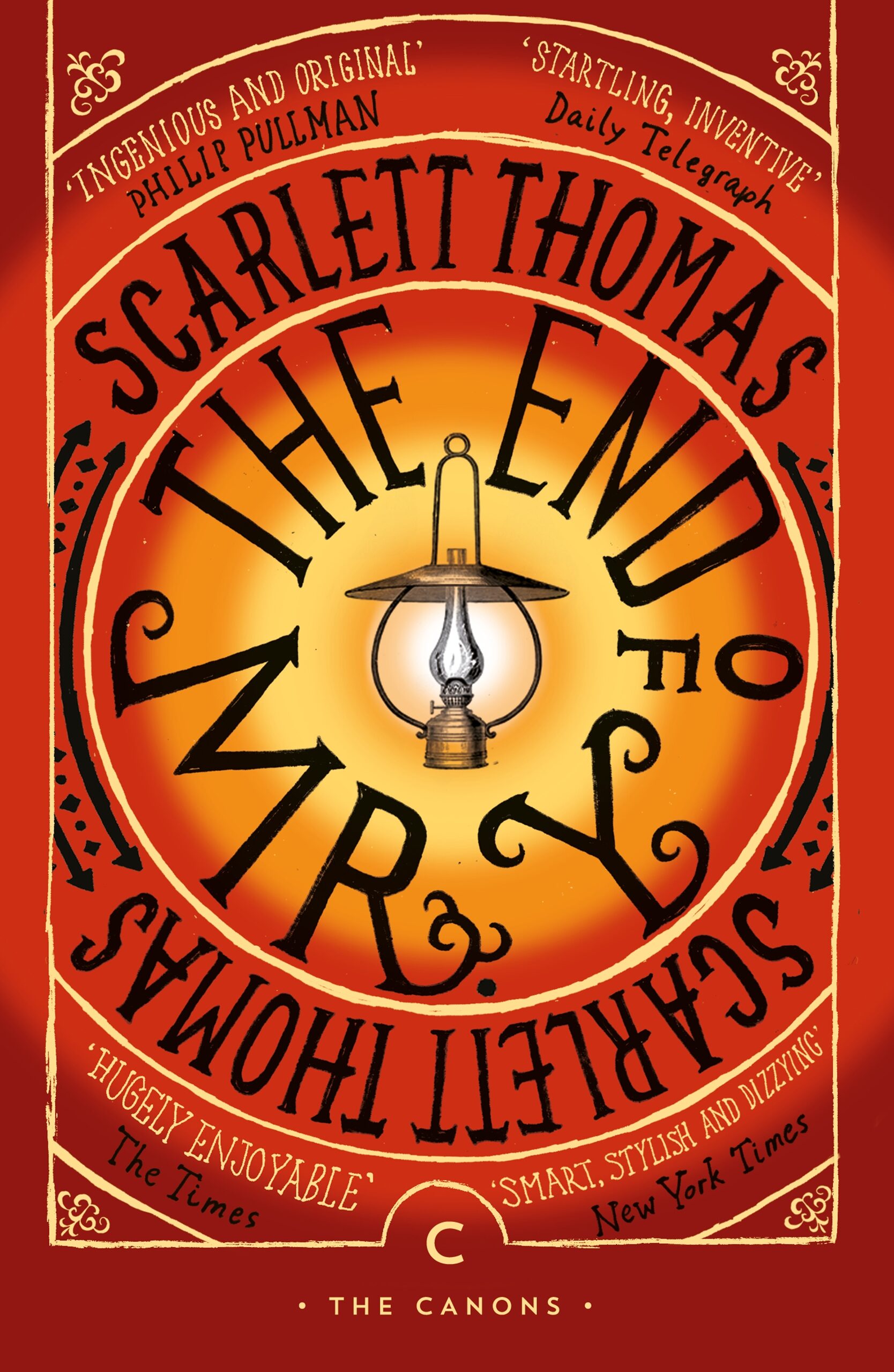
The End of Mr. Y
Ariel Manto, a researcher fascinated by Victorian scientist Thomas Lumas, finds a rare copy of his novel The End of Mr.
About
Spoiler notice: Spoilers cover Ariel’s discovery of the rare book, her entry into the Troposphere and the broad nature of the speculative premise. Later revelations and the ending are withheld.
Scarlett Thomas begins with a book inside a book. Ariel Manto, a researcher drawn to Victorian science and the history of ideas, finds a rare copy of The End of Mr. Y in a second-hand bookshop. It is the work of the fictional Thomas Lumas, an eccentric Victorian scientist, and its scarcity has become part of its reputation: some people say that it is cursed. The discovery gives Ariel a text she has been seeking, but possession turns an academic interest into a personal risk. The title therefore carries two linked questions from the outset. What can a reader learn from a book that is nearly impossible to find, and what might happen when its ideas are treated as instructions rather than as fiction?
Ariel’s interest is not merely antiquarian. Lumas’s writing concerns experiments of the mind, a subject that gives her scholarly work a route into the novel’s speculative action. The text she discovers promises knowledge about consciousness and reality, but it also has the uncertain status of a dangerous object. Her discovery gives the research a concrete centre: a book that had been the subject of study becomes an object that can alter the course of her work and her life. A rare text can be evidence, an intellectual opportunity and a source of danger at once. The novel uses those competing roles to make curiosity consequential without treating scholarship itself as a safe, detached activity.
The fictional Mr. Y book becomes the hinge between ordinary research and the novel’s stranger territory. Following the directions associated with Lumas’s work, Ariel enters the Troposphere, a realm in which consciousness can be encountered through other minds. The idea shifts the story’s scale: inward experience can open onto other places and times, while the boundary between an individual point of view and a wider field of thought becomes uncertain. This is presented as speculative fiction, not as a claim about real physics. Thomas places the adventure near questions about consciousness, space and time, and the publisher describes the novel through quantum physics and the power of love. The imaginative mechanism gives those abstractions a narrative form that Ariel has to navigate.
The plot keeps that intellectual premise connected to danger in Ariel’s ordinary world. A university building collapses, her adviser disappears, and a recipe associated with Lumas’s experiment promises a way into the Troposphere. These events turn her scholarly pursuit into a chain of decisions with physical consequences. Entering another mind may expand what Ariel can perceive, but it also exposes her to forces she does not understand or control. Alongside the mystery, an unexpected romantic connection brings questions of trust and intimacy into the same space as the book’s speculations about consciousness. Love, sex, death and time travel become parts of Ariel’s predicament rather than detached subjects for argument.
The structure also places a fictional text beside the novel that contains it. Ariel reads Lumas’s work while the surrounding story follows the circumstances created by finding it. That arrangement lets a reader weigh the Victorian scientist’s written account against Ariel’s attempts to understand and use it. The inner book is not only a mystery to solve: it shapes the vocabulary through which the outer story interprets experience. The result links reading with action. A passage that appears to offer an explanation can also invite a choice, and that choice can open up consequences beyond what a reader or character can safely predict. The layered design suits a story interested in how descriptions of reality affect the way people act within it.
Thomas combines that speculative structure with a deliberately broad set of intellectual reference points, drawing on popular physics and philosophical thinkers including Aristotle and Derrida. Those ideas sit beside the book’s questions about consciousness and its personal stakes. The range is part of the book’s character, though the narrative remains anchored in Ariel’s pursuit of the rare text and in what follows from it. The mix can appeal to readers who enjoy fiction that makes abstract questions part of a thriller-like chain of discovery. It also asks the reader to accept uncertainty: the same event may invite a scientific, philosophical or emotional interpretation, and the novel allows those frames to press against one another.
The book’s central tension is between the desire to know and the cost of acting on knowledge. Ariel has reason to be fascinated by Lumas before she finds his rare novel, but the discovery makes that fascination immediate and difficult to contain. Its cursed reputation offers a warning rather than a settled explanation. As she moves from reading to experiment, questions of time and consciousness become attached to risks in her own life. The story’s speculative elements therefore work in two directions: they enlarge the possible world while making Ariel’s position within it less certain. Readers looking for a conventional academic mystery may find the novel keeps changing scale, from textual investigation to metaphysical adventure and personal connection.
The End of Mr. Y moves from an uncanny find in a second-hand shop into a much larger puzzle about what a mind can enter and what knowledge may cost. Its mystery has several layers: the scarce book, the vanished adviser, the warnings surrounding Lumas and the experience Ariel discovers when she follows his instructions. Thomas lets questions about science and philosophy drive events, while Ariel’s relationships keep those questions personal. The result is a hybrid of literary mystery, speculative adventure and thriller, built around a reader who cannot leave the ideas she studies safely on the page.
Book details
- Author
- Scarlett Thomas
- First published
- 2006
- Series
- No series listed
- Subgenre
- Experimental fiction, Time travel, Science fantasy
- Primary genre
- Sci-Fi, Literary Fiction
- Tags
- No tags for this book.
Review
Editor profile
Baby Bat
Goodreads and social links will be added soon.
- Goodreads — link coming soon
- Social media — link coming soon