
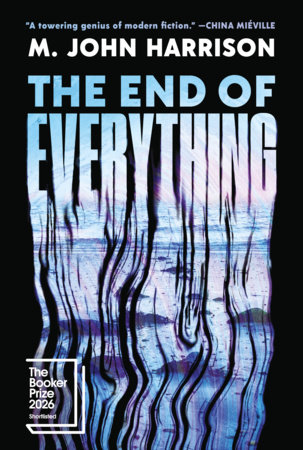
The End of Everything
After a crisis leaves government barely functioning and the Channel full of unfamiliar creatures, beachcomber Phillip Tennent finds a changing artefact on the shore.
About
Spoiler notice: Spoilers for the premise and early character setup, including Phillip’s changing artefact and Marnie’s departure after a violent encounter. Later developments and the ending are not summarized.
M. John Harrison places The End of Everything on England’s east coast after a crisis that has transformed daily life without leaving a settled account of what happened. The novel’s official description gives a few stark measures of the change: government barely functions, unfamiliar creatures fill the seas, and Europe has been mislaid. The setting is recognizable in outline yet no longer dependable. In the Booker guide, Harrison says the east-coast art towns supplied the setting, while current affairs supplied the themes and satire. That combination brings political unease into a landscape of beaches, settlements and former industrial places. The catastrophe is not a puzzle the narrative promises to solve. Instead, uncertainty becomes part of the conditions in which people work, travel, remember and try to make ordinary decisions. The result is a speculative world whose strangeness grows from details that remain close to the present.
Phillip Tennent makes his living by collecting objects washed ashore from the Channel. His beachcombing is an occupation with its own local economy: some scavengers take whatever they can carry and sell it inland, while Phillip waits for a find that seems worth more attention. When he discovers an unusual artefact, he sees the possibility of value and takes it away from the tideline. The object does not remain a stable object. It grows, changes form and begins to imitate human behaviour, making its nature harder to describe even as Phillip tries to understand it and find a buyer. This practical motive keeps the fantastic element tied to work and exchange. Phillip is not introduced as a scientist equipped to classify the discovery; he is a person trying to decide what he has found and what use, if any, it might have. His journey inland turns a piece of beachcombing into an encounter with the limits of interpretation.
The artefact draws Phillip toward Marnie, his seventy-year-old aunt and a former artist. Their relationship links the present crisis to a shared family past, while placing two different kinds of vulnerability beside each other. Marnie has lived through changes in the coastal community and retains memories of earlier social structures; the Booker guide describes her as self-reliant, but also capable of sudden violence. After she kills a teenage boy, she leaves home and heads toward London. Her journey develops alongside Phillip’s attempt to make sense of the artefact, so the novel’s movement is carried by human choices as well as by an unexplained phenomenon. Marnie is not simply a guide to Phillip’s history, and Phillip is not simply a carrier for the strange object. Their separate encounters with a damaged society make the family connection a way to examine how people act when familiar expectations have weakened.
The catastrophe’s origins remain unsettled even as its effects become visible. The Booker guide identifies the iGhetti as one focus of speculation: people propose explanations ranging from the internet and dark matter to a banking crisis or an astral plane. Their arrival is associated with a military response and shifts in the British establishment, but no single account contains the whole event. At the coast, people scavenge, form provisional alliances and disagree about what has happened. Against this larger uncertainty, Phillip’s artefact offers a more intimate version of the same problem. It changes and communicates, yet its resemblance to human behaviour does not make its intentions clear. The parallel gives the novel two scales of unknowability: a society trying to interpret a collective disaster, and an individual trying to understand a being encountered at close range. Explanation remains tempting because people must act, though certainty does not arrive in time to make action easy.
The book’s form reinforces that unsettled view. The Booker guide notes that its chapters are often only a page or so long and move rapidly between characters and moments. Its third-person narration shifts attention from Phillip toward Marnie, while names and descriptions can change without much warning. This construction asks readers to join scenes and infer their significance instead of relying on a continuous explanation. It also changes how information feels: what might be a stable label in a more conventional adventure becomes provisional, like the people’s accounts of the world around them. The artefact itself is described in contradictory ways as it develops, so language participates in the uncertainty rather than standing outside it. Harrison’s use of speculative material consequently does not settle into a single genre contract. The work can be approached as post-apocalyptic fiction or science fiction, while its shifting narrative also resists a neat classification as one kind of adventure.
The coastal setting gives these formal and speculative choices a specific history. The Booker guide describes a stretch once shaped by fishing and shipbuilding, where some former industrial sites have become museums or expensive flats. Its discussion of place and memory connects the disappearing world of the crisis with the way the past is interpreted and repackaged. Harrison’s stated interest is not only what happens when explanations fail, but how people continue to make a life under those conditions. That question reaches from the artefact’s uncertain status to Marnie and Phillip’s altered surroundings. The novel also touches anxieties about artificial intelligence, economic and environmental breakdown, Brexit and the fragility of institutions, without presenting one of them as a master key. Its satire emerges from the mismatch between the scale of disaster and the improvised routines that persist within it. What remains human here is not a confident command of events, but the ongoing effort to interpret, relate and act when the world offers no reliable account of itself.
Book details
- Author
- M. John Harrison
- First published
- 2026
- Series
- No series listed
- Subgenre
- Post-apocalyptic, Experimental fiction, Literary fiction
- Primary genre
- Sci-Fi, Literary Fiction
- Tags
- No tags for this book.
Review
Editor profile
Baby Bat
Goodreads and social links will be added soon.
- Goodreads — link coming soon
- Social media — link coming soon