
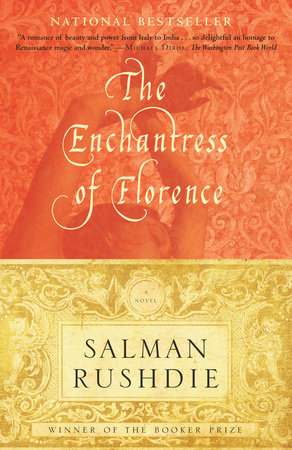
The Enchantress of Florence
A stranger arrives at the court of Mughal emperor Akbar at Fatehpur Sikri and claims a connection to the ruler’s family.
About
Spoiler notice: Spoilers cover the premise, the stranger’s claim and the novel’s principal settings and historical figures; later revelations and the ending are not disclosed.
The Enchantress of Florence brings two powerful Renaissance worlds into a deliberately unstable conversation. At the Mughal court of Akbar, a stranger appears with a story that reaches toward the emperor’s family and a woman remembered for beauty and enchantment. The other pole is Florence, where Niccolò Machiavelli belongs to a city of civic rivalry, art, and arguments about how power works. The novel does not present these settings as a straightforward historical comparison. Instead, a chain of stories carries people and ideas between them, so the reader repeatedly has to ask who is speaking, what a tale can establish, and how much of an identity can rest on what others say about it.
Akbar is a historical emperor, but the Akbar who thinks and debates in Rushdie’s novel is also a literary creation. The publisher’s description places questions of belief and desire at his court; the author, in a contemporary interview, explains that he imagined Akbar thinking about the existence of God and the human capacity to form ethical rules. That imaginative Akbar gives the book a center for philosophical inquiry without turning it into a historical biography. His authority is immense, yet the stories brought before him make knowledge uncertain. Listening becomes a political act: the emperor must decide how to interpret what he hears, while the teller’s account may alter the shape of the court’s reality.
The stranger’s narrative opens out toward Qara Köz, the woman at the heart of the book’s title and its movement across continents. The historical record does not supply a complete life for her; Rushdie has described combining a story about a lost Mughal princess with a motif from Ludovico Ariosto’s Renaissance poem Orlando furioso, in which an Indian princess arrives in Europe. From that meeting of fragments the novel builds a fictional journey. Qara Köz should therefore be understood as an imagined character, not as a documented historical person whose adventures the novel simply recovers. Her beauty and apparent power attract stories, but the book’s interest lies partly in how those stories can make a woman visible while also turning her into an object of other people’s desire and explanation.
Florence supplies a second stage for thinking about who controls a story. Machiavelli appears as a character within a city marked by political calculation and the Medici family’s influence. Rushdie’s interview distinguishes the real historical record from his inventions: even figures who existed had to be imagined as people, and many people in the novel never existed at all. That distinction helps keep the book’s historical texture in view without treating its scenes as evidence about private lives. The Florentine material is not a detached parallel to Akbar’s court, either. The two places echo one another in their ambitions, appetites, and assumptions about authority, while remaining different societies with their own histories and forms of power.
The book’s structure is shaped by narration nested inside narration. A stranger tells Akbar a story; that story reaches back through other lives and places, and each layer changes what the previous one seems to mean. Rushdie told his interviewer that he wanted a fictional device capable of bringing Mughal India and Medici Florence together, even though the worlds had little direct contact in this period. The device makes travel imaginative as well as geographical. A tale can cross distances that historical records leave empty, but it also exposes the teller’s purpose and the listener’s appetite. The reader is asked to notice how narrative can preserve a trace, embroider a gap, or persuade an audience to treat possibility as truth.
Enchantment in this novel is both a fantastic element and a way to examine persuasion. Rushdie has said that people in the late fifteenth and early sixteenth centuries believed in magic as readily as modern people trust other forms of expertise. That historical observation informs the book’s setting, while the novel’s wonders remain literary inventions. Power is exercised through courts, political alliances and the authority to tell a convincing account, but also through beauty, rumor and belief. The magical material does not erase the period’s political realities; it gives the book a language for the forces that shape what people accept as real. Its playful storytelling can shift rapidly from spectacle to questions about freedom, selfhood and the unequal terms on which a woman is remembered.
The result is a historical novel that treats history as a meeting place for evidence and invention. Mughal and Florentine details give the fantasy boundaries, while fictional characters and imagined conversations let Rushdie explore what the surviving record cannot answer. The book is especially interested in connections across cultures and in the ways individuals become stories for other people. Its many digressions and nested tales make it expansive in form, and its humor sits beside serious questions about belief, political power and a person’s command over her own identity. Readers looking for a tightly documented account of Akbar or Machiavelli should keep the novel’s fictional method in view; readers drawn to ornate storytelling will find that invention itself is one of its central subjects.
Book details
- Author
- Salman Rushdie
- First published
- 2008
- Series
- No series listed
- Subgenre
- Historical fiction, Magical realism
- Primary genre
- Literary Fiction, Historical Fiction
- Tags
- No tags for this book.
Review
Editor profile
Baby Bat
Goodreads and social links will be added soon.
- Goodreads — link coming soon
- Social media — link coming soon