
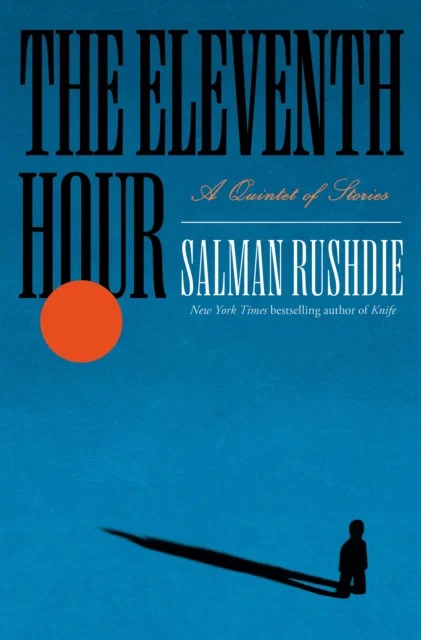
The Eleventh Hour
Across India, England and the United States, five stories consider age, death, memory and the stories people tell about their lives.
About
Spoiler notice: Spoilers for the setup and central premises of all five stories; no endings are revealed.
The Eleventh Hour: A Quintet of Stories gathers five pieces of fiction by Salman Rushdie, moving among India, England and the United States. The book is arranged as two shorter works around a middle group of three longer narratives: “In the South” opens the collection, followed by “The Musician of Kahani” and “Late,” then “Oklahoma,” and finally “The Old Man in the Piazza.” That sequence gives the book a deliberate frame. The first and last stories are shorter, while the central novellas allow their characters and questions more room to develop. The stories differ in scale and mode, from contemporary domestic life to ghost story and parable, but all look toward moments when age, loss or uncertainty changes how a life is understood.
“In the South” begins in southern India with two elderly neighbours, Junior and Senior, whose friendship is expressed through argument. They spend time on adjoining verandas, where small disputes and familiar routines give shape to their days. A sudden accident brings private bereavement into this contained setting, and the surviving man must reckon with a loss that makes death feel close to ordinary life. The story’s domestic scale matters: its large subject is approached through habit, banter and the fact of living beside another person. Rushdie sets the episode against a moment of national calamity, joining the neighbours’ personal story to a wider public emergency without turning their grief into a simple symbol.
The central novella “The Musician of Kahani” returns to the Mumbai neighbourhood associated with Rushdie’s earlier novel Midnight’s Children. Its protagonist, Chandni, is a gifted musician whose abilities emerge when she is still a child. After she marries into a wealthy academic family, her musical gifts and the power around them become entangled with family conflict. The publisher describes her as using magical gifts to bring devastation on the household she joins. The story therefore combines a family saga with the collection’s most overtly fantastical premise: talent is not simply a route to recognition, and wealth does not protect a family from the consequences of its own behaviour. The tale’s longer form lets domestic alliances, ambition and supernatural possibility build together.
“Late” shifts from Mumbai to Cambridge and turns the collection toward the afterlife. Rosa, a student from India, encounters the ghost of a Cambridge academic, a celebrated older man whose reputation conceals unresolved history. He asks for her help in pursuing revenge against a lifelong tormentor. The story begins from the recognizable relationship between a young scholar and a powerful academic, then changes its terms by making the older figure dead and the student able to communicate with him. That premise permits questions about what institutions remember, whose accounts of the past gain authority and whether a person’s legacy can be separated from the harm buried beneath it. The supernatural element makes the past active in the present rather than safely concluded.
In “Oklahoma,” the setting is literary and American: a young writer tries to understand the strange disappearance of his mentor, an older novelist. He is left to consider whether the man died by suicide or staged his death, while his investigation opens a web of deception and uncertainty. Rushdie draws on Kafka’s unfinished Amerika as an imaginative point of departure, and the story uses a writer’s search to ask how fiction shapes what people believe about a life. The title invokes Kafka’s imagined destination, not a claim that the plot recounts the real state or a literal journey there. The mentor relationship also brings influence into view: the younger writer is trying to distinguish his own story from the one his admired predecessor may have written for him.
The closing story, “The Old Man in the Piazza,” is a parable about public speech and the uses of authority. At its centre is an elderly man whose apparent wisdom makes him a focal point in a shared public space. The piazza gives the story a different kind of setting from the private verandas, households and university rooms earlier in the book: it is a place where people encounter one another and where language can shape a community. The publisher frames the story around freedom of speech. Its position at the end turns that civic concern into a closing question about what happens when words are ignored, appropriated or made to fail. The piece does not resolve the collection into a single moral; it leaves the reader with the vulnerability of communication itself.
Taken together, the stories approach mortality from several angles. In “In the South,” it enters the ordinary rhythm of a friendship; in “Late,” death makes a voice persist beyond life; in “The Musician of Kahani,” extraordinary talent is bound to family power; and “Oklahoma” makes the truth of a death difficult to settle. The final parable widens the focus from individual endings to the condition of public language. This movement helps explain the title’s sense of an eleventh hour: the phrase suggests a point of urgency near an ending, yet the book keeps asking what a person can still do, understand or say at such a moment. Its five stories remain distinct in setting and form while conversing about memory, legacy, invention and the uncertain boundary between an ending and what follows.
Book details
- Author
- Salman Rushdie
- First published
- 2025
- Series
- No series listed
- Subgenre
- Literary fiction
- Primary genre
- Literary Fiction
- Tags
- No tags for this book.
Review
Editor profile
Baby Bat
Goodreads and social links will be added soon.
- Goodreads — link coming soon
- Social media — link coming soon