
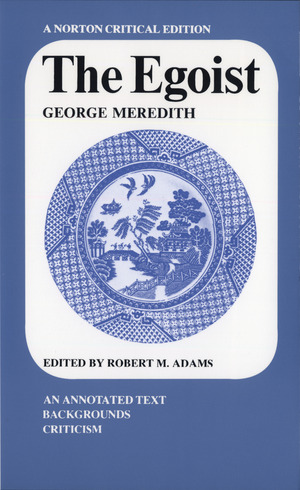
The Egoist
Sir Willoughby Patterne expects marriage to confirm the admiration he already enjoys.
About
Spoiler notice: Full-plot spoilers, including Clara’s release, Laetitia’s acceptance and the closing image of Clara and Vernon.
Sir Willoughby Patterne has a title, an estate and a neighbourhood accustomed to admiring him. The prospect of his marriage consequently attracts attention well beyond his own household. George Meredith’s The Egoist, first published in 1879, examines what happens when a man trained to expect admiration tries to make marriage an arrangement that will preserve it permanently. An earlier engagement to Constantia Durham has already ended badly for his pride. Clara Middleton now appears to offer another chance at the union he wants. Her presence at Patterne Hall brings the question out of congratulatory public talk and into daily conversation, where the assurances he expects become much more demanding than the ordinary promise to marry somebody.
Clara begins to see a difference between loving Willoughby and supplying the picture of love in which he wants to live. He asks for a devotion that will protect him against humiliation, rivalry and the possibility of being judged differently. Her pledge does not make her comfortable with everything he wishes to extract from it. The difficulty becomes more serious as she understands her own changed feelings. She wants release from the engagement, while he regards her withdrawal as an injury done to him. Wealth and politeness do not make that disagreement easy to state or settle. The man who can be generous when his position is secure becomes far less accommodating when another person’s choice threatens the flattering account of himself.
Clara turns to her father for help, but his presence at the Hall does not immediately provide a way out. Dr Middleton belongs to a world of learning and conversation, and the house offers pleasures that can distract him from the urgency of his daughter’s position. Around them are relatives, visitors and friends capable of commenting on the proposed marriage without having to bear its consequences. Colonel De Craye adds another possible attachment to the crowded situation, while Vernon Whitford offers a very different kind of company. Vernon is a scholar who has to work for his livelihood. His conduct matters to Clara partly because he does not simply convert her distress into an opportunity to press his own feelings upon her.
Laetitia Dale also knows what it means to live near Willoughby’s expectations. She once admired him romantically, and his habit of returning to her appreciation has depended on treating it as something he can recover when needed. Time has altered her judgement. Her later conversation with Clara helps the younger woman recognise her attachment to Vernon, but it is also an exchange between people who understand the cost of mistaking another person’s wishes for their own duty. Clara has imagined accepting almost any help that might release her, and is ashamed of what such desperation could have made her do. The prospect of Vernon’s love brings happiness together with the need to look honestly at the choices she has been considering.
The young relative Crossjay makes the household’s control over other people’s futures especially concrete. His education and prospects are matters on which adults can confer, while his immediate comfort depends on how they treat him. Clara wants proper provision for him, and Vernon becomes the person prepared to take responsibility when the boy displeases Willoughby. A disclosure that injures the master’s pride leads to Crossjay’s expulsion, exposing the fragility of belonging by favour. Laetitia later makes his welfare part of her response to Willoughby’s renewed attention. Her demand that her home must also be Crossjay’s home requires a practical concession from a man who finds it easier to describe generosity than to forgive somebody who has embarrassed him.
As the engagement to Clara ends, Willoughby persists in asking Laetitia to marry him. She tells him plainly that her old romantic feeling is gone, that she sees his faults and that she would be accepting material security rather than offering worship. She repeats those warnings before the ladies of his family so that her meaning cannot be dismissed as a private misunderstanding. Willoughby still wants her, and she obtains his promise to forgive Crossjay and provide for his education. Her eventual acceptance is expressed as submission under exhaustion, with a pledge to do her duty and no concealment about what she thinks. His answer treats her as his possession. The agreement does not suddenly make their two accounts of the marriage identical.
Clara leaves the Hall with her father, exchanging an affectionate farewell with Laetitia and a courteous one with Willoughby. De Craye’s hopes for sharing their future travels have been disappointed, leaving him to recover his manner in Mrs Mountstuart’s company. Preparations for Willoughby’s wedding restore something of his public splendour, while the closing image turns elsewhere, to two lovers meeting near the Lake of Constance between the Swiss and Tyrolean Alps. Clara and Vernon’s understanding has developed without a wedding ceremony being narrated, and Laetitia’s marriage likewise remains in preparation at the close. Meredith’s final return to the Comic Muse keeps both outcomes in view: an escape towards a freely chosen attachment, and a household rearranging itself around a man whose self-regard has survived the disruption.
Book details
- Author
- George Meredith
- First published
- 1879
- Series
- No series listed
- Subgenre
- Literary fiction, Modern classics
- Primary genre
- Literary Fiction
- Tags
- No tags for this book.
Review
Editor profile
Baby Bat
Goodreads and social links will be added soon.
- Goodreads — link coming soon
- Social media — link coming soon