
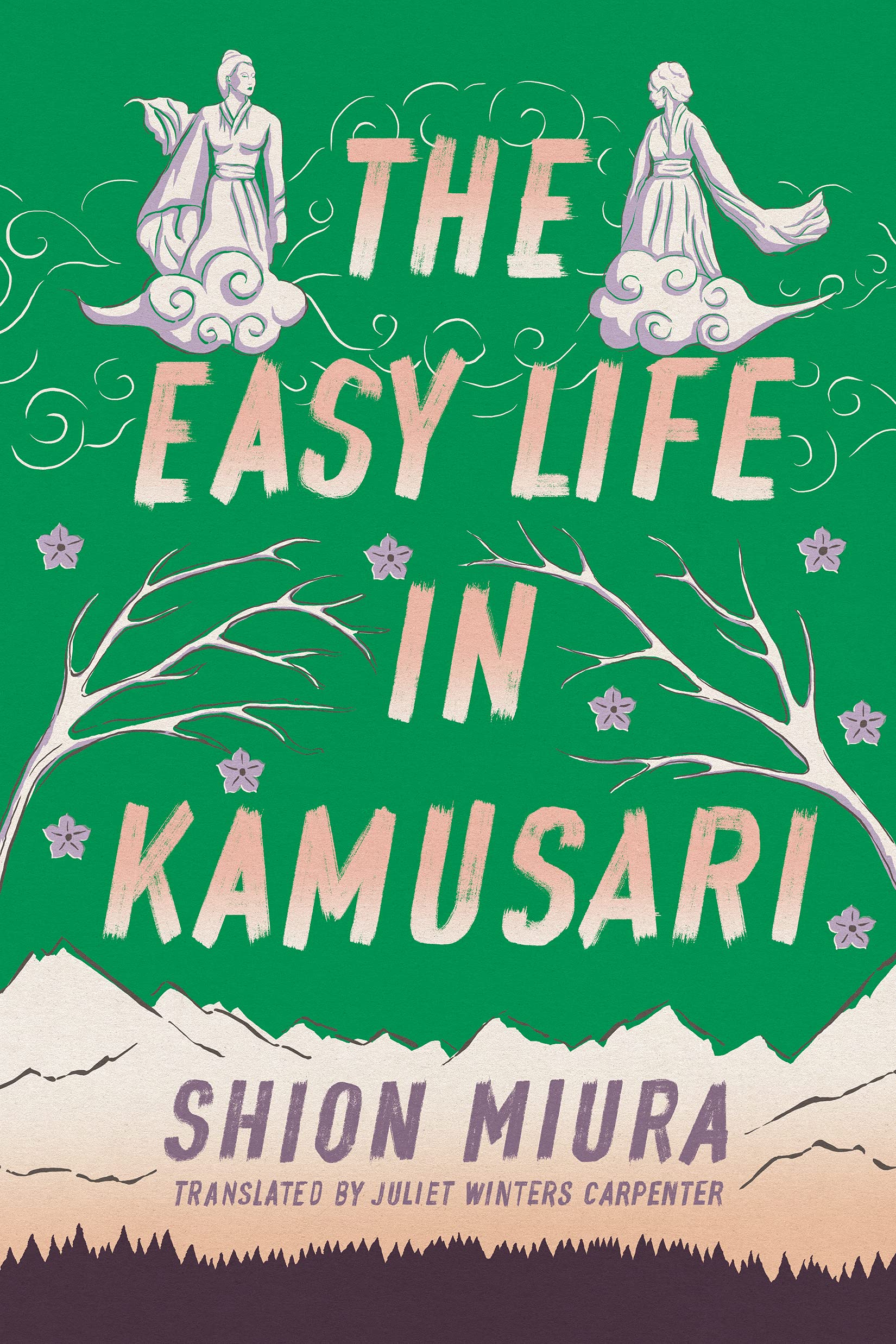
The Easy Life in Kamusari
After graduating from high school in Yokohama, Yuki Hirano is sent to the mountain village of Kamusari for a year of forestry training.
About
Spoiler notice: Major plot spoilers below, including Yuki’s changing relationship with forestry work and his participation in Kamusari’s climactic fiftieth-anniversary festival.
The Easy Life in Kamusari opens with a decision Yuki Hirano has not made for himself. After finishing high school in Yokohama, the eighteen-year-old is sent by his parents to a forestry training program in Kamusari, a remote village in the mountains of Mie Prefecture. The move replaces a familiar city routine with a small community and work he has never chosen. He arrives without the phone and conveniences that would keep him connected to home, and the distance makes his first response plain: he wants to leave. The book begins from that resistance rather than from an instant discovery that rural life is better. Yuki has to live through the gap between what he expected after school and the year his parents have arranged for him.
The forestry work makes that gap physical. Yuki has to handle tools, learn unfamiliar tasks and accept that enthusiasm cannot substitute for skill. His early efforts are clumsy, and the work leaves him with cuts, bruises and a wounded sense of competence. A chainsaw, a senior worker’s rough treatment, mites and leeches add to the obstacles he faces. These incidents place the coming-of-age story in the body: training means sore muscles, insects, danger and repeated instruction, not just a change of scenery. Yuki’s frustration is understandable, but it does not make the villagers responsible for making the work easy. He has to decide whether he can keep learning inside conditions he would never have selected.
Kamusari gives the novel a second kind of education. The community’s easygoing manner and its habit of saying “take it easy” contrast with Yuki’s impatience to get through the year and return to Yokohama. That phrase does not erase the demands of forestry. It describes a local pace and an attitude he cannot understand from outside. As Yuki spends time with the people around him, he encounters practical knowledge, local festivals and stories associated with the mountain. The village is not simply a refuge from modern life: its customs shape work, relationships and the way residents understand the place where they live. Yuki has to pay attention before any of those details can mean more to him than proof that he is far from home.
The forest is both workplace and presence in the story. Yuki learns to fell trees and plant saplings, activities that connect a single job to the longer life of a woodland. He gradually comes to respect the forest on Mount Kamusari, including its scale, traditions and mysteries. That development is not the same as treating nature as a decorative cure for city boredom. The trees make demands on the people who work among them, while the training shows that using timber and caring for a forest are linked responsibilities. The book’s attention to the cycle of cutting and replanting also gives Yuki a way to measure time differently: a task can belong to a community and landscape that extend beyond one young worker’s immediate plans.
Yuki’s feelings for Nao, a schoolteacher in the area, give his interest in staying a more personal edge. The attraction does not make him an accomplished forester, and it cannot replace the work required to become one. Instead, it sits alongside the practical challenge of learning a trade and finding a place in a community that already has its own history. The novel connects his romantic hopes to the life he is trying to enter, while keeping the difference between wanting someone and understanding their world in view. As he grows more capable, his feelings become part of a larger question: what kind of person could he become if he stopped treating Kamusari as an interruption and began taking its people and responsibilities seriously?
The village’s traditions gather into the story’s major public undertaking, the Oyamazumi-san festival, held every fifty years. Yuki becomes part of the group assigned to cut a very large tree high on Mount Kamusari and guide it down toward the river. The task puts his training, the coordination of the workers and the community’s inherited practice into one event. A festival can be celebratory, but this one also depends on dangerous labour and people trusting one another to carry it out. Yuki is no longer only an outsider watching local customs. His work has a place in an effort whose meaning is shared by Kamusari’s residents and whose scale makes individual confidence insufficient. The climax brings together the novel’s concerns with skill, belonging and the forest without turning them into separate lessons.
Told through Yuki’s first-person perspective, the novel lets his understanding change at the same time as his circumstances. Kamusari does not have to become an ideal village for him to find value there, and the story does not suggest that every young person should exchange city life for forestry. Its focus is narrower: a resistant teenager encounters unfamiliar work, people and traditions, then begins to see relationships among them that were invisible to him at first. The English title frames this as an “easy life,” but the year is full of effort and uncertainty. The ease lies in the village’s manner, not in an absence of hardship. That distinction gives the book’s movement from rejection toward participation its shape, while the mountain remains more than a backdrop for Yuki’s personal change.
Book details
- Author
- Shion Miura
- First published
- 2009
- Series
- Forest, book 1
- Subgenre
- Coming-of-age, Translated literary fiction
- Primary genre
- Literary Fiction
- Tags
- No tags for this book.
- Reading order
- This is the only Forest title on the shelf right now.
Review
Editor profile
Baby Bat
Goodreads and social links will be added soon.
- Goodreads — link coming soon
- Social media — link coming soon