
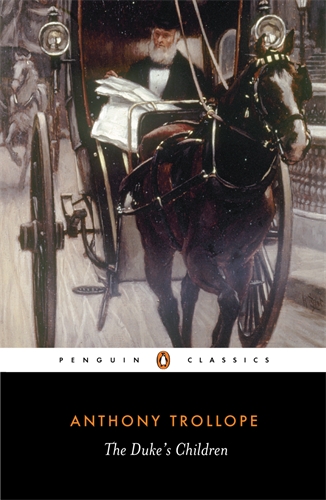
The Duke's Children
After Lady Glencora’s death, the Duke of Omnium struggles to guide three children whose hopes differ sharply from his own.
About
Spoiler notice: Full-plot spoilers for the original published version, including Silverbridge’s marriage and the Duke’s consent to Mary and Tregear’s wedding.
In the original 1880 version of The Duke’s Children, Plantagenet Palliser faces a family crisis for which his experience of public office has not prepared him. Lady Glencora has died, leaving the former Prime Minister to understand three young people whose wishes do not follow his plans. He has money, rank and a strong sense of duty, but none gives him a comfortable way to express affection or obtain the confidence he needs. Lord Silverbridge, Lord Gerald and Lady Mary must deal with his grief while trying to establish lives of their own. Trollope brings the Palliser family’s public importance into an intimate setting, where the preservation of an inheritance is inseparable from the question of how a parent should live with children he cannot simply command.
Mary’s attachment to Frank Tregear creates the most persistent conflict. Tregear is Silverbridge’s friend and a younger son with limited means, making him an unacceptable match in the Duke’s eyes. For Mary, the relationship is already a commitment, not a passing preference she can discard when told that her choice is unsuitable. Mrs Finn’s knowledge of it places her in a difficult position between the daughter’s confidence and the father’s right to be told. Her intervention makes it impossible for the engagement to remain an entirely private understanding. Yet bringing it into the open does not make the Duke’s objections easier for Mary to answer. Father and daughter have to live alongside a disagreement in which the same prospect appears to one as happiness and to the other as misfortune.
Silverbridge challenges his father through politics as well as his personal conduct. The Duke expects an heir of his family to recognise the weight of its Liberal tradition, while Silverbridge announces himself a Conservative. His inability to support that position with the kind of study his father respects does not make him willing to surrender it. The argument reveals their different ideas of independence: the father sees an obligation to weigh experience and inherited responsibility, while the son resists being told that his opinion must become someone else’s. Their exchanges make public allegiance part of the family’s emotional language. A political choice can feel like rejection when the person hearing it has devoted much of his life to the cause being set aside.
Money supplies other occasions for painful communication. Silverbridge’s involvement in racing with Major Tifto brings serious losses and doubts about the people with whom he has chosen to associate. Gerald’s card-playing creates a separate crisis, which he first tries to resolve through his brother rather than tell their father. His letter admits a debt of £3,400 and describes how a game he expected to keep within modest limits became something he could not control. He imagines possible help from the family’s arrangements or from lenders, revealing how little the possession of an impressive name has taught him about the consequences of borrowing against it. The brothers’ mistakes expose the limits of treating future wealth as though it were already available for every immediate wish.
Silverbridge’s courtship of Isabel Boncassen asks the Duke to reconsider another set of inherited expectations. Isabel’s American background places her outside the marriage he would naturally have imagined for his heir, and the son’s changing affections have also involved Lady Mabel Grex. Accepting Isabel therefore requires more than choosing an agreeable guest for the household. The Duke must recognise a relationship as his son’s future even when it has not been formed according to his own preferences. His eventual welcome becomes concrete through a ring: the first present he gave his wife is placed on Isabel’s finger. The gift joins the new marriage to a memory he regards as sacred, making room for a daughter-in-law without pretending that the loss of Glencora has ceased to matter.
His resistance to Tregear is slower to yield. Mrs Finn’s appeal and the circumstances surrounding Tregear’s hunting accident enter a change that cannot be reduced to one successful argument. The Duke’s need for Mary’s affection becomes increasingly difficult to reconcile with the sternness he believes his duty requires. When she embraces him in the carriage, he can enjoy the closeness without yet agreeing that the marriage should take place. This separation between tenderness and permission gives their conflict its persistence: he does not have to stop loving her to oppose her wishes, and she does not have to stop loving him to remain firm. His eventual consent means accepting that protecting his daughter cannot require the permanent denial of the future she has chosen.
The published ending gives the family two weddings with different kinds of display. Silverbridge and Isabel’s marriage is followed by a visit to America, while Mary waits for her brother’s return before marrying Tregear at Matching in November. Her ceremony is smaller, with family, neighbours and the Finns present, and the Duke leads her to the church. His apparent good spirits coexist with the memory of what reaching this point has cost him. Afterwards, speaking with Silverbridge, he admits that he can now regard Tregear’s boldness as courage rather than arrogance. The changed judgment does not erase the differences that produced their quarrel. It shows the father finding a way to recognise worth within choices he had previously understood chiefly as challenges to his authority.
Book details
- Author
- Anthony Trollope
- First published
- 1880
- Series
- No series listed
- Subgenre
- Literary fiction, Modern classics
- Primary genre
- Literary Fiction
- Tags
- No tags for this book.
Review
Editor profile
Baby Bat
Goodreads and social links will be added soon.
- Goodreads — link coming soon
- Social media — link coming soon