
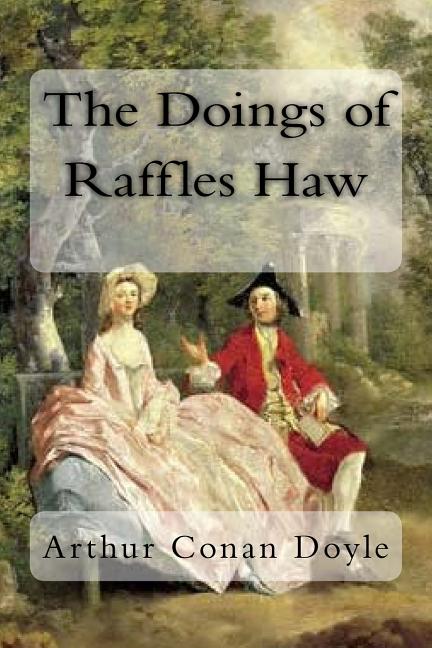
The Doings of Raffles Haw
After their father's financial collapse, Robert and Laura McIntyre live modestly in Tamfield, where Laura is engaged to sailor Hector Spurling.
About
Spoiler notice: This overview discusses Haw’s discovery, Laura’s engagements, his death and the surviving characters’ later lives.
The McIntyres begin The Doings of Raffles Haw in reduced circumstances, with a snowstorm outside and the consequences of their father's financial failure inside the home. Robert paints, Laura waits for her sailor fiancé Hector Spurling, and their father's increasingly troubled behaviour makes money a source of anxiety rather than security. The arrival of a fabulously wealthy neighbour therefore enters a household already primed to notice what wealth might change. Raffles Haw's newly built New Hall becomes an object of curiosity, promising splendour on a scale the surrounding community cannot easily explain. Doyle introduces the mystery through ordinary expectations about comfort, courtship and status before revealing the extraordinary means by which the new owner can satisfy them.
Robert meets Haw without recognising him, taking the plainly dressed stranger for a workman. Their conversation gives Robert an opportunity to say that making art matters more to him than possessing a fortune, and Haw values the apparent candour of someone who does not know whom he is addressing. The revelation at the gates of New Hall reverses the encounter: the supposed workman is its master, with resources and comforts that astonish his visitor. Haw's reserve has a practical reason. Money makes it difficult to know whether people like him or what he can supply. Robert seems to offer companionship outside that calculation, and the friendship begins with the possibility that a rich man might be trusted without being pursued for his riches.
Haw is already thinking about how to spend responsibly. He wants his money circulating through useful activity, yet fears that indiscriminate gifts will create dependence or do damage he cannot foresee. Robert and the local vicar become people from whom he seeks advice, making their judgment part of the experiment. New Hall's marvels show the pleasure wealth can purchase, while local assistance raises harder questions about its effect on other lives. The story gives Haw a desire to help before testing whether that desire is sufficient. He can relieve an immediate difficulty without knowing what habits or expectations will follow the relief. His fortune removes the ordinary limit on giving, but leaves him dependent on imperfect knowledge of the recipients.
The explanation for that fortune moves the book into science fantasy. Haw shows Robert an electrical and chemical process that transforms lead through other metals into gold, then demonstrates further transformations until the material becomes grey dust. These are the novel's imagined workings of alchemy, rather than a real chemical method. Their narrative purpose is to place extraordinary power in the hands of someone trying to decide how it should be used. Robert sees enough to understand the scale of the discovery, but one essential link remains withheld. Written instructions are reserved in a case, making access to the secret a possible future inheritance. Trust now involves something far more consequential than entry to a luxurious house.
As Haw's assistance spreads, the possibility of doing good becomes harder to separate from the possibility of changing people for the worse. He sees financial rescue and gifts altering expectations, and begins doubting the larger schemes he has discussed with Robert. The vicar's warnings bring those concerns back to particular lives rather than allowing good intentions to remain an abstract defence. The McIntyres also cease to stand outside the influence of the fortune they once regarded with curiosity. Robert's first declaration of artistic independence becomes a measure against which his later desires can be judged. Haw's experiment consequently tests the advisers as well as the giver, asking what survives of a person's stated values when wealth seems available without a fixed limit.
Laura appears to offer Haw an affection that he can trust, but Hector's unexpected return exposes the engagement she has failed to end. The two men discover that they have been given incompatible understandings of her intentions. Haw withdraws in distress, and that disappointment joins his accumulating fear that his money has corrupted rather than improved the lives around him. During the day he carries valuables into the laboratory and destroys his apparatus and accumulated treasure. When the locked room is opened, he is found dead amid the wreckage. A note tells Robert that the secret will never be used again and directs what remains to charity. It records pain and an intended departure; the narrative does not establish suicide as the explanation for his death.
The ending follows the consequences beyond that discovery. New Hall's remaining treasures are sold, helping people who had never benefited from Haw during his life, and the house becomes a hydropathic establishment. Robert abandons art for a futile attempt to recover the missing scientific link, spending his small income on experiments. His father remains confined and obsessed with imaginary gold. Laura keeps house for Robert, dissatisfied but increasingly involved in charitable work; village gossip suggests a possible attachment to a curate without narrating a marriage. Hector continues his naval career and postpones marrying. These different outcomes prevent the destruction of the laboratory from neatly ending its influence. Haw's attempt to erase the power has not restored the people who came within its reach to their earlier lives.
Book details
- Author
- Arthur Conan Doyle
- First published
- 1891
- Series
- No series listed
- Subgenre
- Science fantasy, Classic science fiction
- Tags
- No tags for this book.
Review
Editor profile
Baby Bat
Goodreads and social links will be added soon.
- Goodreads — link coming soon
- Social media — link coming soon