
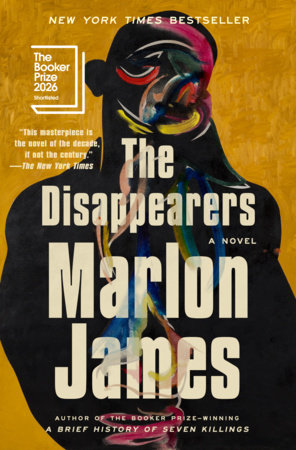
The Disappearers
In 1988 Kingston, eight gay men begin rehearsing a play in a society hostile to their lives.
About
Spoiler notice: Spoilers for the premise and early setup, including the assault on the actors and its immediate aftermath. Later developments and the ending are not summarized.
The Disappearers begins in Kingston in 1988, where eight men meet through rehearsals for a play. They do not arrive as a ready-made community: they have different backgrounds and reasons for taking part, but share the fact that they are gay in a society where that identity can expose them to danger. James builds the novel around this tension between the ordinary work of making a performance and the risk of being seen. The rehearsal room offers a temporary place to gather, while the world beyond it presses its own rules about masculinity, family, respectability and public life. Kingston is more than a backdrop. Its social divisions and local language shape what the characters can say, whom they can trust and which forms of belonging remain possible.
One of the novel’s early narrators is Edmond ‘Eddy’ Porteous, a Belgian Jamaican college student from a well-off family. His diary entries lead into the assault that changes the course of the story. They cover the month before the attack, so readers first meet the group through a perspective that cannot anticipate what is coming. Eddy is not present when it happens, and his distance does not spare him from its consequences: he has to reckon with survivor’s guilt and with the knowledge that violence has reached people connected to him. The diary form gives his section a personal scale. Rather than beginning with a broad account of Jamaican history, the novel lets a young man notice other people through desire, uncertainty, class assumptions and the details of everyday conversation. That limited view matters because it makes room for what Eddy understands and for what his position leaves him unable to see.
The attack kills one of the actors and leaves the survivors to recover physically and emotionally. The novel follows the differing ways they respond to what has happened: some want to push it aside, while others turn toward retribution. James is concerned with the aftermath as much as the event itself. Grief, anger and fear do not resolve neatly into a single shared response, even among people bound by the same threat. That divergence also complicates the language of solidarity. A group can be brought together by danger without agreeing about what justice should mean or how much risk anyone can bear. The book’s crime-story movement grows from this unsettled situation, as a survivor sets out to discover what became of the others and the original violence opens into a wider reckoning.
Jordan Brown becomes central to that search. A fellow actor, he teams up with Eddy to find the attackers and draws him into parts of Jamaica that lie beyond the sheltered world Eddy knows. Jordan is a forceful, profane presence and an obsessive reader of John Rechy’s The Sexual Outlaw, a book he turns to in search of validation. Reading is not decorative here: the books characters carry help them name desire, measure themselves against a tradition and imagine forms of life their surroundings may deny. The novel also engages Toni Morrison’s Song of Solomon through its treatment of revenge and collective violence. These references place the characters’ questions within a queer and Black literary inheritance, while leaving the ethical problem in the present tense: what can retaliation repair, and what might it reproduce?
The narrative reaches backward as well as outward. Havelock Titus, the play’s director, is followed to his years at Oxford, where class and sexual power shaped his experience, and into the early years of the AIDS crisis. His memories add another generation and another geography to the book’s portrait of gay life. They show how the pressures surrounding the Kingston actors have histories, even as those histories take different forms in different places. Titus also carries shame about fleeing the doomed rehearsal, joining private memory to the public event. Other figures reveal further kinds of vulnerability, including the risks created when help comes from people with power over those in crisis. The novel’s account of community therefore includes care, exploitation, obligation and distrust, not just mutual recognition.
James moves among diaries, recollections, changing viewpoints and other narrative modes, allowing voices to disagree and correct one another. The Booker guide describes a sweep from 1950s England to AIDS-era Kingston in the 1980s and 1990s and the United States in the 2000s. Across those shifts, disappearance means more than physically vanishing: it can describe the concealment demanded by stigma, the choice to retreat, or the erasure of people from public memory. The play at the novel’s centre makes performance a useful counterpoint, since acting involves taking up a visible role while the surrounding culture may punish that visibility. Humor and sexual frankness sit alongside grief and violence, reflecting the varied ways characters speak and survive. The result is a novel about who gets to tell a story, who is believed, and what remains when a life has been pushed out of view.
Book details
- Author
- Marlon James
- First published
- 2026
- Series
- No series listed
- Subgenre
- Literary fiction, Crime thriller
- Primary genre
- Literary Fiction, Mystery & Thriller
- Tags
- No tags for this book.
Review
Editor profile
Baby Bat
Goodreads and social links will be added soon.
- Goodreads — link coming soon
- Social media — link coming soon