
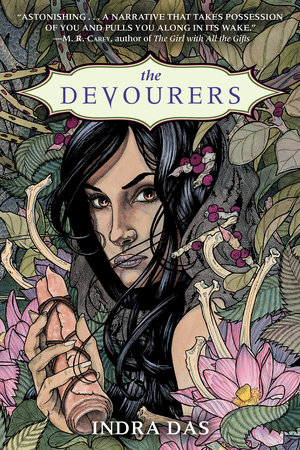
The Devourers
In present-day Kolkata, divorced history professor Alok Mukherjee meets a stranger who claims to be a werewolf and agrees to transcribe the records of his story.
About
Spoiler notice: Spoilers for the publisher- and author-described premise, including Alok's encounter with the stranger and Cyrah's meeting with a shape-shifter. This account does not cover the full novel or its ending.
The Devourers uses two moments in India to build one account of people who are not quite human. In present-day Kolkata, history professor Alok Mukherjee meets a stranger who claims to be a werewolf and offers an account that reaches back centuries. In seventeenth-century Mughal India, a wanderer called Cyrah meets a man who describes himself as a monster. These are not separate plot summaries placed side by side: Alok becomes the listener and transcriber of the older story, and the act of recording it brings the two narrative periods into contact. Indra Das makes the passing of a tale part of the novel’s action, so questions of what is true and who is telling it matter from the outset.
The present-day thread begins with Alok in a private, unsettled position. The publisher describes him as alone after a divorce and drawn toward the stranger, even as he cannot decide whether the man is deluded, deceptive or genuinely uncanny. That uncertainty gives the frame a personal stake: Alok is not simply collecting an unusual historical document. He wants the unfinished story badly enough to accept the stranger’s terms and handle the materials that contain it. The relationship between listener and storyteller therefore becomes a source of tension in its own right. As the account continues, the stranger’s presence grows more urgent for Alok, linking narration to desire, trust and the limits of what one person can know about another.
The older story moves to a caravanserai in seventeenth-century Mumtazabad, near the Taj Mahal, where the wandering Cyrah encounters a man who says he is a monster. The publisher’s descriptions emphasize her initial revulsion and dread, then the lasting effect of their meeting. The historical setting supplies more than a distant backdrop: it places these unusual lives within a specific Mughal-era landscape and social world. Das’s premise joins the recognisable and the fantastic without erasing either. A traveler seeks shelter and meets a stranger; the stranger’s account opens onto a hidden population of shape-shifters whose instincts, appetites and long histories complicate ordinary definitions of humanity.
The novel’s imagined beings are described as kin to beasts while also more than human, with second selves and instincts that reach across generations. They hunt people and live alongside human civilization, often beyond its notice. This mythology makes transformation physical and social: the characters inhabit human spaces, but their bodies and desires do not fit comfortably within human rules. The publisher presents their story through documents that Alok is asked to transcribe, including notebooks, parchments and skins. That choice turns the archive into a narrative device. The reader encounters a life through evidence handled by characters, and the materials suggest that memory, record and body are entangled rather than cleanly separated.
Cyrah’s connection with the stranger is described as a force that draws her into two clashing worlds. The public descriptions do not provide the complete course or resolution of that relationship, so its role is best understood at the level they establish: it makes the shape-shifter tale intimate as well as mythic. The novel is concerned with love and transformation, but its characters also act through appetite, fear and violence. The nonhuman premise does not remove familiar conflicts; it intensifies them by changing what bodies can do and what kinds of belonging are possible. The result, as framed by the publisher, is a story in which desire crosses boundaries while the consequences remain dangerous.
Formally, The Devourers is described as moving between the present and the past in a dreamlike way. The frame narrative, the embedded chronicle and the physical records Alok transcribes create several layers between event and reader. A story arrives through a stranger, then through documents, then through Alok’s attention to them. That structure keeps interpretation active: the account is not presented as a neutral history detached from its teller. The author’s own page repeats the central setup and identifies Cyrah by name, while the publisher specifies Alok’s role and the material form of the records. Together those descriptions support an account of the novel’s architecture without claiming access to scenes or outcomes beyond the available summaries.
The settings make the novel’s scale distinctive. Its movement connects contemporary Kolkata with Mughal India and, in the publisher’s broader description, reaches toward the forests of the Sunderbans. That span places urban modern life, historical memory and a less visible natural world in the same imaginative geography. The shapeshifters’ existence in the shadows of civilization makes the boundary between wilderness and society permeable: they are neither simply monsters outside the human world nor ordinary people within it. Das’s story asks what humanity means when a character can be kin to animals and a participant in human history. The question is approached through relationships and choices rather than a detached catalogue of supernatural rules.
Alok’s decision to transcribe the documents makes him more than a spectator to a centuries-old encounter. The stranger controls the beginning of the tale but leaves it unfinished, and Alok’s wish for the rest draws him further into its telling. Cyrah’s meeting with a self-described monster offers another version of that dangerous curiosity: revulsion and attraction coexist, and neither tells her exactly what the man is. Between those two relationships, the book keeps returning to a difficult question: how much can someone understand a life that crosses the boundaries they rely on? Its fantasy is carried through bodies and appetites, but also through notebooks, parchments and the act of listening. The past arrives in the present because someone chooses to tell it and someone else chooses to keep reading.
Book details
- Author
- Indra Das
- First published
- 2015
- Series
- No series listed
- Subgenre
- Dark fantasy, Literary fiction
- Primary genre
- Fantasy, Literary Fiction
- Tags
- No tags for this book.
Review
Editor profile
Baby Bat
Goodreads and social links will be added soon.
- Goodreads — link coming soon
- Social media — link coming soon