
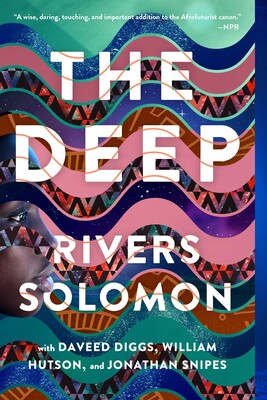
The Deep
Yetu serves as historian for the wajinru, an underwater people descended from pregnant African women thrown overboard during the slave trade.
About
Spoiler notice: Spoilers for the premise and opening setup, including Yetu’s role as historian, her distress during the rememberings, the annual Remembrance, and her departure from the deep. Later developments and the ending are not summarized.
The Deep imagines an underwater people called the wajinru, descended from pregnant African women thrown overboard during the slave trade. They breathe water and have made a society in the ocean, with traditions shaped by a history that is both foundational and painful. Solomon developed the novella from “The Deep,” a song by Daveed Diggs, William Hutson and Jonathan Snipes of Clipping. The result connects an imagined community to real histories of forced passage and loss, while keeping the story’s immediate focus with the people who live below the surface.
At the centre is Yetu, the wajinru historian. Her people have difficulty retaining the past, and the historian alone carries the memories of their ancestors and community. This role makes history more than a record kept at a distance: it is something one person experiences in body and mind on behalf of many. The memories include terrible events, but they also hold the lives and relationships that make a community intelligible to itself. Yetu’s duty is therefore both protective and demanding. The arrangement lets the wajinru live without constantly reliving collective suffering, while placing its accumulated weight on the person designated to remember. Earlier historians gathered memories from living wajinru and considered who might be suited to inherit the role, so the office also involves judging how knowledge will continue after its current keeper. History belongs to the whole community, even when its burden is concentrated in one person.
The story opens with Yetu in serious distress after being pulled out of a dangerous encounter with sharks. Her mother, Amaba, tends to her and urges her back toward food, medicine and the present. Yetu’s attention can be drawn so strongly into the rememberings that ordinary sensations become difficult to manage and the boundary between inherited memory and current experience grows uncertain. The pressure, salt and movement of the sea arrive through the sensitive skin of her body, making the surrounding water impossible to ignore. Speech, too, reaches her through vibrations in the water, so she has to focus to take in what Amaba says. This opening makes the historian’s burden concrete before the story explains its larger social structure. It also establishes the intimacy between mother and daughter: Amaba is worried about Yetu’s survival, while Yetu is struggling to describe a condition bound up with the work her people expect her to perform.
A central custom is the Remembrance, the gathering at which the wajinru receive the history Yetu has carried. The ceremony gives the community a shared encounter with its past, but it does not make that past easy to hold. The yearly rhythm places a public responsibility beside the private cost of remembering: the community needs its history, while the person tasked with preserving it is being overwhelmed by the task. At the opening, the ceremony is overdue by a mating cycle, and Yetu is unsure she has the strength to conduct it. Amaba tells her that the people are alive, but not well, making the delay a matter for more than Yetu alone. Solomon’s speculative society consequently asks practical questions about how history is transmitted, who is asked to carry it and what happens when care for a group depends on one individual’s suffering. These tensions emerge through family obligations and communal rituals rather than through abstract explanation alone.
When Yetu leaves for the surface, she steps away from the expectations surrounding the historian’s role and encounters a world the wajinru have long left behind. There she learns more about her own past and the future facing her people. Her absence also has consequences for the community: a responsibility that seemed concentrated in one person cannot simply disappear without affecting everyone who depends on it. The movement between deep water and the surface gives the story a physical shape for questions of distance, inheritance and belonging. The ocean is home to the descendants, while the surface brings Yetu into contact with a world beyond the boundaries of their familiar customs. Her departure is therefore both a personal attempt to escape an unbearable role and a change that reaches back to those who remain. Her journey shifts the story from the enclosed routine of the Remembrance toward the possibility that the wajinru may need a different relationship with their past.
The Deep is speculative fantasy and science fiction that draws on folklore, Afrofuturist imagination and the memory of slavery. It is also a story about narration: the historian preserves events, but preservation alone does not decide how a people will understand or share them. The novella asks whether forgetting can offer relief, what is lost when a community cannot remember together, and whether the work of memory can be shared. Its sea-born society is invented, yet its questions about inherited trauma and collective identity point toward recognisable human concerns. The wajinru face the work of reclaiming their memories and identity if they are to shape a future together, placing cultural continuity beside Yetu’s personal survival. Memory is not only a burden inherited from the past; it becomes part of how this imagined people might decide what comes next.
Book details
- Author
- Rivers Solomon
- First published
- 2019
- Series
- No series listed
- Subgenre
- Science fantasy
- Tags
- No tags for this book.
Review
Editor profile
Baby Bat
Goodreads and social links will be added soon.
- Goodreads — link coming soon
- Social media — link coming soon