
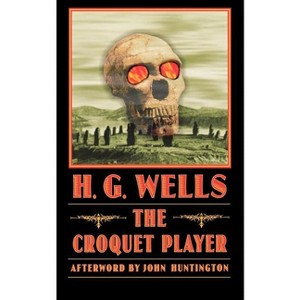
The Croquet Player
Georgie Frobisher’s comfortable holiday is disturbed by a doctor who describes a countryside consumed by fear.
About
Spoiler notice: This overview discusses the skull, Norbert’s interpretation of Cainsmarsh and Georgie’s final decision.
Georgie Frobisher would prefer a world that leaves him enough time for games. He is accomplished at croquet and archery, accustomed to comfort and closely attached to the aunt who has managed his life since childhood. In The Croquet Player, H. G. Wells gives this protected man a story he cannot comfortably put aside. Two encounters have disturbed his sleep and changed the way he looks at the news, and he tries to recover his composure by writing down what happened. Published in Britain in 1936, the novella begins with a narrator who considers himself neither heroic nor particularly curious about unpleasant realities. His problem is that someone else’s account of those realities has entered his imagination, where politeness and a well-ordered daily routine cannot entirely contain it.
The first encounter takes place at the Perona Source Hotel, where Dr Finchatton is angrily rejecting books that fail to distract him. Georgie’s casual interest gives the doctor an audience for experiences he needs to tell. Finchatton had left hospital work and London hoping that a rural practice would offer a gentler life. The physical suffering encountered in medicine and his concern about war had become more than he could bear. Cainsmarsh seemed remote enough to protect him: flowers, butterflies, fishing visitors and manageable ailments promised work without constant exposure to horror. He even restricted his reading and news to avoid further stimulation. The countryside he describes therefore begins as an attempted refuge, much as Georgie’s life has been arranged around avoiding what might upset him.
That refuge becomes increasingly difficult to recognise. Finchatton reports nightmares, sleeplessness and moments when harmless things seem threatening. His growing suspicion reaches colleagues and patients, while people around him appear to share a fear that has no stable object. An old woman attacks a shadow with a clock; a farmer fires at a scarecrow. The incidents do not present a conventional ghost whose identity can be discovered and whose demands can be satisfied. Instead, almost anything can become the occasion for terror. Explanations multiply as religious figures connect the marshes with graves, ancient violence and the disturbance of buried things. Their interpretations offer stories through which fear can be expressed, but Finchatton cannot find in them a dependable way to resume the quiet practice he wanted.
A museum gives that diffuse dread a memorable face. Finchatton confronts a prehistoric skull and imagines the long history of violent lives preceding the small portion of the past familiar to him. Conversation with the custodian moves between excavation, local superstition and the possibility that giving fear a recognisable shape might make it easier to confront. The custodian does not establish that a ghost is haunting the district. His more troubling suggestion is that modern knowledge has broken the narrow frame within which people once experienced the present. The remote past and an uncertain future now press upon everyday life. The skull condenses that argument into an object Finchatton can see, while his mind supplies a presence far larger than anything the museum has placed on display.
Wells keeps this explanation inside an account that has already passed through more than one speaker. Finchatton tells Georgie what others told him, and Georgie reconstructs the conversation for a reader. Fear travels through those layers with disturbing ease, while certainty does not. The doctor’s later visions and dreams turn the skull into an immense, overshadowing figure, until he can no longer manage his practice as he intended. Seeking help brings him to Dr Norbert, whose forceful manner offers very little of the calm reassurance Georgie expects from a psychiatrist. Norbert challenges the listener to respond before he has had time to prepare a socially acceptable answer. The comfortably detached position Georgie occupies begins to look less like neutral observation and more like a position the doctors will not allow him to keep.
Norbert then changes the terms of the story. He calls Cainsmarsh a myth and describes Finchatton’s experiences as real distress transformed into a fable. Some incidents happened, but the imagined marshland gives overwhelming modern realities a form the patient can hope to expel. Norbert directs attention towards human cruelty, public events and the continued capacity for violence beneath claims of civilised progress. His insistence is alarming in its own right. Georgie notices the gestures, the booming voice and the refusal to leave room for a question, and wonders how reliable this supposedly recovered authority can be. The novella does not turn the psychiatrist’s speech into a practical cure. His demand for a stronger civilisation leaves Georgie wondering what someone with his upbringing and abilities could possibly be expected to do.
By the close, retreat has become harder without becoming impossible. Georgie avoids further meetings with both men, but he recognises changes in his temper, dreams and reading habits. Writing the story does not free him from it, just as telling it did not free Finchatton. Even the holiday setting has admitted a glimpse of political conflict when a transport strike interrupts an ordinary journey. Georgie acknowledges the possibility of catastrophe while resisting the burden of making a response. His final decision is to keep an appointment to play croquet with his aunt. The return to the game provides a definite ending to the encounter, but no reassurance that the unease has passed. The quiet lawn and the world beyond it now occupy the same troubled mind, however firmly its owner insists on attending to the lawn.
Book details
- Author
- H. G. Wells
- First published
- 1936
- Series
- No series listed
- Subgenre
- Psychological horror, Literary fiction
- Primary genre
- Horror, Literary Fiction
- Tags
- No tags for this book.
Review
Editor profile
Baby Bat
Goodreads and social links will be added soon.
- Goodreads — link coming soon
- Social media — link coming soon