
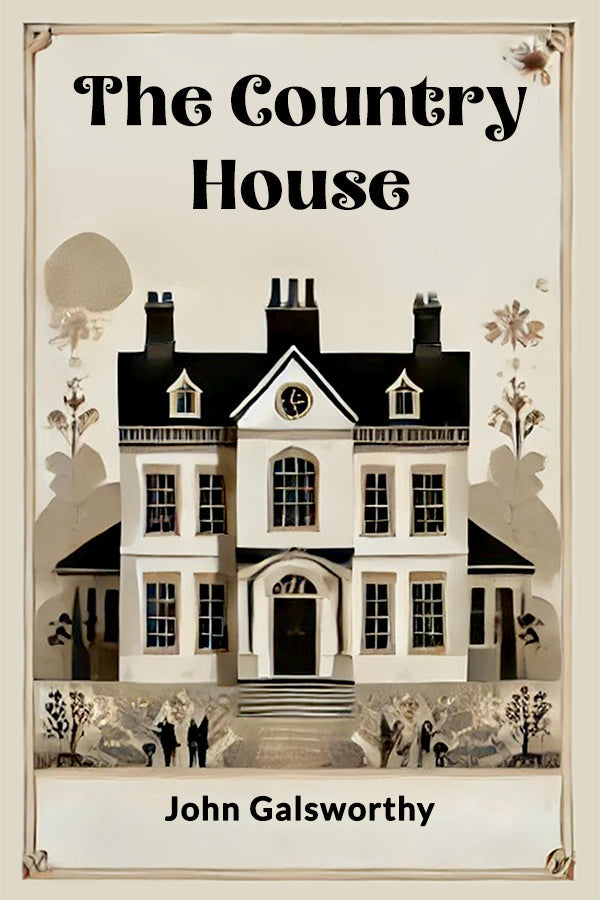
The Country House
At Worsted Skeynes, the Pendyce family’s country estate, George Pendyce’s affair with Helen Bellew, the wife of Captain Jaspar Bellew, threatens family standing and draws his parents into a bitter dispute over divorce, duty and social convention.
About
Spoiler notice: This overview includes Helen's changed feelings, Margery's intervention and the ending of the divorce dispute.
The carriages waiting at Worsted Skeynes station introduce a household accustomed to occupying space and directing other people's movements. It is autumn 1891, and Horace Pendyce's guests are arriving for a country-house visit. Servants discuss the visitors, room assignments and racing prospects before the company reaches the estate itself. John Galsworthy establishes the family through the machinery that supports its comfort: vehicles, liveries, property, meals and the quiet knowledge of those employed to make everything work. Horace, the Squire, considers his management of the land a contribution to the country's welfare. He dislikes individualism among his tenants while imposing his own preferences upon them. That contradiction gives an early indication of how difficult he will find any independence within his family that threatens his established arrangements.
The house offers warmth, leisure and a sense that life can continue indefinitely along familiar lines. Its guests know how to behave, whom to recognize and what judgments to make about an acquaintance whose circumstances have become uncomfortable. Helen Bellew's separation from Captain Jaspar Bellew makes her an especially convenient subject. Her appearance, riding, money and attention to George Pendyce can all be interpreted as evidence against her, while the social restrictions surrounding a separated woman attract less concern. George is Horace and Margery's son, and Helen's relationship with him brings the problem inside the family. Gossip is part of the pressure, but it also shows how an entire company can participate in enforcing a code without anyone having to explain its principles clearly.
Gregory Vigil, Margery's cousin and Helen's guardian, tries to find a practical way out of her unhappy marriage. His consultation with the solicitor Edmund Paramor exposes the distance between wanting two people to be free and obtaining a divorce under the rules depicted in the novel. Gregory assumes that agreement between husband and wife should help. Paramor explains that apparent agreement can instead make the case impossible, and that evidence must be obtained through means Gregory finds degrading. Surveillance and the appearance of an injured party become necessary parts of a process supposedly protecting morality. Their conversation gives the family drama an institutional setting. Sincere concern does not remove the law's requirements, while professional knowledge does not necessarily make those requirements humane or reasonable to the people suffering under them.
The threat changes shape when Bellew names George in divorce proceedings and offers to withdraw the suit if George promises never to see Helen again. Horace receives that offer as an assault upon the standing and security of Worsted Skeynes. He has accepted the general proposition that young men must be allowed their indiscretions, but the consequences of his own son's affair appear intolerable. His anger passes easily from Bellew to George and to whoever seems unwilling to support his response. The family name, inheritance and the anticipated continuation of the estate crowd into a problem involving living people. Even his spaniel John becomes an absurdly revealing companion to these scenes, seeking reassurance from a master whose agitation repeatedly makes the dog's faithful attendance painful.
Margery's concern follows another course. She fears disgrace and conflict, yet the immediate suffering of her son matters more to her than maintaining an appearance of firmness. Her journey to London to be near George challenges the habits that have kept her available to Horace and fitted her conduct to the expectations of the house. George does not respond with uncomplicated gratitude. He is shocked that his mother has left his father, imagines the talk her behaviour may provoke and tells her to return. The independence he claims for his own affairs does not extend comfortably to hers. Their meeting places her between two men who assume that their needs should determine her actions, even while neither fully recognizes what she is attempting or how much the attempt costs her.
Helen's disclosure that she no longer loves George overturns the terms on which Margery has understood the crisis. She had approached the relationship as a powerful mutual attachment that might justify extraordinary sacrifice. Hearing that Helen has ended it should seem to offer escape from scandal, but her first response is outrage that anyone could tire of her son. Galsworthy allows maternal love its own limitations alongside its generosity. Margery then has to face George's misery without the belief that a shared romantic future explains it. Returning home does not restore everything to its previous condition. Horace's uncharacteristic tenderness and anxious questions disclose feelings his customary authority has concealed, while both husband and wife struggle to speak about a situation neither can simply command away.
The final intervention belongs to Margery. She crosses the fields to Bellew's house as a storm approaches, frightened of the weather, the meeting and the possibility of encountering him drunk. Inside, her sympathy for his loneliness exists beside her fear of what he can do. She tells him that Helen has given George up; he eventually offers to stop the proceedings for her sake. The personal appeal succeeds where pride and formal demands have failed. Margery walks back through rain-washed fields in relief, finding the familiar house, church and garden awaiting her. Yet Horace and the Rector still seem to embody the same underlying spirit, and an ordinary concern about weeds quickly returns. Her kiss upon a white rose closes the book without providing later histories or promising that the social order itself has changed.
Book details
- Author
- John Galsworthy
- First published
- 1907
- Series
- No series listed
- Subgenre
- Literary fiction, Modern classics
- Primary genre
- Literary Fiction
- Tags
- No tags for this book.
Review
Editor profile
Baby Bat
Goodreads and social links will be added soon.
- Goodreads — link coming soon
- Social media — link coming soon