
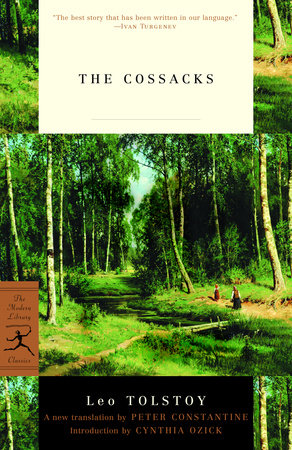
The Cossacks
Leaving Moscow for army service in the Caucasus, Dmitri Olenin hopes to find purpose among people whose lives seem freer and more direct than his own.
About
Spoiler notice: Full-plot spoilers, including Olenin’s pursuit of Maryanka, Lukashka’s grave injury, her rejection and Olenin’s departure. Lukashka’s eventual fate remains unresolved.
Dmitri Olenin leaves Moscow convinced that distance might give his life a purpose. He is twenty-four, wealthy enough to have avoided a settled career, and disappointed in the experiences that were supposed to make him happy. His farewell conversation circles around love, guilt and the possibility of starting again, while his friends wait for the long discussion to end. Joining the army as a cadet takes him towards the Caucasus, where he hopes to exchange comfortable indecision for physical effort and something more truthful. Tolstoy lets that desire feel sincere without allowing Olenin's account of himself to stand unchallenged. Even his emotional departure contains a considerable pleasure in imagining the person he is about to become. The novel follows what happens when that self-renewal requires other people to take the roles he has prepared for them.
The Cossack settlement he reaches has its own work, attachments and dangers. Along the Terek, military watchfulness belongs to everyday life, with river crossings, patrols and knowledge of paths carrying immediate consequences. Lukashka, a young Cossack admired for his skill and daring, shoots a Chechen crossing the river. The dead man's recovery becomes an occasion for discussion and pride among the guards, while his family connection will return with terrible force later. Olenin's arrival therefore places him inside a community whose confidence is bound to armed conflict. The landscape may promise freedom to him, but it is already inhabited, defended and worked. Its people do not need an outsider's search for meaning to explain their own reasons for living there, and the narrative repeatedly makes those reasons visible beyond his admiration.
Maryanka attracts Olenin almost immediately, while her expected marriage to Lukashka makes his desire difficult to separate from envy. He sees her strength and beauty as qualities belonging to the whole life he hopes to enter. Yet she has household duties, family expectations and judgments of her own, which do not simply mirror his feelings. His older companion Eroshka offers another way into the settlement. A hunter and enthusiastic drinker, he talks readily of his past and takes pleasure in teaching the newcomer practical things. Stories, songs, hunting and shared wine gradually establish intimacy between them. Eroshka's friendships and experiences also complicate the boundaries Olenin might expect to find between different peoples. This companionship gives him genuine contact with local life, even while the old man's outlook cannot be adopted as easily as a new set of habits.
Time in the woods encourages Olenin to formulate a philosophy of happiness. He concludes that living for others and sacrificing his own wishes could release him from his former dissatisfaction. Giving Lukashka a horse becomes an experiment in that generosity, bringing Olenin real pleasure. It also invites suspicion and puzzlement about his motives. An action that feels morally clear in his private reasoning has a less certain meaning when received by someone else. His days of hunting and observation likewise allow him to feel independent of fashionable officer life, but they cannot settle his relationship with the village. Tolstoy keeps his ideas close to the experiences that produce them: fatigue, solitude, attraction and the desire to be accepted. The difficulty lies in turning those discoveries into conduct that does not keep Olenin himself at its centre.
His attraction to Maryanka makes the limits of his new selflessness increasingly apparent. Visits, village gatherings and work during the grape harvest bring them into contact, but his wish for intimacy repeatedly outruns what she has actually offered. When he presses her about Lukashka, her response challenges his assumption that he has a right to the answer. The community continues its own courtship and celebration around them. Olenin's rival is no remote symbol of natural happiness; Lukashka moves within friendships, risks and expectations that the outsider only partly understands. Eroshka's songs can also introduce grief into the scene, including the destruction of a home by Russian violence. The village world holds affection and suffering together, making Olenin's vision of an uncomplicated alternative to Moscow progressively harder to sustain.
Olenin finally speaks of marrying Maryanka, buying a vineyard and a house, and enrolling as a Cossack. She does not answer every approach with the same refusal: at one point she gives a conditional agreement if her father consents, while questioning whether a gentleman would truly marry her. He takes the conversation as a promise of possibility, although her calmness troubles him. Before the imagined future can be tested, a clash with Chechen fighters changes the situation. The Cossacks advance behind a hay-cart, and Lukashka tries to seize a wounded opponent alive. That man is the brother of the Chechen he killed earlier. He breaks free and shoots Lukashka in the stomach. The encounter brings an earlier triumph back as a personal catastrophe, while Olenin can only witness the violence he once viewed from outside.
Lukashka is brought home gravely wounded, and the novel leaves his recovery uncertain. When Olenin approaches Maryanka after the fighting, her grief and anger make clear how far his romantic hopes are from her immediate concern. She tells him to leave, and he understands that she will not love him. He obtains permission to return to his regiment and prepares to depart. Eroshka sees him off with stories, advice, affection and a request for a gun as a remembrance. Olenin gives him one, but the final glance backwards finds the old man talking to Maryanka, neither looking after the departing cart. This departure contains no fresh declaration that life will begin again. The community continues beyond his disappointment, and Tolstoy ends with the distance between a visitor's intense experience and the lives that were never his to possess.
Book details
- Author
- Leo Tolstoy
- First published
- 1863
- Series
- No series listed
- Subgenre
- Translated literary fiction, Literary historical fiction
- Primary genre
- Literary Fiction, Historical Fiction
- Tags
- No tags for this book.
Review
Editor profile
Baby Bat
Goodreads and social links will be added soon.
- Goodreads — link coming soon
- Social media — link coming soon