
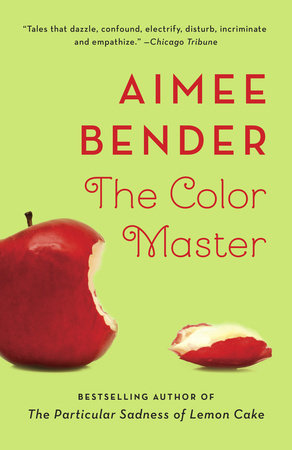
The Color Master
A young apprentice learns to sew emotion into dresses while working for a master colorist, and two sisters travel to Malaysia to mend wounded tigers.
About
Spoiler notice: Spoilers below for the setup of several stories, including a child-eating ogre; later story outcomes are not disclosed.
A girl appears in an apple orchard with hair the colour of golden wheat. A woman turns marital sex into a paid arrangement, then becomes fascinated by a shop assistant’s red ribbon. Two sisters go to Malaysia to mend tigers torn to shreds. The Color Master is a collection of fifteen short stories, not one continuous novel, and Aimee Bender lets each premise open a different door into ordinary needs and uneasy relationships. Some doors lead through fairy-tale territory; others begin with an awkward conversation or a problem that has no magical answer. Its characters do not all face the same kind of strangeness, and that variety is part of the book’s shape.
In the title story, a young woman learns dressmaking as an apprentice to the Color Master. The work asks her to bring emotion into cloth: anger, for example, becomes part of what she is taught to sew into a dress. The craft lesson belongs to a fairy-tale plot, where garments made in colours associated with the sun, moon and sky are intended for a royal family. A princess’s impending marriage to her father gives the apprentice’s skill an urgent purpose. Bender ties the extraordinary task to the physical work of making something by hand, so a feeling has to become an object that can be worn and used. The story’s magic grows from attention to material details rather than from a separate system of spells.
“Tiger Mending” begins with a different kind of making. Two sisters travel deep into Malaysia, where one learns to repair tigers that have been ripped apart. The fantastic image of sewing their striped bodies makes the sisters’ bond visible: they rely on one another as they join the torn pieces. The story also asks what it means to make something by hand: the mender has to consider what she puts into the tiger as she works. That concern is close to the title story’s lesson about emotion in clothing, though the setting and the family dynamic are distinct.
“The Devourings” places a marriage inside a grim fairy-tale predicament. A human woman marries an ogre, and he mistakenly eats their six children. The story follows the wife’s struggle over whether to remain with him after this loss. Bender does not soften the scale of what has happened; the tale has to make room for grief and for the uncomfortable fact that a marriage is still a relationship between two people, even when one has done something monstrous. The ogre’s appetite belongs to fable, while the question of what a spouse owes, forgives or can survive belongs to a more recognisable emotional world. The result is a story where a fantastic event changes the practical terms of a shared life. Its premise is among the collection’s starkest, and it gives the fairy-tale setting a painful domestic centre.
“The Red Ribbon” also starts from a fairy-tale echo, but turns toward desire and secrecy in a marriage. A woman begins charging her husband for sex and becomes infatuated with a shop girl who wears a red ribbon around her neck. Bender’s version takes an old, unsettling image and makes its pressure social and intimate: what is withheld between people, what is offered as a bargain, and what can become compelling simply because it remains unexplained. The story sits beside “The Color Master” and “The Devourings” as another fairy-tale-shaped piece, though its scale is closer to a private change in a couple’s habits than to royal dressmaking or an ogre’s household.
Other stories put strangeness beside encounters that could happen in everyday life. In “Faces,” a boy cannot recognise faces, and his mother tries to make sense of what that means for him and for their relationship. “The Fake Nazi,” “Bad Return” and “The Doctor and the Rabbi” bring characters into contact with strangers who offer unexpected comfort. “On a Saturday Afternoon” centres on a young woman arranging a sexual encounter between two male friends. These premises do not resolve into one lesson about connection. Instead, each gives awkwardness a different form: a difficulty of recognition, a brief kindness, or a desire that changes the terms between friends.
The book is divided into three parts, but they do not sort stories into separate thematic groups. Bender has compared her approach to arranging a mixtape, placing pieces of different moods beside each other and attending to where a section begins and ends. A fable can be followed by a contemporary encounter; an image of bodily repair can give way to a story about how people read one another. The sequence lets contrast do some of the work, giving each story its own beginning and pressure while allowing one piece to alter the feeling of the next.
First published in 2013, The Color Master was named a New York Times Notable Book that year. The stories move between fairy-tale transformations and modern relationships without requiring the reader to choose between the two. A dress can carry anger, a ribbon can hold a secret, and a tiger can need mending, while the people attending to those things remain vulnerable to loneliness, attraction, grief and misunderstanding. Some stories make their impossible premise immediately visible; others let the oddness gather around an ordinary exchange. The collection’s distinctions matter: the tiger mender’s bond with her sister is not the same problem as an ogre wife’s decision, or a mother’s effort to understand her son. Bender gives each an individual shape, then lets their differences sit together across the book’s three parts.
Book details
- Author
- Aimee Bender
- First published
- 2013
- Series
- No series listed
- Subgenre
- Literary fiction, Magical realism, Fairytale retelling
- Primary genre
- Literary Fiction
- Tags
- No tags for this book.
Review
Editor profile
Baby Bat
Goodreads and social links will be added soon.
- Goodreads — link coming soon
- Social media — link coming soon