
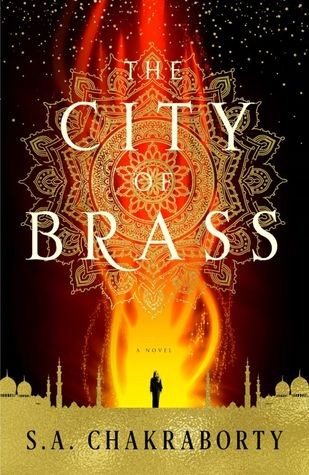
The City of Brass
Nahri survives in Cairo by pretending to be a healer, with just enough real talent to be dangerous and no idea where it came from.
About
Spoiler notice: Spoilers follow for the complete first Daevabad novel, including the lake confrontation and epilogue.
Nahri earns a living in Cairo by understanding what people are willing to believe. She can make a wealthy client fear an illness, sell reassurance and take advantage of the confidence her performance creates. Yet some of her abilities are real in ways she cannot explain: she senses sickness, heals unusually quickly and understands languages she has never learned. She wants money enough to study a legitimate trade, rather than a place in a magical world she does not believe exists. During a zar ceremony, her singing summons a warrior, and the possessed girl she has been treating becomes a deadly threat. Escaping through a cemetery with Dara forces her to reconsider what she thought was pretence. The skills that have helped her survive are suddenly connected to a history other people know far better than she does.
Dara introduces her to a world of beings made from different elements and bound by old judgments. Djinn, or daeva, are associated with fire, while marid belong to water and peri to air. Suleiman’s intervention restricted daeva power, and the tribes that accepted his judgment received more humanlike bodies. The ifrit resisted and remain cursed, searching for ways around their confinement. These histories are not merely explanations of how magic works. They determine who may live where, whose ancestry is respected and which relationships are forbidden. The shafit, descendants of humans and djinn, carry the consequences of those restrictions into their everyday lives. Nahri’s connection to the Nahid healing family makes her valuable and places her in danger. Dara believes Daevabad can protect her, but its safety comes with obligations attached to a bloodline she barely understands.
The narrative also follows Prince Alizayd, or Ali, inside Daevabad’s ruling family. A disciplined soldier and a deeply religious young man, he finds the palace’s comforts and compromises difficult to inhabit. His concern for the shafit leads him to support the Tanzeem, but discovering weapons among their activities complicates his belief that he has only helped people obtain necessities. His father Ghassan treats the city’s unequal order as something that must be maintained, even when it requires cruelty. Ali’s older brother Muntadhir understands the court more fluently and tries to protect him from consequences he is not always willing to recognise. Ali can be generous while retaining prejudices of his own, especially toward the Daeva tribe. His position gives him access to power without making it simple to use that power according to his conscience.
Nahri’s arrival reveals how much the city is prepared to make of her. Daevabad stands amid dangerous water, protected by wards and walls of brass, with quarters belonging to different tribes. Its markets and architecture astonish her, but unrest is already visible beneath that splendour. Ghassan offers Nahri and Dara status and protection in exchange for loyalty, presenting her publicly as a returned Nahid. Celebration among the Daeva gives her a sense of belonging she has never had, while the palace expects her to become a healer almost immediately. Nisreen guides her into customs and demanding medical work for which instinct alone is insufficient. Ali offers to teach her to read, beginning a friendship that also serves his father’s plan to make Nahri accept marriage to Muntadhir. Welcome, training and political recruitment become difficult to separate.
The argument over Dara’s past deepens as Nahri learns from people who remember him differently. For her, he is the warrior who brought her to safety; for Ali, he embodies violence committed in the name of the old rulers. Their sparring and conversations reveal competing histories that cannot be settled by choosing the person Nahri likes most. Dara’s own attempts to plan her future frustrate her, especially when preserving her bloodline becomes a reason to overrule her wishes. Healing provides a more concrete way to gain authority. After a failed procedure kills a patient, she experiences success treating Ali’s secret wound and practises the difficult technique until she can perform it confidently. She then goes to Ghassan with conditions for a marriage agreement. Her demands concern money, training and control over her life, turning inherited importance into something she can negotiate with.
Dara refuses to accept the life Nahri is building inside the city. When she rejects his plan to flee, he takes Ali hostage to force her departure. The escape meets waiting warships and becomes a catastrophic confrontation, with Dara unleashing power that kills soldiers and endangers people Nahri cares about. Ali falls into the cursed lake and returns changed, carrying Suleiman’s seal on his face. He cuts away Dara’s ring-bearing hand, and Dara turns to ash. The explanation offered afterward is that a marid possessed Ali, leaving him with gaps in his memory and a body that no longer behaves as expected. The struggle has moved beyond disputes about belonging into forces none of them fully controls. Ghassan sends Ali away, regarding his sympathy for the shafit and his possible political supporters as a threat to Muntadhir’s succession.
Ghassan then makes public storytelling another means of control. Nahri is forced to read a false account portraying Dara as having assaulted her, under the threat of an alternative story that would endanger her own life. The Daeva response gives her an unexpected measure of solidarity: their bows acknowledge her even as she speaks words imposed by the king. The epilogue reveals further resistance through Nisreen and Kaveh, and Dara’s surviving ring keeps the possibility of his return open. This first novel therefore ends with the apparent security of palace life broken, rather than with the city’s conflicts solved. Nahri’s practical intelligence survives the change from Cairo thief to celebrated healer. She now understands more clearly that learning the world means examining who tells its history, who benefits from its laws and what her new status allows her to resist.
Book details
- Author
- S. A. Chakraborty
- First published
- 2017
- Series
- The Daevabad Trilogy, book 1
- Subgenre
- Historical fantasy, Epic fantasy
- Primary genre
- Fantasy
- Tags
- No tags for this book.
- Reading order
- This is the only The Daevabad Trilogy title on the shelf right now.
Review
Editor profile
Baby Bat
Goodreads and social links will be added soon.
- Goodreads — link coming soon
- Social media — link coming soon