
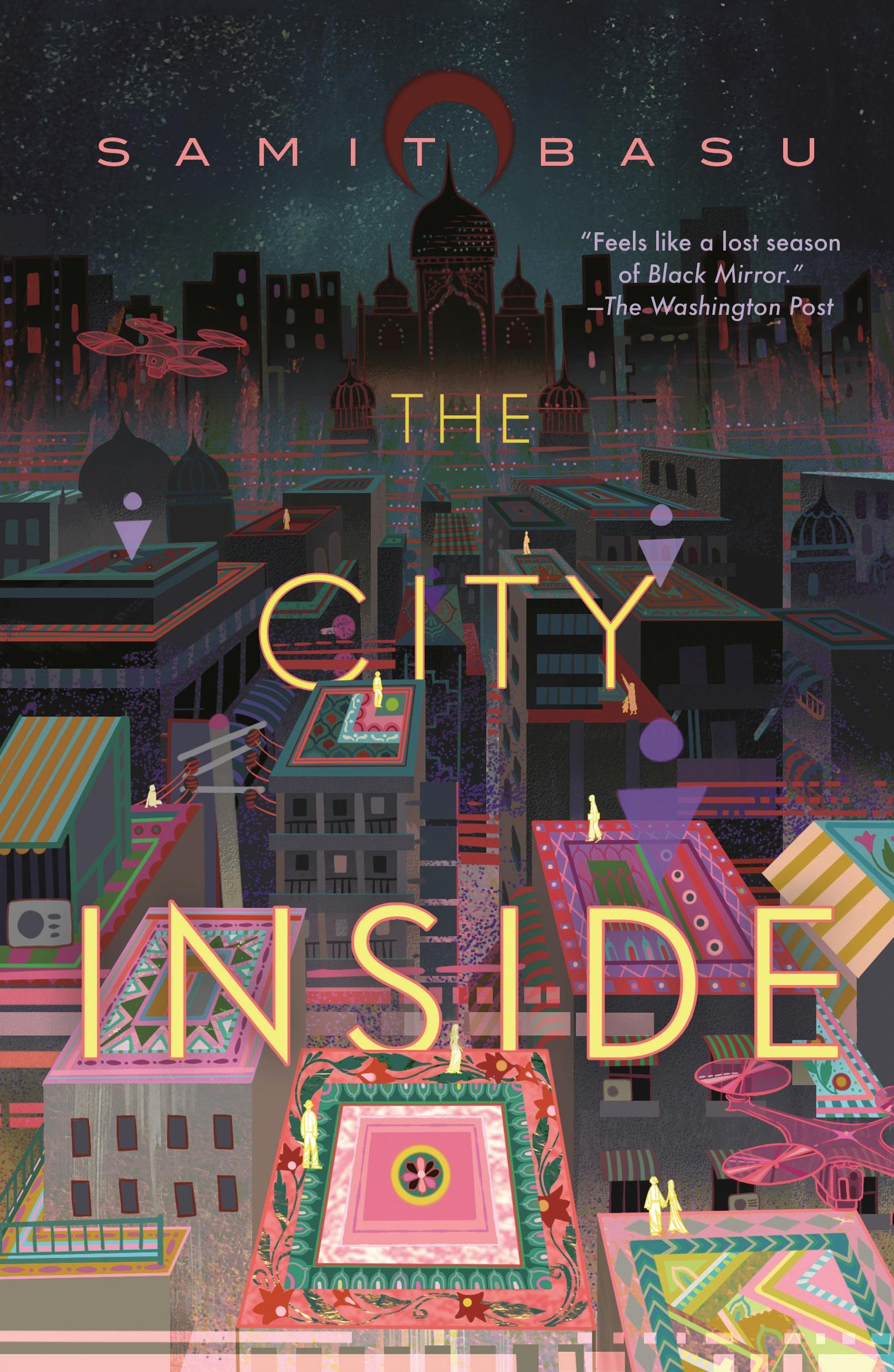
The City Inside
In near-future Delhi, Reality Controller Joey manages the immersive livestreams of Indi, her former college partner and a rising celebrity.
About
Spoiler notice: Discusses the premise, character relationships, media work, and the novel’s central pressures around surveillance and resistance; does not disclose the ending or later plot turns.
The City Inside places Joey and Rudra in a near-future Delhi where ordinary life is crowded by climate anxiety, political pressure, and an entertainment economy designed to keep people watching. Joey works as a Reality Controller, shaping the multimedia livestreams of Indi, a rapidly rising online celebrity and her former college partner. Her job sits at an intersection of production, management, and cultural influence: she decides how a public personality is presented while handling the immediate problems that can disrupt a broadcast. The novel’s starting point is not a clean division between private life and public spectacle. Joey’s work, relationships, and sense of what matters are already entangled with a system that makes attention valuable and difficult to escape.
Indi’s celebrity is built through Flow, a layered media environment in which followers can experience public figures through different forms of immersive content. That machinery matters because it turns a city’s crises into material that can be packaged, watched, and managed. The publisher describes Joey as so occupied with day-to-day crisis handling that she struggles to recognise her own cultural power or decide what she wants. Basu’s opening excerpt places her memories of protest alongside her present professional life, connecting this future to recognisable political experience rather than presenting it as a distant technological fantasy. The distance between a live event and its mediated version becomes a question of who controls the story, whose attention counts, and what audiences are encouraged to overlook.
Rudra enters from a different position. Estranged from his wealthy, influential family, he has chosen to live in an impoverished immigrant neighbourhood and keep away from the life expected of him. His father’s death pulls him back into that family orbit, and Joey’s impulsive offer of work gives him a possible route out of the future his relatives represent. This arrangement makes the characters’ differences structural as well as personal. Joey has learned to operate inside the media economy; Rudra has tried to withdraw from inherited privilege. Neither position grants a simple answer. The job brings them into one another’s daily lives, but it also connects their decisions to loyalties, money, public image, and unequal access to safety.
The city is not merely scenery behind this relationship. In Basu’s own account of the book’s development, he describes moving away from a more conventional cyberpunk thriller about two young people who would lead a revolution with technology and individual heroism. He came to doubt that one protagonist, or one spectacular invention, could undo entrenched power. That author’s explanation helps clarify the novel’s scale: the central question becomes what part of a world a person can actually change, and how any small effort relates to wider movements. The publisher’s synopsis likewise describes Joey and Rudra becoming caught in conspiracies while confronting corporate loyalty and surveillance capitalism. The story’s stakes therefore emerge through the friction between individual choices and forces too large for any one person to command.
Joey’s relationship with Indi adds a personal history to the professional arrangement. He is not only a celebrity she manages but also someone with whom she shares an earlier life, so the work requires her to navigate the overlap between curated persona and past intimacy. The available excerpt establishes how closely she thinks in terms of stories, edits, and presentation, while the official description makes clear that her daily crisis work has narrowed her attention to immediate demands. Rudra’s arrival changes that routine, but it does not simply free her from it. As the pair become entangled in larger schemes, the people around them have their own interests, and the distinction between helping, using, and protecting someone becomes harder to hold steady.
The novel’s political landscape includes the pressures of surveillance, concentrated wealth, environmental instability, and a government the publisher describes as part of a shadowy, conspiratorial setting. These conditions do not function as separate issue-of-the-week obstacles. They shape how people move through Delhi, what they can safely say, and how much of their lives can be turned into data or public content. Basu’s essay stresses that resistance cannot be reduced to a lone saviour restoring an imagined past; it depends on communities and on efforts suited to people’s different abilities and privileges. The book’s two central characters consequently face related but unequal decisions. Their response cannot be identical simply because they share a crisis.
The title draws attention to both an outer city and an interior one: the visible streets and media systems people inhabit, and the private judgments they form while being watched, distracted, and shaped by others. Rather than treating technological novelty as a solution in itself, The City Inside asks what happens when tools that promise connection also help organise attention and reinforce existing hierarchies. Its near-future setting keeps the speculative frame close to political and social realities already named in the publisher material and in Basu’s reflections on the novel. Joey and Rudra’s choices matter, but the book’s account of change remains collective in scale. It follows two people trying to find a truthful, proportionate way to act within a world that offers no clean position outside its systems.
Book details
- Author
- Samit Basu
- First published
- 2022
- Series
- No series listed
- Subgenre
- Cyberpunk, Dystopian
- Primary genre
- Sci-Fi, Literary Fiction
- Tags
- No tags for this book.
Review
Editor profile
Baby Bat
Goodreads and social links will be added soon.
- Goodreads — link coming soon
- Social media — link coming soon