
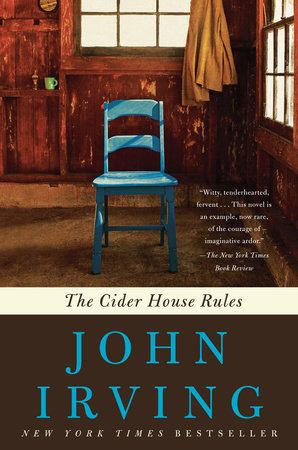
The Cider House Rules
Homer Wells grows up at St.
About
Spoiler notice: Spoilers discuss Homer’s departure from St. Cloud’s, the orchard household, and the later discovery that leads him back; the novel’s final decisions and outcomes are withheld.
The Cider House Rules begins in the routines of St. Cloud’s, a rural Maine orphanage where Homer Wells grows up among children who may be adopted or returned by prospective parents. Dr. Wilbur Larch runs the institution and tends to two kinds of need: he delivers babies and performs abortions that the law forbids. Homer is not merely a resident under Larch’s care. The doctor teaches him medicine and imagines that the boy will one day continue his work. From the start, their closeness is also a disagreement about duty. Larch sees the work as care for women with few safe options, while Homer cannot accept one part of the physician’s practice. That conflict gives the novel its central question about how a person can be of use without surrendering a moral boundary.
Homer’s education at St. Cloud’s is practical as well as intellectual. He learns to observe illness, assist with births and understand the institution’s daily demands, but he also sees that adults shape the stories children receive about their origins. The orphanage’s children depend on decisions made by people they may never know, and Larch’s own history influences the way he thinks about parenthood and responsibility. His determination to guide Homer’s future leads him to alter records and arrange facts around the young man. Those interventions complicate Larch’s affection: he acts from attachment and conviction, yet his care includes controlling another person’s choices. The doctor can offer Homer a place and a profession, but he cannot make the young man share his beliefs.
A visit from Candy Kendall and Wally Worthington gives Homer a route out of the place he has always known. They come to St. Cloud’s seeking an abortion, and Homer meets them at a moment when his training and refusal collide. When they leave, he goes with them to the Worthington family’s apple orchard, Ocean View, where the work follows the harvest and the seasons. The move replaces the orphanage’s ordered wards with open fields and a household shaped by the orchard’s owners and workers. Homer is no longer a boy being prepared for a role by Larch. He has to find his place in a community whose customs, labor and private relationships carry their own pressures.
The orchard’s cider house gives the title its literal setting and its wider idea of rules. Instructions are posted on the wall for the seasonal workers, but the workers cannot read them; the reader’s guide singles out Mr. Rose as the one person who does, and who also makes and breaks rules of his own. The distance between a written instruction and the life of the people expected to follow it becomes a recurring problem. Rules can be presented as neutral, yet their authors and interpreters hold different power from those who must live under them. Irving places this problem beside Larch’s argument about legal prohibitions and Homer’s personal refusal, so the novel asks who has authority to make a rule and whose needs it serves.
Homer’s time at Ocean View also reshapes his ties to Candy and Wally. Their arrival at St. Cloud’s binds the orchard family to the orphanage, while Homer’s feelings and decisions make that connection more intimate and difficult. The novel explores complicated forms of fatherhood, including Larch’s relation to Homer and Homer’s later relation to Angel. These bonds are formed through care, secrecy, biology and choice, rather than through one simple definition of family. Homer’s passage from ward to worker and then toward parenthood gives the novel its coming-of-age movement, but the book does not treat maturity as a clean break from the past. The people who raised or sheltered him remain part of how he understands obligation.
Women’s experiences with sex, pregnancy and violence give the medical question an immediate human context. At St. Cloud’s, Larch performs abortions for women who come to him because they have few legal options. At the orchard, Homer encounters workers whose private lives include abuse and limited control over their futures; the reader’s guide names Melony, Grace and Rose Rose among the women whose experiences raise questions about violence and sex. Their stories make clear that choices are shaped by physical vulnerability, money, work and the power of other people. The novel’s debate is therefore not an abstract contest between a law and an individual conscience. It touches the bodies and prospects of people who have different degrees of safety and authority.
First published in 1985, The Cider House Rules follows Homer across a large stretch of life, linking the orphanage and the orchard through questions of work, parenthood and moral responsibility. The selected Ballantine paperback was published in 1997 and runs 640 pages. Its scale lets Irving return to people and places as Homer’s understanding changes; the story’s movement between St. Cloud’s and Ocean View makes setting part of the argument, with each community offering a different version of care and belonging. A later discovery brings Homer back toward the orphanage, where he must reckon with the path Larch hoped he would take. The question that has followed him since childhood becomes more urgent when other people’s needs collide with the rules he has tried to live by.
Book details
- Author
- John Irving
- First published
- 1985
- Series
- No series listed
- Subgenre
- Family novel, Coming-of-age, Literary fiction
- Primary genre
- Literary Fiction
- Tags
- No tags for this book.
Review
Editor profile
Baby Bat
Goodreads and social links will be added soon.
- Goodreads — link coming soon
- Social media — link coming soon