
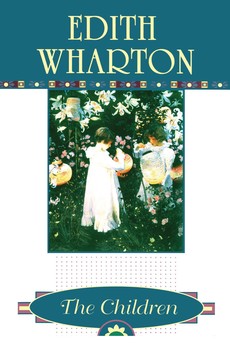
The Children
Martin Boyne, a forty-six-year-old civil engineer travelling in Europe, becomes involved with the seven Wheater children.
About
Spoiler notice: This overview includes the children's later separation, Chip's death and the novel's ending.
Martin Boyne is forty-six, accustomed to demanding engineering work and disappointed by his lack of interesting adventures. On a Mediterranean cruise, he looks over the arriving passengers with the expectation that none will reward his curiosity. Then he notices a young girl carrying a baby and begins constructing a story about her before he knows who she is. His first mistake, assuming that she must be an exceptionally young mother, introduces a problem that will run through Edith Wharton's 1928 novel. Boyne is observant and sympathetic, but his observations are continually shaped by what he wants to find. The Wheater children give him an unexpected place in their lives. Understanding what that place can legitimately become proves much harder than recognizing that they need an adult who will pay attention.
Judith Wheater is a teenager who has taken on responsibilities far beyond her age. The baby is her sibling Chip, and the wider group of seven includes children brought together through their parents' marriages, divorces and remarriages. Their bonds do not follow a simple division between full siblings and the children they call steps. Terry and Blanca are twins; others have different parents, yet the children want to remain a household. The adults' romantic rearrangements continually threaten that wish. Judith organizes practical care, tells stories and tries to keep the younger ones reassured. Her competence can mislead Boyne into treating her as older than she is. Away from the others, as when he takes her into the cathedral at Monreale, her uncertainty and lack of experience become unmistakable. The caretaker is also a child who needs care.
Education offers one of the first concrete ways Boyne can help. Terry asks him to persuade the adults that he should have a tutor, and the request exposes how little the surrounding luxury has guaranteed a settled childhood. Hotels, journeys and access to fashionable places have supplied experiences without necessarily providing continuity. Boyne's usefulness grows through taking these needs seriously rather than simply admiring the children as charming company. They respond to someone who listens, and their confidence in him increases his sense of obligation. Judith imagines a future in which each child has a distinctive vocation but all somehow remain together. The dream is touching because it is so practical in its details and so uncertain in its foundations. None of the people planning the children's future can make the parents stop changing theirs.
Rose Sellars represents another future Boyne had expected to pursue. He has loved her from a distance, finding in her carefully arranged home and cultivated companionship a stability missing from his travelling life. Now widowed, she is no longer unavailable in the way that helped sustain his ideal of her. Their reunion forces the imagined relationship into actual decisions. Boyne's involvement with the children increasingly occupies the time and attention Rose hoped they would share. She asks him to understand his own feelings, and eventually names what he resists admitting: his attachment to Judith is not adequately explained by philanthropy. His insistence that Judith is merely another child in his care does not settle the question. The novel makes the adult's self-knowledge a necessary part of judging the protection he offers.
For a while, keeping the children together in the mountain air seems to justify his commitment. Terry becomes healthier and more active, and Boyne takes pleasure in the everyday management of a small community that trusts him. He appeals to their grandmother as a possible means of securing a more permanent home. Yet his emotional investment is also growing harder to separate from their interests. He imagines himself on the children's side of a barrier against grown-ups, an appealing position that lets him evade how completely his own age and desires distinguish him from them. Rose's questions disturb that refuge. Her objections can sound unsympathetic to him, while his interpretation of her distress becomes equally unfair. Wharton lets the reader hear the strain in his explanations without making the children's need for security any less real.
The prospect of a settlement through their mother and the lawyer Dobree brings that distinction into focus. Judith is delighted by assurances that the children may be kept together, and Boyne discovers that the person offering such assurances can gain her confidence just as he did. Her happiness does not depend on making him indispensable. He sees plans that fail to remove the children from the adult world he distrusts, while Rose sees practical possibilities he ought to welcome. His bond with Rose finally breaks under the weight of feelings he cannot honestly explain away. An engineering commission in Brazil offers departure and a return to defined duties. He leaves before a promised excursion with the children, then dreams of that outing aboard ship. The imagined scene cannot repair the actual absence, or turn his withdrawal into a successful rescue.
Nearly three years later, Boyne returns to Europe for a short rest after illness and encounters Zinnie in a Biarritz hotel. Her casual news reveals the scattering of the group: children at school, in a convent or with other parents, and baby Chip dead after meningitis. Their mother has married again. The family has continued changing during the years in which work allowed Boyne to distance himself from its fate. Hearing that Judith is nearby draws him back to the hotel that evening, but he remains outside while she stands among dancers within. He sees her without speaking to her and cannot know what her momentary expressions mean. The window makes visible the separation his intense attention cannot overcome. Two days later he sails back to Brazil alone. His longing remains, while Judith's life continues beyond the account he can give of it.
Book details
- Author
- Edith Wharton
- First published
- 1928
- Series
- No series listed
- Subgenre
- Literary fiction, Modern classics
- Primary genre
- Literary Fiction
- Tags
- No tags for this book.
Review
Editor profile
Baby Bat
Goodreads and social links will be added soon.
- Goodreads — link coming soon
- Social media — link coming soon