
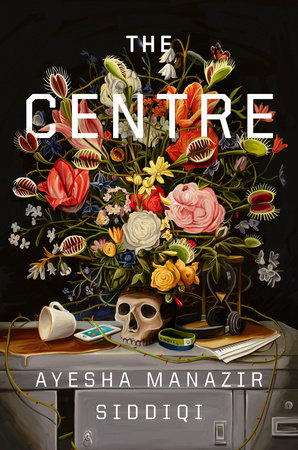
The Centre
Anisa Ellahi, a Pakistani translator living in London, wants to move beyond subtitling Bollywood films and translate literature.
About
Spoiler notice: Covers Anisa’s decision to enter the Centre, the restricted conditions of its ten-day programme, her growing investigation afterward and the journey toward New Delhi; it does not reveal the Centre’s concealed method or the novel’s final resolution.
Anisa Ellahi has a clear ambition: she wants to translate great works of literature. In London, however, her working days mostly go to subtitling Bollywood films, while a generous allowance from her family in Karachi keeps her afloat. That gap between the work she does and the work she imagines gives the novel its starting tension. Anisa is not simply waiting for an opportunity; she is alert to how class, migration and cultural expectation shape what counts as a plausible career. Her discontent turns especially sharp when she meets Adam, a white English translator whose career seems to have converted extraordinary language skills into effortless professional success.
Adam’s fluency initially appears to confirm the distance between them. He speaks a remarkable range of languages, yet struggles to learn even basic Urdu, the language Anisa wants him to share with her. When he suddenly begins speaking it with ease, she presses him to explain. The answer is the Centre, a private, invitation-only programme that claims it can make a student fluent in any language in ten days. For Anisa, this sounds like a route past years of stalled effort and into the literary life she has wanted. It also makes the novel’s central offer unsettlingly practical: if a coveted skill can be acquired almost overnight, what has been removed from the process, and who pays for that removal? The contrast between Anisa’s fluency in her mother tongue and Adam’s sudden command of it also gives the offer an intimate edge: the language is part of her history and family life, as well as a professional skill. Anisa’s choice grows from real professional frustration, not from simple credulity.
Getting into the Centre requires more than paying its substantial fee. Anisa has to pass an application process, sign away her ability to discuss the programme and accept an unusual degree of control over her surroundings. On arrival, she is separated from her belongings and outside contact. The retreat follows a strict schedule, curtailing ordinary conversation and social contact in the name of concentration. Its routines unsettle the familiar ways people use language to explain themselves and build relationships. Anisa tries to understand the institution from within, but the information available to her is limited and carefully managed. The secrecy turns the school into more than an eccentric teaching venue: it becomes a place where the promise of mastery depends on surrendering the usual means of judging what is happening.
The arrangement works on Anisa because the promised result is not abstract. She wants the standing, confidence and freedom that she associates with literary translation, and the Centre seems to have delivered a version of that transformation for Adam. The novel follows her attraction to the programme alongside her suspicions about its methods and staff. She is not an outsider looking at a puzzle from a safe distance; she has chosen to enter, and each new discovery has to be weighed against what she hopes to gain. That conflict gives the mystery its personal stakes. The question is not only whether the Centre’s claim is true, but how Anisa will interpret the people and practices that make the claim possible while she is still benefiting from its promise.
After her stay, the effects of the programme do not settle neatly into a success story. Anisa’s professional prospects change, but she remains troubled by what she has seen and by what she cannot publicly explain. She becomes closer to Shiba, a manager at the Centre, and uses that connection to learn more about the school. Their relationship carries the investigation beyond the controlled retreat and toward New Delhi, where the institution’s history and its founders come into view. The move from London to Karachi and then Delhi keeps Anisa’s private choices connected to the different places and communities that have shaped her. Her search for answers becomes another form of translation: she has to interpret incomplete accounts, unequal relationships and the motives of people whose interests do not necessarily align with hers.
The Centre combines an increasingly strange institutional mystery with a close account of a woman measuring ambition against belonging and complicity. Language here is both a craft and a form of access: it can connect people, support a livelihood and carry the traces of history, but it can also be packaged as a purchasable advantage. Anisa’s life between Pakistan and England makes questions of appropriation, class and cultural authority immediate to her, while the programme’s reach into India widens the frame. The novel’s dark humour and speculative premise keep those questions attached to a concrete plot about a translator, her boyfriend and a school with tightly guarded methods. This description covers Anisa’s entry into the Centre, the nature of its programme, her post-programme investigation and the journey to Delhi; it does not disclose the concealed method or the mystery’s final resolution.
Book details
- Author
- Ayesha Manazir Siddiqi
- First published
- 2023
- Series
- No series listed
- Subgenre
- Psychological thriller, Literary fiction
- Primary genre
- Literary Fiction
- Tags
- No tags for this book.
Review
Editor profile
Baby Bat
Goodreads and social links will be added soon.
- Goodreads — link coming soon
- Social media — link coming soon