
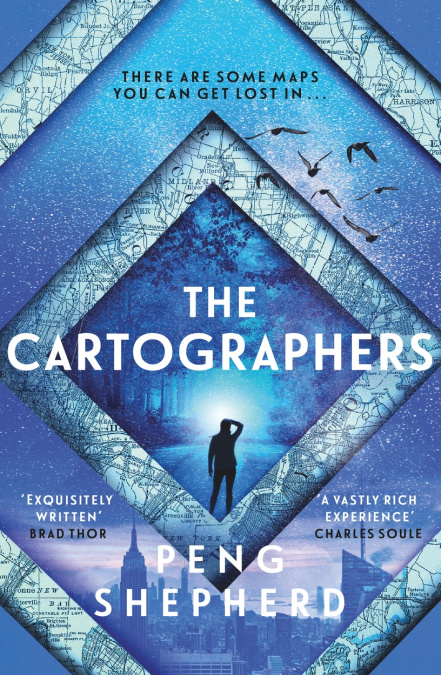
The Cartographers
Cartographer Nell Young has spent years estranged from her father, Dr.
About
Spoiler notice: Spoilers cover the premise and opening setup: Nell’s estrangement from her father, his death, and the map that draws her into an investigation. Later revelations and the ending are not summarized.
Nell Young’s estrangement from her father is tied to a map that seems too ordinary to matter. Dr. Daniel Young is a celebrated cartographer and Nell’s personal hero, but years earlier he fired her after an argument over a cheap, mass-produced highway map. They have not spoken since. Then Daniel is found dead in his office at the New York Public Library, and that same map turns up hidden in his desk. The small, everyday object becomes the point where an old family rupture meets a new mystery. Nell knows its value cannot be explained by its paper, print run or apparent usefulness alone: someone has been hunting down and destroying the remaining copies. Her decision to investigate brings the novel’s central question into view. What can a map do beyond showing a route, and why would anyone risk so much over one that looks disposable?
Cartography is both Nell’s passion and the language through which she understands the conflict. The story places a trained mapmaker at the centre of the inquiry, rather than treating maps as decorative clues for an outside detective. That choice makes the search attentive to how a map is made, stored and read. A printed sheet fixes a view of the world into lines, labels and boundaries; a digital search can retrieve information from vast collections but cannot erase the choices made in the original representation. The official reading guide points to a contrast between ancient maps, library databases and contemporary search engines, and asks readers to consider Nell’s attraction to older tools. These different forms of looking matter because the mystery depends on an object whose importance is easy to overlook when it is judged only by its ordinary appearance.
The map at the centre of the plot is a mass-produced highway map from a gas station, not a rare chart that advertises its significance. Its apparent cheapness sharpens the puzzle: if it is just one copy of a common road map, why did Daniel and Nell fight over it, and why are other copies being destroyed? The publisher’s premise holds back the answer while making the danger clear. A mysterious collector seeks the maps and acts against people who interfere. Nell begins with a question about her father’s choices and is pulled toward a wider conspiracy. The progression turns a familiar printed object into evidence, while refusing to make its importance obvious at the outset. Readers can follow Nell as she tests the distance between a map’s mundane purpose and the claims being made for its hidden power.
The novel’s map references also place its mystery within the long history of representing the world. At the beginning, Nell notices that the Fra Mauro Map has its cardinal directions reversed, with south above and north below. The author’s reading guide connects this detail to the question of whether there is a single correct way to view the world. That is more than a technical aside: orientation is a decision made by a mapmaker, and a different choice can alter what a viewer expects to see. The story’s interest in maps therefore includes their history and their limits, not only the suspense of a secret object. A representation can be useful without being neutral or complete. This gives the historical material a clear connection to Nell’s personal search, in which her assumptions about her father and their shared past also need to be reconsidered.
The physical setting adds another layer to that search. The New York Public Library is where Daniel is found and where his professional life has taken shape; the author identifies New York State as the story’s main setting, with Nell visiting distinctive locations. Libraries and map collections offer the institutional side of cartography: material that has been preserved, organized and made available for consultation. The plot also reaches into contemporary online tools, placing old maps beside databases and search engines. That mix lets the investigation move between looking closely at a single paper artifact and searching across information at scale. The difference is practical as well as atmospheric. A library can hold a document whose significance has been missed, while an online system can surface connections but still depends on what was recorded and how it was described. Shepherd uses both older and newer forms of research in a story about what people can know from the traces places leave behind.
Nell’s investigation is inseparable from her family history. She approaches the map after a painful break with the person who taught her to value the field, and Daniel’s death means their disagreement cannot be resolved through an ordinary conversation. The publisher frames the journey as one toward the family’s darkest secrets, while the author’s guide asks how secrets can protect or harm and whether a person or place can be fully understood. These questions place emotional stakes beside the puzzle. Nell is not simply locating an item or identifying a collector; she is trying to understand what her father’s actions meant and how much of their relationship has been shaped by withheld or misread information. The map gives that inquiry concrete form, but the family questions keep its stakes personal.
By bringing together a cartographer’s work, a library’s collections, a damaged parent-child relationship and a conspiracy around maps, The Cartographers treats geography as something people create as well as something they cross. A map selects, arranges and names; it can guide someone, but it can also leave gaps or create expectations about what is present. The story’s speculative premise turns that familiar tension into danger and adventure, while its historical and technological details keep the investigation rooted in the tools people use to describe places. Nell’s path begins with one seemingly worthless highway map and a father she has not spoken to in years. From there, the mystery opens onto questions of orientation, memory and family, without requiring the reader to know the answer to the map’s power before Nell starts looking for it.
Book details
- Author
- Peng Shepherd
- First published
- 2022
- Series
- No series listed
- Subgenre
- Conspiracy thriller, Magical realism
- Primary genre
- Mystery & Thriller, Fantasy
- Tags
- No tags for this book.
Review
Editor profile
Baby Bat
Goodreads and social links will be added soon.
- Goodreads — link coming soon
- Social media — link coming soon