
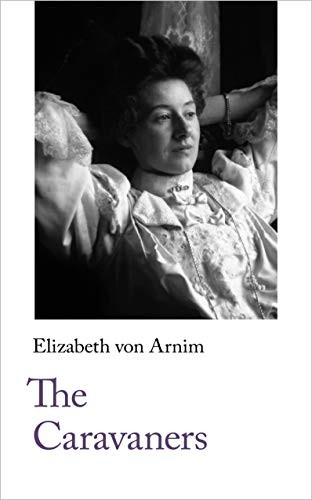
The Caravaners
Baron Otto von Ottringel, a Prussian army major, recounts a planned month-long caravan holiday in Kent with his younger wife, Edelgard, and a party of English companions.
About
Spoiler notice: This overview discusses the early end of the tour, the couple’s return and the marriage news in the postscript.
Baron Otto von Ottringel intends to tell the truth about his holiday, and sees little difference between telling it and vindicating himself. A Prussian army major accustomed to treating his own judgment as the proper measure of events, he records an expedition whose other participants repeatedly fail to behave as he thinks they should. The Caravaners gives the entire account to that self-confident voice. Its comedy depends on hearing more than Otto believes he is revealing: a complaint about another person's conduct may show his own vanity, and a declaration of reasonableness may accompany an unreasonable demand. He imagines listeners ready to share his assumptions. The reader is instead able to watch those assumptions collide with the people he describes.
The expedition begins as a holiday plan with his younger second wife, Edelgard. Frau von Eckthum encourages them to join a party travelling through Kent in three horse-drawn caravans, with a month set aside for the tour. Otto evaluates enjoyment alongside expense, convenience and the standing of the people involved. The prospect of Frau von Eckthum's company matters to him in ways that his explanations about the trip do not always admit. Edelgard is excited by a departure from their usual life, and that excitement becomes something he later tries to attribute to her impulsiveness. From the beginning, the two have reasons for joining that do not necessarily promise they will enjoy the same holiday once it starts.
Caravanning makes daily life inconveniently physical. Horses have to be managed, equipment carried, meals arranged and sleeping quarters accepted, while weather refuses to respect anyone's status. Otto cannot transfer all those demands into the familiar organisation of home or regiment. The English companions' informal habits leave him uncertain where to locate the authority he believes a group ought to have. Small incidents consequently expand into statements about civilisation, rank or the proper behaviour of women. His account keeps attempting to restore order through explanation after events have escaped him. The travelling party, meanwhile, continues to have its own conversations and pleasures. Much of the fun comes from the persistence of ordinary life around a narrator determined to make it answer to his rules.
The countryside supplies a particularly revealing disagreement. When Mrs. Menzies-Legh delights in sparkling hedges and a blue sky, Otto regards the response as excessive attention to things that are merely doing what summer weather should make them do. His struggle with a horse leaves him less available to enjoy the scene, but he turns that irritation into an opinion about women of her age expressing enthusiasm. The narrative gives the reader the wet leaves, sunlight and her pleasure before adding his judgment. It is therefore possible to experience the attraction he dismisses. His apparently confident account of good manners exposes how much vitality those manners would suppress if everyone accepted his definition of them.
Edelgard's growing ease with the company threatens him more personally. She laughs, enjoys the tour and begins responding in ways that do not automatically confirm his view. He treats the change as an infection acquired abroad rather than a discovery she might have reason to value. His attempts to correct her reveal the unequal marriage he has taken for granted, while her questions make that arrangement newly visible to him as a problem. The book does not need to replace his voice with hers to show that difference. What he calls an unwifely response can communicate a coherent objection, and what he describes as firm guidance can sound like a refusal to hear it. The journey gives her room to act beyond his usual expectations.
At the deserted Frogs' Hole Farm, damp weather and the party's tensions darken Otto's account. Advice about protecting his health runs against his determination to receive the month he has paid for. He also fails to understand the attachment developing between Frau von Eckthum and Jellaby, whose opinions and manner offend his standards. The holiday ends after roughly a week, leaving him to explain a departure he had not anticipated. On the railway journey Edelgard asks what he did to make the party break up. Otto regards the question itself as an offence against his authority. The early return consequently fails to restore the comfortable partnership he expected to find waiting outside the difficulties of camp life.
Back in Storchwerder, he hopes familiar routines will return Edelgard to her former conduct. She is quieter and sometimes critical, while he insists that he himself remains unchanged: patriotic, dutiful and reasonable. The postscript then interrupts his preparations to read the manuscript aloud. News arrives that Frau von Eckthum is about to marry Jellaby, and Otto interprets her choice as a catastrophe imposed upon a helpless woman. Edelgard claps her hands with delight. Their opposite reactions provide the final correction to his account without requiring him to recognise it. The wedding has not yet happened in the news he receives, and the book offers no further settlement of his own marriage. It ends with the difference between his certainty and her pleasure still intact.
Book details
- Author
- Elizabeth von Arnim
- First published
- 1909
- Series
- No series listed
- Subgenre
- Literary fiction, Social realism
- Primary genre
- Literary Fiction
- Tags
- No tags for this book.
Review
Editor profile
Baby Bat
Goodreads and social links will be added soon.
- Goodreads — link coming soon
- Social media — link coming soon