
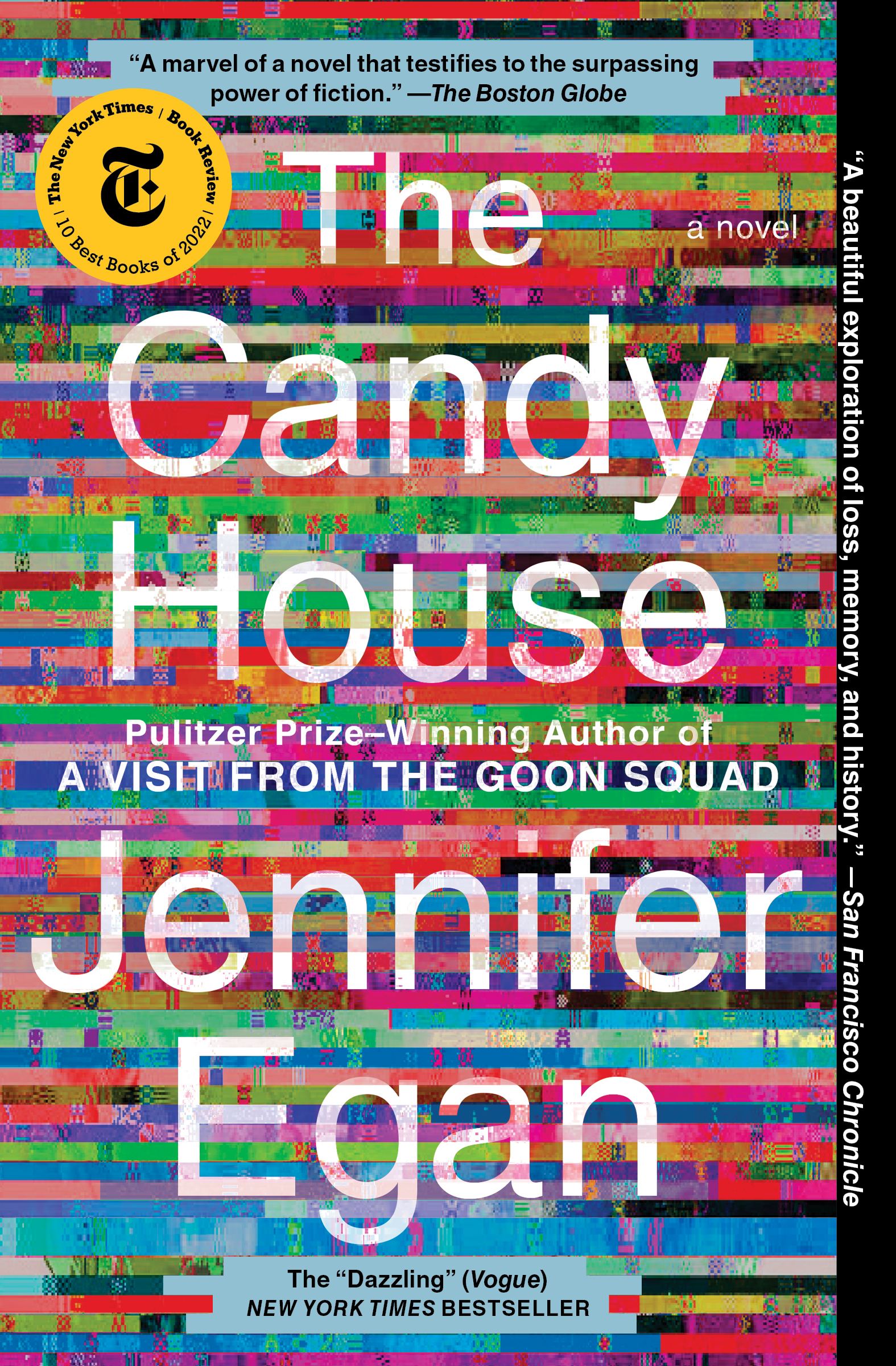
The Candy House
Tech entrepreneur Bix Bouton develops Own Your Unconscious, a way to revisit and share memories.
About
Spoiler notice: Spoilers for the 1993 East River drowning recalled from A Visit from the Goon Squad, the memory-sharing invention, recurring characters and selected chapter situations. Later resolutions are not described.
Bix Bouton has already built Mandala into a technology company whose founder has become a celebrity, yet his own memory of an important night has gone dim. At forty, with four children and no next idea, he disguises himself as a graduate student and joins a Columbia discussion group. There he meets academics considering whether memory might be downloaded and revisited. That conversation gives the restless entrepreneur a new project, but the invention begins with a private gap: Bix wants to recover the past surrounding an event that shaped several lives. The premise links the appetite for innovation to the ordinary uncertainty of what a person can remember about their own history.
The missing memory reaches back to 1993, when Bix and fellow NYU students Drew and Rob spent a night together before walking to the East River. Bix was the last to see Drew and Rob before they went swimming and Rob drowned. He returns to that event as an adult who has become a tech icon, startled by how little he can retrieve from a moment that mattered so much. Memory retrieval offers more than a private replay: Bix’s device eventually opens his past to other people’s records as well. The novel revisits the river through lives changed by what happened there, making the search itself part of a longer story about what survives in memory and how people interpret an incomplete account.
Bix calls his device Own Your Unconscious. A user can externalize memories, revisit them, and choose to add them to a shared archive called the Collective Consciousness; access to other people’s memories depends on contributing one’s own. The bargain turns remembrance into a social technology, with permission, curiosity, and exposure bound together. Some people welcome the possibility of finding details they had lost, while others leave their online identities and become eluders. Counters, meanwhile, try to identify and track people who disappear from the network. That conflict gives the imagined invention a human scale: each decision about sharing belongs to someone with a private history and relationships that continue outside the system.
The linked stories move across several decades, reaching back to 1965 and forward into the 2030s. Lou Kline’s music business and family belong to one strand; Bix’s invention connects his story to people whose lives intersect with that technology in different periods. Lulu, once a child in the earlier story-world, appears later as a spy, while Miles, Ames, and Alfred Hollander receive space as people whose names had previously sat at the edges of other lives. The collection of viewpoints widens the book beyond the inventor. A character may be a stranger in one chapter and part of someone else’s history in another, so each shift in time changes what the reader can know about the same network of people.
The novel also follows the effects of shared memory through smaller, sharply defined situations. A recovering lawyer searches for a man he remembers only as Damon, perhaps not even by his real name. By contributing the fragment he has, he can encounter other people’s memories of Damon and assemble a partial account of what became of him. That search moves him from private recollection toward action. Other chapters turn toward Bix’s son Gregory, or to Roxy at a drug-treatment centre, where a weekly Dungeons & Dragons game becomes a way to think about how people make and inhabit stories. These episodes keep the speculative device attached to ordinary needs: locating someone, understanding a family member, or imagining another person’s point of view.
The chapters do not use one stable narrative voice. They include first-person and collective voices, correspondence, text messages, and a spy story told in very short units. One strand follows Lulu in 2032; another arrives through emails exchanged among people whose social connections gradually become legible. The book is arranged in four sections titled “Build,” “Build,” “Break,” and “Drop,” borrowing the vocabulary of electronic dance music. These changes in shape let a reader encounter characters through different kinds of evidence, from direct recollection to a message written for someone else. Recognition across chapters is part of the design: a familiar name or event can look different when seen from another person’s angle.
The story-world returns to familiar figures from A Visit from the Goon Squad but gives substantial attention to the people who once surrounded them, including their children and later connections. The books share a world and can be read in either order: The Candy House reaches backward as well as forward, and its linked chapters follow curiosity among an ensemble rather than one continuous protagonist. The earlier novel is not required to understand the central premise here. Bix’s project supplies a point of connection, but the narrative keeps shifting toward people who encounter its consequences from outside his immediate circle. As memories circulate, the cast grows through old friendships, family ties, chance meetings, and histories that one person remembers differently from another.
Book details
- Author
- Jennifer Egan
- First published
- 2022
- Series
- No series listed
- Subgenre
- Literary fiction, Experimental fiction
- Primary genre
- Literary Fiction, Sci-Fi
- Tags
- No tags for this book.
Review
Editor profile
Baby Bat
Goodreads and social links will be added soon.
- Goodreads — link coming soon
- Social media — link coming soon