
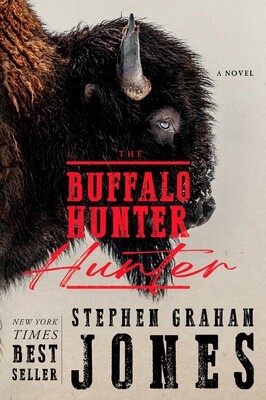
The Buffalo Hunter Hunter
While seeking an academic book contract, Etsy Beaucarne learns that a journal found in a Miles City parsonage belonged to her ancestor, Lutheran pastor Arthur Beaucarne.
About
Spoiler notice: Spoilers for the premise and historical setup, including the 1912 diary, Good Stab’s confessions and the 1870 massacre. Individual outcomes and the novel’s ending are not detailed.
The story begins with a document pulled from the wall of a parsonage in Miles City, Montana. It is a Lutheran pastor’s diary, written in 1912 and left behind for a descendant who has reason to look closely: Etsy Beaucarne is trying to establish herself as an academic, and the journal may give her a book worth publishing. Its discovery joins a professional problem to a family one. The old pages belong to Arthur Beaucarne, Etsy’s ancestor, and their contents reach further back than the century separating them. The novel gives this chain of custody real weight. A fragile object moves from a renovation site to a special collection, then into the hands of someone whose surname connects her to its writer. The record is not an abstract history book. It is a family document that Etsy must decipher, and its survival makes the past newly present in her life.
Arthur’s diary preserves a series of confessions from Good Stab, a Blackfeet man who came to the pastor to tell him the story of his life. The account is presented through transcribed interviews and journal entries rather than through a single, uninterrupted narrator. That structure keeps the reader aware of the acts that carry a story across time: Good Stab speaks, Arthur records, and Etsy later reads and researches the record. Each person approaches it from a different position. Good Stab is telling what happened to him; Arthur is the listener entrusted with the account; Etsy is a descendant with scholarly ambitions and personal ties to the diarist. Their roles give the narrative several layers of perspective. They also make the question of who gets to tell a history part of the book’s form, since the testimony reaches its later audience through a pastor’s writing and an academic’s recovery of it.
The diary’s narrative reaches back to 1870 and follows events toward Starvation Winter in 1884. At its centre is a chain of violence that begins with a winter camp of Blackfeet people massacred by the United States and reaches 217 Blackfeet dead in the snow. This is the historical ground on which the novel builds its horror. The time span matters because the story follows more than one isolated atrocity: Good Stab’s account moves through years in which violence and its consequences continue, while the 1912 journal gives those events a later witness. A reader meets this past through a document written decades afterward, then through Etsy’s still later effort to understand it. The distances between event, testimony and recovery shape how the history can be known, and keep the record’s human stakes in view.
Good Stab’s story also brings the supernatural directly into this historical frame. He is a Blackfeet man whose life is bound to a vampire’s search for justice across the fields of the Blackfeet reservation. That premise places vampire horror beside a specific history of colonial violence. It changes the familiar relation between predator and victim: the supernatural figure cannot be understood apart from the violence that formed his life, while revenge raises its own questions about justice and what survival can require. The book’s horror therefore works on two linked levels. There is the bodily threat associated with a vampire story, and there is the human history that its setting keeps in the foreground. Good Stab’s presence in a Lutheran parsonage makes religion part of that arrangement too, since the pastor’s church becomes the place where the confession is offered.
The historical setting carries details beyond the diary’s central account. The events move across Montana between the massacre in 1870 and Starvation Winter in 1884. In 1912, Arthur lives in Miles City, where the buffalo are already gone from the region. These details connect the novel’s title and its central figure to a changing landscape. The buffalo belong to a world that has already been altered by the time Etsy studies her ancestor’s pages. In this context, the act of hunting sits alongside questions of land, historical memory and survival. The novel moves between an individual life and a broader account of what happened to Blackfeet people, because the diary places personal testimony inside a record of regional change. Its setting gives Etsy part of the historical context she must piece together as she reads.
Etsy’s 2012 research frame gives the recovered diary another kind of pressure. She wants the material to support her academic career, and the journal also connects her to a relative who disappeared from the historical record. That combination makes the archive useful and intimate at once. The discovery offers a path toward publication, while the handwriting, the family name and the story of Good Stab draw Etsy into contact with people she knew only through inherited traces. The novel’s arrangement asks how a present-day reader handles testimony from the past when the record has passed through several hands and carries family meaning of its own. History takes shape through the work of reading: finding a document, learning its context and deciding what its account demands from the people who receive it.
Book details
- Author
- Stephen Graham Jones
- First published
- 2025
- Series
- No series listed
- Subgenre
- Historical horror, Vampire horror
- Primary genre
- Horror, Historical Fiction
- Tags
- No tags for this book.
Review
Editor profile
Baby Bat
Goodreads and social links will be added soon.
- Goodreads — link coming soon
- Social media — link coming soon