
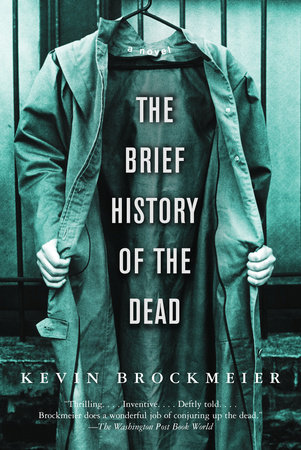
The Brief History of the Dead
Laura Byrd is stranded at an Antarctic research station as a deadly virus devastates the world and her supplies, power and radio contact fail.
About
Spoiler notice: Discusses the novel's premise and early circumstances in both storylines; later developments and the ending are not disclosed.
Kevin Brockmeier builds The Brief History of the Dead from two alternating stories set on either side of death. In one, Laura Byrd is stranded at an Antarctic research station as a catastrophic virus devastates the human population. In the other, the dead live in a city that resembles an ordinary urban place, with streets, shops, work and newspapers. Its residents believe they remain there while someone alive remembers them. As the book switches between Laura’s physical struggle and the city’s changing population, a survival narrative becomes linked to a question about how individual lives persist in other people’s minds.
The City does not offer a polished version of heaven. It has familiar routines and imperfect details: residents take jobs, eat in diners, sell flowers, print a newspaper and argue about what their surroundings mean. The place feels recognizable precisely because its people continue to conduct ordinary lives after death. Its rules, however, are uncertain even to those who live there. The residents understand memory as the condition that keeps them present, but they do not know what ultimately happens when that connection ends. Brockmeier lets mundane civic life sit beside that unanswered metaphysical question, so the afterlife is both a setting for daily business and a source of uncertainty.
Luka Sims works at the centre of the City’s attempt to make sense of itself. A former professor and journalist, he produces its newspaper and listens to reports from newly arrived dead. His occupation gives him a practical reason to collect information, but the newspaper cannot turn the City’s mysteries into settled facts. The residents bring their old habits, relationships and opinions with them, and they respond to death in recognizably social ways. A religious figure such as Coleman Kinzler interprets events through his own beliefs, while others look for explanations in observation or conversation. The City’s public life therefore becomes a gathering of competing ideas rather than a guidebook to the afterlife.
That community begins to change when its population starts to shrink. New arrivals appear, yet people already living there vanish sooner than the residents expect. The publisher’s description identifies the contrast between the City’s departures and the worsening crisis on Earth, while the book’s reader guide explains that the dead depend on living memory. The pattern gives Luka a mystery to investigate and gives the City’s ordinary routines a new pressure. A newspaper can record testimony, but it cannot restore the absent or prove what lies beyond the residents’ experience. The novel keeps the cause and meaning of the change within the characters’ unsettled understanding rather than making the City a system with simple, reassuring rules.
Laura’s chapters shift the novel into a stark physical environment. She is alone at an Antarctic station, cut off by a radio that returns only static while the power and her supplies fail. She has been sent south on a corporate research mission, and the frozen landscape becomes a place where small decisions about shelter, communication and movement carry immediate consequences. When remaining at the station offers little hope, she sets out over the ice to search for help. The publisher’s synopsis leaves the danger direct and concrete: Laura has limited resources, no reliable contact and time running short. Her story is not an abstract parallel to the City; it follows a living person trying to remain alive.
Memory connects the two settings through its uneven, personal character. The City’s residents are sustained by what people on Earth remember, yet memory is not presented as a formal archive in which only important events survive. The reader guide points to the novel’s interest in unexpected recollections: everyday details can return with force alongside the major facts people assume define a life. Laura’s isolated journey gives those memories a different function. As she moves through a landscape emptied of ordinary company, people and incidents from her past recur in her thoughts. The book places these recollections beside the City’s dependence on her survival, making remembering an action with consequences inside the imagined world as well as an intimate part of Laura’s experience.
The people around Laura also give the City its particular scale. Her parents, former acquaintances and others from her life have their own relationships and routines there, including the former professor Luka. They are not simply symbols waiting for Laura to remember them; the reader guide describes them continuing to sell, eat, print, argue and form attachments. Their stories broaden the idea of connection beyond a single dramatic bond. A person can matter to many others through a web of encounters, some close and some incidental. By alternating between the lone survivor and a crowded community made from the dead, Brockmeier gives separate narrative space to solitude and social life, while letting the relationship between them emerge gradually.
The structure is central to how the novel handles its ideas. Laura’s chapters move through immediate material dangers, while the City chapters follow a community trying to understand a change it cannot control. The alternation gives each strand information and emotional weight without turning one into a straightforward explanation of the other. The settings share questions about what keeps life going, how people respond to loss and what can be known when familiar systems fail. Yet the book also makes room for ordinary gestures: work, conversation, remembered episodes and the search for company. Its imagined afterlife keeps the texture of everyday life, while its Antarctic scenes narrow attention to the next task and the possibility of help.
Book details
- Author
- Kevin Brockmeier
- First published
- 2006
- Series
- No series listed
- Subgenre
- Dystopian, Post-apocalyptic, Survival fiction
- Primary genre
- Literary Fiction
- Tags
- No tags for this book.
Review
Editor profile
Baby Bat
Goodreads and social links will be added soon.
- Goodreads — link coming soon
- Social media — link coming soon