
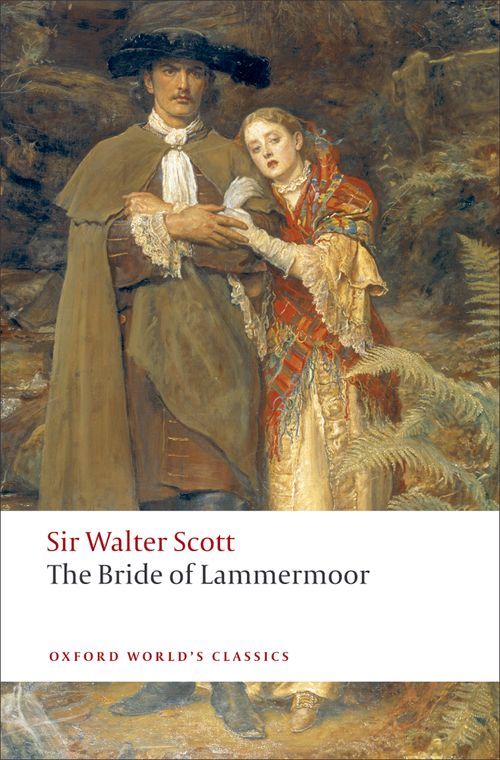
The Bride of Lammermoor
Edgar Ravenswood’s affection for Lucy Ashton crosses a bitter family dispute over property and power.
About
Spoiler notice: Full-plot spoilers, including the wedding-night crisis, Lucy’s death and Ravenswood’s disappearance.
Edgar Ravenswood inherits a family name that carries more weight than the property left to sustain it. His ancestral estate has passed to Sir William Ashton, and his father’s death leaves grievance and pride as powerful parts of what remains. Published in 1819, Walter Scott’s The Bride of Lammermoor sets its tragedy within a Scottish world of estates, legal influence and changing political advantage. The question of who possesses a house cannot be separated from the question of whose account of the past will be believed. Edgar, known as the Master of Ravenswood, regards the Ashtons through the injury done to his family. That hostility becomes far more difficult to maintain once his feelings for Sir William’s daughter Lucy begin to contradict it.
Edgar’s intervention saves Lucy and her father when a bull pursues them, creating an obligation across the families’ enmity. A later encounter in stormy weather brings the Ashtons into the shelter of Wolf’s Crag, where old resentment must coexist with hospitality. The rescue creates a personal debt; the visit makes that debt part of household life, requiring enemies to receive one another as host and guest. Lucy’s gratitude grows into affection, while Edgar finds himself drawn towards the daughter of the man he distrusts. Their attachment begins inside a dispute that neither of them can simply settle by choosing to disregard it. Sir William’s position and the history of the Ravenswoods remain present even when the conversation becomes courteous and the possibility of reconciliation appears nearer.
Wolf’s Crag carries the diminished family’s identity in its rooms and in Caleb Balderstone’s devotion to his master. The old servant’s attachment is to the continuity of a house as much as to the needs of one young man, and the ending will make that loyalty painfully clear. Around Edgar and Lucy, meanwhile, marriage is assessed as a connection between families with interests to advance or defend. Their own promise must compete with those calculations. Lady Ashton is particularly unwilling to allow affection to determine the arrangement. Her authority within the household makes resistance costly, while Sir William’s desire to strengthen his position leaves him susceptible to a more useful match. Scott gives the lovers no private space in which a mutual commitment can automatically become an accepted future.
Edgar’s absence gives Lady Ashton greater opportunity to press Lucy towards Bucklaw. Correspondence becomes crucial because the lovers cannot simply meet and confirm what each intends. Lucy tries to hold to her earlier promise while the people around her control access, interpret silence and present another marriage as the required course. The pressure gradually makes consent itself difficult to read. A signature can be displayed as proof that a decision has been made, even when the circumstances producing it are deeply coercive. When Edgar returns, he demands an answer about their engagement and is confronted with the signed arrangements for Bucklaw. Lucy’s condition and her inability to respond as he hopes leave the confrontation governed by wounded pride, family intervention and the documents produced before him.
The planned wedding proceeds despite signs that Lucy is profoundly unwell. Lady Ashton manages what Bucklaw is allowed to see and hopes that a change of situation will restore her daughter, while postponement would expose the family to another kind of public humiliation. The procession and feast supply all the outward marks of a successful alliance: splendid clothes, numerous guests, generous refreshments and popular acclaim. Lucy’s younger brother, absorbed in his own part in the ceremony, will later remember the dreadful coldness of her hand. Scott sets those public celebrations beside ominous conversations and details whose meaning becomes clear only afterwards. The contrast makes the marriage feel increasingly detached from the person whose future it supposedly secures, as other people continue to congratulate themselves on an event she scarcely seems able to direct.
A scream from the bridal chamber stops the dancing. Bucklaw is discovered bleeding at the threshold, while Lucy is found in the room in a state of violent derangement. He is alive, and the surgeon judges that recovery is possible; Lucy’s condition worsens and she dies without explaining what happened. The inquiry supports the general belief that she stabbed him, but the scene itself has not shown the act, and Bucklaw later refuses to answer questions about it. He recovers, dismisses Craigengelt from his company and eventually leaves Scotland. Lucy is buried in the same churchyard where she had so recently appeared as a bride. Her brother Colonel Ashton then challenges Edgar, treating him as responsible for her death and demanding a meeting with swords the following morning.
The promised duel never takes place. Caleb sees Edgar ride along the shore towards the meeting place, and Colonel Ashton also watches his approach, but the rider suddenly disappears. Altered tides have extended the quicksand, and hoofprints indicate that Edgar took a dangerous route across it. Searches recover no body; a feather from his hat is carried to Caleb by the water. The remaining lives are then briefly followed: Caleb fades after the extinction of the family he served, the Ashton sons do not continue the line, and Lady Ashton survives to old age without showing outward remorse. Her splendid memorial contrasts with the absence of marked graves for those destroyed around her. The tragedy ends with reputation still capable of displaying virtue in stone, even where the story has shown the cost of preserving it.
Book details
- Author
- Walter Scott
- First published
- 1819
- Series
- No series listed
- Subgenre
- Literary fiction, Modern classics
- Primary genre
- Literary Fiction
- Tags
- No tags for this book.
Review
Editor profile
Baby Bat
Goodreads and social links will be added soon.
- Goodreads — link coming soon
- Social media — link coming soon