
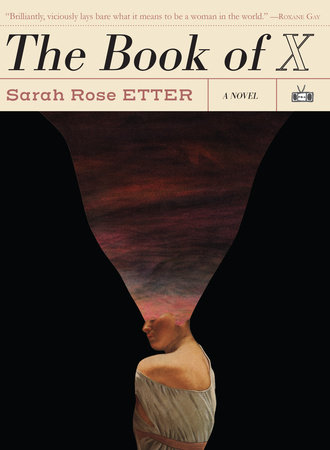
The Book of X
Cassie is born with a knot in her abdomen, a condition shared by the women in her family.
About
Spoiler notice: Spoilers for Cassie’s family history, childhood relationships and the novel’s recurring bodily imagery; major later-life events and the ending are not summarized.
Sarah Rose Etter builds The Book of X around an impossible inheritance. Cassie is born with a knot in her abdomen, a condition shared by her mother and grandmother, and the novel follows her from childhood into adult life. The setting makes that bodily difference part of a larger, unsettling world: Cassie grows up on a family meat farm where her father and brother work at a nearby quarry, extracting meat from cavern walls. The strange landscape is presented alongside familiar pressures such as school, work, money, illness and family obligation. This combination gives the book its distinctive scale. Cassie’s life is intimate and specific, while the imagery around her makes ordinary structures feel newly visible. The premise does not ask readers to solve the knot as a medical puzzle. It becomes the physical fact through which Cassie experiences attention, shame, pain and the expectations other people place on her.
The novel’s structure reflects a mind trying to imagine more than the life immediately available to it. Alongside the main narrative, sections called “Vision” turn toward alternate possibilities and idealized scenes. These passages interrupt chronology and create a countercurrent to the events in Cassie’s everyday life. Rather than functioning as a conventional escape into a separate fantasy world, they show how imagination can offer brief room to move when the body and social environment seem to dictate the terms. The changing form also resists a smooth coming-of-age arc. Cassie’s development is marked by repetitions, abrupt transitions and images that recur in altered contexts. That approach asks the reader to make connections across fragments: a desire or fear may return in another register, less as a plot clue than as evidence of how experience accumulates.
Cassie’s childhood gives the book a close view of how difference becomes social. At school, she is singled out for her body, while friendship and attraction offer both hope and uncertainty. Her connection with Sophia matters because it provides a relationship that can briefly loosen Cassie’s self-consciousness, even as the girls’ closeness changes over time. Her mother’s attention to appearance adds a domestic version of the same pressure. Beauty advice is offered as if the right habits might correct what makes Cassie conspicuous, turning care into another demand to make herself acceptable. The novel keeps these forces entangled: Cassie’s own curiosity about other bodies, her wish to be seen, and her awareness of judgment do not fit into a simple opposition between victim and society. Her difficulty comes from living inside a body that attracts scrutiny while growing up among people who also carry their own needs and limitations.
The meat farm and quarry enlarge those bodily concerns into an economic landscape. Meat is both a grotesque material and a source of work and livelihood. Cassie’s father allows her to join him in the quarry, giving her a place in an activity associated with the men in her family. The work connects them through skill and shared effort, even as the surrounding imagery makes harvesting feel strange and unsettling. Etter’s world therefore does not separate the surreal from practical life. The quarry has a market; the city has desks and bills; the family has illnesses and routines. These recognizable details keep the fantastic images from becoming decorative oddities. They suggest that bodies are shaped not only by private feeling but by labor, resources and the systems that assign value to what can be produced. Cassie’s movement from the rural farm to an urban desk job changes her surroundings without removing the questions she carries about how she is seen and what kind of life is possible.
The story’s attention to gender comes through repeated encounters with looking, touching and judgment. Cassie becomes conscious of how women’s bodies are compared and evaluated, and of how men’s responses can make desire feel conditional or unsafe. The knot is a literal difference, but it does not stand outside the broader world of beauty standards; it sharpens Cassie’s awareness of a culture that treats some bodies as more acceptable than others. The novel’s physical imagery can be disturbing, yet its focus remains on the social meaning attached to flesh. Cassie’s relationships are not all alike: her father offers a form of acceptance, while other encounters reinforce distance or scrutiny. That variation prevents the book from reducing its people to fixed symbols. The same body can be a source of pain, a matter of medical uncertainty, a target of judgment and an ordinary part of someone’s daily existence.
Across Cassie’s life, The Book of X holds the everyday and the uncanny together without promising that one will neatly explain the other. The visions create alternatives, but the novel does not treat imagination as a cure for material difficulty. The family’s history persists, and the body remains present through changes in place, age and relationship. This tension gives the book its emotional shape: Cassie wants forms of love and belonging that do not require her to disappear into someone else’s expectations, yet the world offers no simple route to that freedom. The fragmentary narration leaves space around what cannot be resolved, asking readers to stay with images and contradictions rather than reduce them to a lesson. The result is a work of literary fiction in which surreal invention makes familiar questions newly strange: who gets to define a body, how family patterns travel forward, and what a person can imagine when the world around her seems to have already decided what she is.
Book details
- Author
- Sarah Rose Etter
- First published
- 2019
- Series
- No series listed
- Subgenre
- Weird fiction, Body horror, Psychological horror
- Primary genre
- Literary Fiction
- Tags
- No tags for this book.
Review
Editor profile
Baby Bat
Goodreads and social links will be added soon.
- Goodreads — link coming soon
- Social media — link coming soon